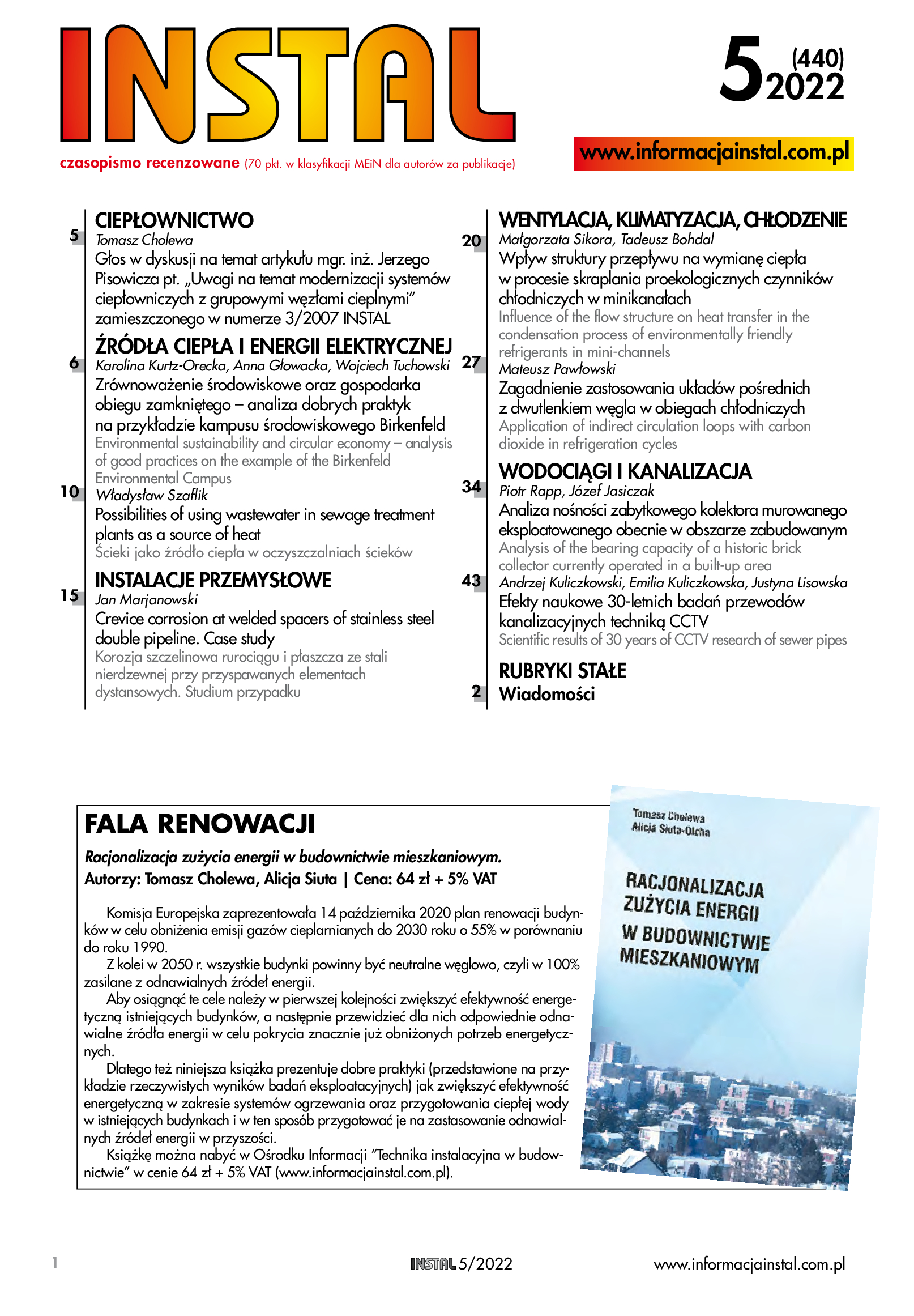
Environmental sustainability and circular economy – analysis of good practices on the example of the Birkenfeld Environmental Campus
DOI:
https://doi.org/10.36119/15.2022.5.1Keywords:
sustainable construction, renewable energy, sustainable use of resources, energy and built environment management, MoRE projectAbstract
Despite the fact that environmentally friendly solutions and technologies are widely known, their implementation and technical space related to construction still encounter difficulties. Bringing information about the pioneers of implementing sustainable energy and environmental management is therefore an important activity supporting the energy transformation process in construction. The article describes the idea of an environmentally sustainable university campus – Umwelt-Campus Birkenfeld, Germany. It is the only university campus in Germany that uses renewable energy sources on a scale that allows for the full offset of carbon dioxide emissions to the atmosphere resulting from the operation of the campus. The work was created as part of the INT190 MoRE project – Model Region of Renewable Energy of the Usedom and Wolin Islands.
Downloads
References
Rozporządzenie Parlamentu Europejskiego i Rady ustanawiające ramy na potrzeby osiągnięcia neutralności klimatycznej i zmieniające rozporządzenie (UE) 2018/1999 (Europejskie prawo o klimacie), 2020/0036 (COD).
Dyrektywa Parlamentu Europejskiego i Rady 2010/31/UE z dnia 19 maja 2010 r. w sprawie charakterystyki energetycznej budynków.
https://www.umwelt-campus.de/en/campus/life-on-campus/green-campus-concept
Downloads
Published
License

This work is licensed under a Creative Commons Attribution 4.0 International License.
Authors retain copyright and grant the journal the right of first publication, with the work simultaneously licensed under a Creative Commons Attribution 4.0 International License, which permits others to share the work with appropriate acknowledgment of the authorship and initial publication in this journal.