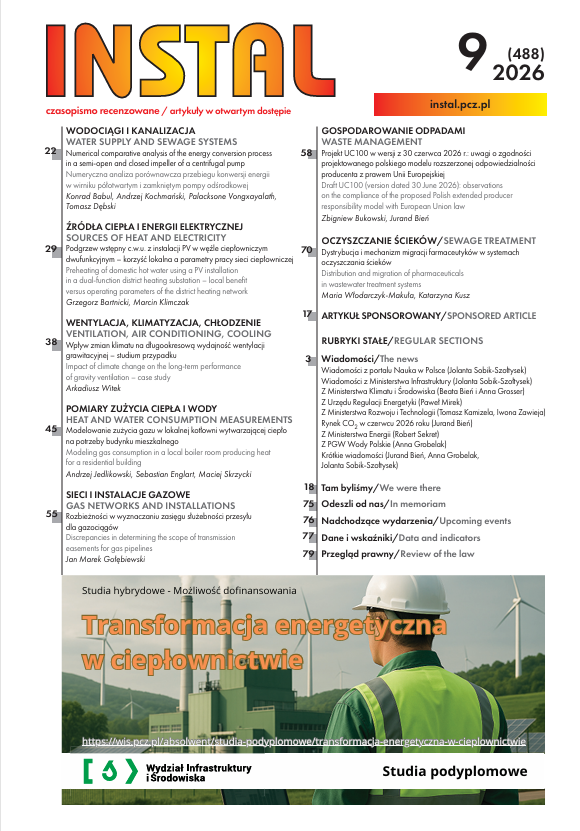
Draft UC100 (version dated 30 June 2026): observations on the compliance of the proposed Polish extended producer responsibility model with European Union law
DOI:
https://doi.org/10.17512/INSTAL.2026.09.06Keywords:
extended producer responsibility, EPR, UC100 draft legislation, packaging fee, eco-modulation, recycling at scale, food-contact packaging safety, packaging wasteAbstract
The article examines the compatibility of the proposed Polish extended producer responsibility model for packaging, as set out in the UC100 draft dated 30 June 2026, with European Union law. The assessment is based on Articles 8 and 8a of Directive 2008/98/EC, the polluter pays principle, the principle of effectiveness of EU law, and Regulation (EU) 2025/40 on packaging and packaging waste. Particular attention is paid to the designation of the National Fund for Environmental Protection and Water Management as the public Packaging EPR Organisation, the financing of municipalities and other system participants, net-cost calculation, financial transparency, fee modulation, and the transitional rule in Article 208. The analysis also addresses food-contact safety, the protective and barrier functions of packaging, prevention of food waste, and the need to assess whether packaging is actually collected, sorted and recycled at industrial scale. A centralised model is not, as such, contrary to EU law. Its compliance nevertheless depends on a genuine link between fees and auditable net costs, measurable eco-modulation, transparent redistribution, a clear allocation of responsibilities, and preservation of producers' influence on the environmental performance of the system.
Downloads
References
[1] Lindhqvist, T. (2000), Extended Producer Responsibility in Cleaner Production: Policy Principle to Promote Environmental Improvements of Product Systems. Doctoral Thesis (monograph), Lund University
[2] Lifset, R., Atasu, A., Tojo, N. (2013), Extended Producer Responsibility. Journal of Industrial Ecology, 17: 162-166. https://doi.org/10.1111/jiec.12022
[3] Pouikli, K. (2020), Concretising the role of extended producer responsibility in European Union waste law and policy through the lens of the circular economy. ERA Forum 20, 491–508. https://doi.org/10.1007/s12027-02000596-9
[4] Cahill,R., Grimes S.M., Wilson D.C., (2011) Extended producer responsibility for packaging wastes and WEEE - a comparison of implementation and the role of local authorities across Europe. The Journal for a Sustainable Circular Economy, Vol 29(5). https://doi.org/10.1177/0734242X10379455
[5] da Cruz, N.F., Ferreira, S., Cabral, M., Simões, P., Marques, R.C. (2014) Packaging waste recycling in Europe: Is the industry paying for it?, Waste Management, Volume 34, Issue 2, 2014, 298-308, https://doi.org/10.1016/j.wasman.2013.10.035.
[6] Dyrektywa Parlamentu Europejskiego i Rady (UE) 2018/851 z dnia 30 maja 2018 r. zmieniająca dyrektywę 2008/98/WE w sprawie odpadów (Dz. Urz. UE L 150 z 14.06.2018, s. 109–140)
[7] Projekt ustawy o opakowaniach i odpadach opakowaniowych, projekt z dnia 30 czerwca 2026 r., UC100, Rządowe Centrum Legislacji, https://legislacja.rcl.gov.pl/projekt/12401003
[8] Laubinger F., Brown A., Dubois M., Börkey P., Deposit-refund systems and the interplay with additional mandatory extended producer responsibility policies, OECD Environment Working Papers No. 208, ENV/WKP(2022)20, OECD Publishing, Paris 2022. https://doi.org/10.1787/a80f4b26-en
[9] Hogg D., Sherrington C., Papineschi J., Hilton M., Massie A., Jones P., Study to Support Preparation of the Commission’s Guidance for Extended Producer Responsibility Schemes: Final Report, Eunomia Research & Consulting, Bristol 2020. https://op.europa.eu/en/publication--detail/-/publication/08a892b7-9330-11ea--aac4-01aa75ed71a1
[10] Leclerc S.H., Badami M.G., Extended Producer Responsibility: An Empirical Investigation into Municipalities’ Contributions to and Perspectives on e-Waste Management, „Environmental Policy and Governance” 2024, Vol. 34, No. 2, s. 111–124. https://doi.org/10.1002/eet.2059
[11] Pruess J.T., Unraveling the Complexity of Extended Producer Responsibility Policy Mix Design, Implementation, and Transfer Dynamics in the European Union, „Journal of Industrial Ecology” 2023, Vol. 27, No. 6, s. 1500–1520. https://doi.org/10.1111/jiec.13429
[12] Hocherman T., Trop T., Ghermandi A., Implementation lags: A case study of the European plastics strategy, „Marine Policy” 2026, Vol. 190, art. 107135. https://doi.org/10.1016/j.marpol.2026.107135
[13] Karpus K., Extended producer responsibility as a pillar of circular economy: Current challenges for Polish waste management policy and law, „Athenaeum. Polskie Studia Politologiczne” 2021, t. 71, nr 3, s. 111–126. https://doi.org/10.15804/athena.2021.71.07
[14] Karpus K., Gospodarka o obiegu zamkniętym i przeobrażenia prawa o odpadach Unii Europejskiej, „Prawne Problemy Górnictwa i Ochrony Środowiska” 2023, nr 1, s. 1–22. https://doi.org/10.31261/PPGOS.2023.01.06
[15] Czaplicka-Kotas A., Kulczycka J., Managing Poland’s Transition to Circular Economy: Regulatory Implementation and Governance Challenges in Plastic Packaging Sector, „Sustainability” 2026, Vol. 18, No. 4, art. 1762. https://doi.org/10.3390/su18041762
[16] Kułak-Krzysiak K., Interes przedsiębiorcy wprowadzającego opakowania jednorazowego użytku z tworzyw sztucznych, „Studia Prawno--Ekonomiczne” 2025, t. 124, s. 87–104. https://doi.org/10.26485/spe/2025/124/5
[17] Sidorczuk-Pietraszko E., Piontek W., Larsson A., Are Deposit–Return Schemes an Optimal Solution for Beverage Container Collection in the European Union? An Evidence Review, „Sustainability” 2025, Vol. 17, No. 19, art. 8791. https://doi.org/10.3390/su17198791
[18] Papineschi J., Hogg D., Chowdhury T., Durrant C., Thomson A., Analysis of Nordic Regulatory Framework and Its Effect on Waste Prevention and Recycling in the Region, TemaNord 2019:522, Nordic Council of Ministers, Copenhagen 2019. https://doi.org/10.6027/TN2019-522
[19] OECD, Extended Producer Responsibility: Updated Guidance for Efficient Waste Management, OECD Publishing, Paris 2016. https://doi.org/10.1787/9789264256385-en
[20] Mallick P.K., Salling K.B., Pigosso D.C.A., McAloone T.C., Designing and operationalising extended producer responsibility under the EU Green Deal, „Environmental Challenges” 2024, Vol. 16, art. 100977. https://doi.org/10.1016/j.envc.2024.100977
[21] Siuta-Tokarska B., Thier A., Hornicki K., The Concept of Extended Producer Responsibility in the Field of Packaging Industry and the Energy Sector in the Light of the Circular Economy — The Example of Poland, „Energies” 2022, Vol. 15, No. 23, art. 9060. https://doi.org/10.3390/en15239060
[22] Puentes Cociña B., The circular economy strategy as a way of designing more durable, repairable, and reusable products, „UNIO – EU Law Journal” 2023, Vol. 9, No. 2, s. 88–105. https://revistas.uminho.pt/index.php/unio/issue/view/363
[23] Da Cruz N.F., Simões P., Marques R.C., Economic cost recovery in the recycling of packaging waste: The case of Portugal, „Journal of Cleaner Production” 2012, Vol. 37, s. 8–18. https://doi.org/10.1016/j.jclepro.2012.05.043
[24] Leal Filho W., Saari U.A., Fedoruk M., Iital A., Moora H., Klöga M., Voronova V., An overview of the problems posed by plastic products and the role of extended producer responsibility in Europe, „Journal of Cleaner Production” 2019, Vol. 214, s. 550-558. https://doi.org/10.1016/j.jclepro.2018.12.256
[25] Wyrok TK z dnia 10 grudnia 2002 r., sygn. P 6/02, OTK-A 2002, nr 7, poz. 91.
[26] Krzywoń A., Podatki i inne daniny publiczne – podstawowe pojęcia konstytucyjne, „Zeszyty Naukowe Sądownictwa Administracyjnego” 2011, nr 2, s. 47–62.
[27] Wyrok Trybunału Konstytucyjnego z dnia 10 września 2020 r., sygn. akt K 13/18, OTK ZU A/2020, poz. 47.
[28] Król U., Opłaty za korzystanie ze środowiska jako instrumenty polityki ekologicznej państwa, Wydawnictwo Naukowe UMK, Toruń 2021, s. 159–166.
[29] IEEP i in., Green taxation and other economic instruments – Internalising environmental costs to make the polluter pay, Study for DG Environment, European Commission, 2021.
[30] Art. 288 akapit 3 Traktatu o funkcjonowaniu Unii Europejskiej (wersja skonsolidowana), Dz.Urz. UE C 202 z 7.06.2016.
[31] Wyrok TS z 30.05.1991 r., C-59/89, Commission v Germany, EU:C:1991:225; wyrok TS z 7.04.1992 r., C-45/91, Commission v Greece, EU:C:1992:164; wyrok TS z 28.02.1991 r., C-131/88, Commission v Germany, EU:C:1991:87.
[32] Kurcz B., Dyrektywy Wspólnoty Europejskiej i ich implementacja do prawa krajowego, Zakamycze, Kraków 2004, s. 31–40.
[33] Wyrok TSUE z 10.04.1984 r., C-14/83, Von Colson and Kamann v Land Nordrhein-Westfalen, EU:C:1984:153; wyrok TSUE z 13.11.1990 r., C-106/89, Marleasing SA v La Comercial Internacional de Alimentación SA, EU:C:1990:395.
[34] Komisja Europejska, Nowy plan działania UE dotyczący gospodarki o obiegu zamkniętym na rzecz czystszej i bardziej konkurencyjnej Europy, COM(2020) 98 final, Bruksela, 11.03.2020.
[35] Rozporządzenie Parlamentu Europejskiego i Rady (UE) 2025/40 z dnia 19 grudnia 2024 r. w sprawie opakowań i odpadów opakowaniowych, zmiany rozporządzenia (UE) 2019/1020 i dyrektywy (UE) 2019/904 oraz uchylenia dyrektywy 94/62/WE, Dz. Urz. UE L 2025/40 z 22.01.2025.
[36] Raport z konsultacji i opiniowania projektu UC100, odniesienie do uwag, Rządowe Centrum Legislacji, opublikowany 14 lipca 2026 r.
[37] Rozporządzenie Komisji (UE) 2022/1616 z dnia 15 września 2022 r. w sprawie materiałów i wyrobów z tworzyw sztucznych pochodzących z recyklingu przeznaczonych do kontaktu z żywnością oraz uchylające rozporządzenie (WE) nr 282/2008, Dz. Urz. UE L 243 z 20.09.2022, s. 3-46.
[38] Komisja Europejska, Zawiadomienie Komisji: Wytyczne dotyczące rozporządzenia (UE) 2025/40 w sprawie opakowań i odpadów opakowaniowych, C/2026/3084, 10.06.2026.
[39] Ncube L.K., Ude A.U., Ogunmuyiwa E.N., Zulkifli R., Beas I.N., Environmental Impact of Food Packaging Materials: A Review of Contemporary Development from Conventional Plastics to Polylactic Acid Based Materials, Materials 2020, 13(21), 4994. https://doi.org/10.3390/ma13214994.
[40] Wohner B., Pauer E., Heinrich V., Tacker M., Packaging-Related Food Losses and Waste: An Overview of Drivers and Issues, Sustainability 2019, 11(1), 264. https://doi.org/10.3390/su11010264.
[41] Pauer E, Wohner B, Heinrich V, Tacker M. Assessing the Environmental Sustainability of Food Packaging: An Extended Life Cycle Assessment including Packaging-Related Food Losses and Waste and Circularity Assessment. Sustainability. 2019; 11(3):925. https://doi.org/10.3390/su11030925
Downloads
Published
License
Copyright (c) 2026 Zbigniew Bukowski, Jurand Bień (Autor)

This work is licensed under a Creative Commons Attribution 4.0 International License.
Authors retain copyright and grant the journal the right of first publication, with the work simultaneously licensed under a Creative Commons Attribution 4.0 International License, which permits others to share the work with appropriate acknowledgment of the authorship and initial publication in this journal.