
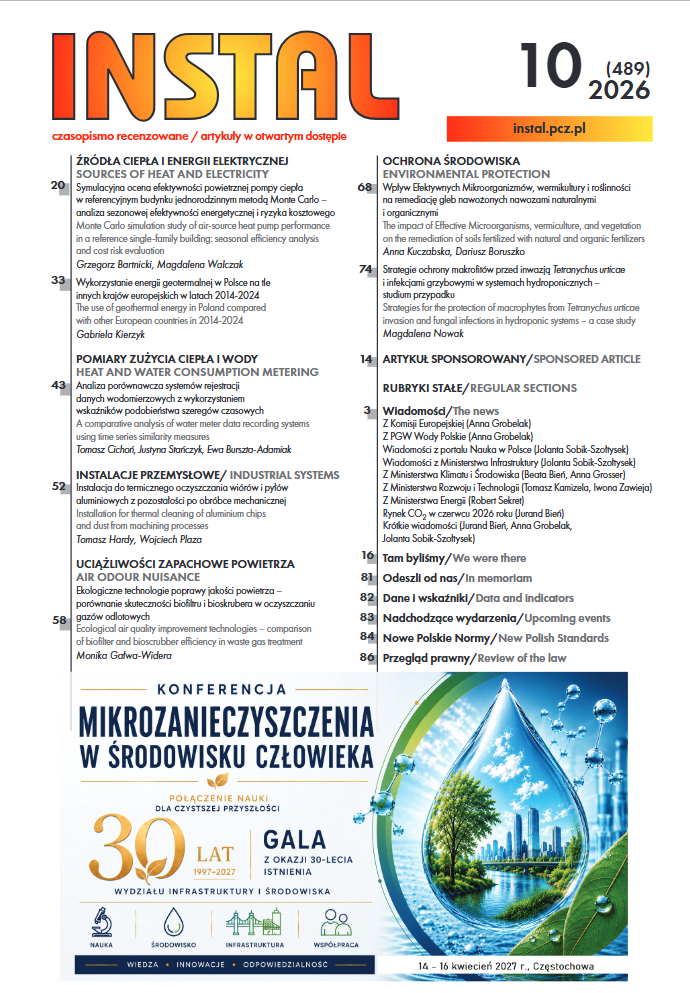
Monte Carlo simulation study of air-source heat pump performance in a reference single-family building: seasonal efficiency analysis and cost risk evaluation
DOI:
https://doi.org/10.17512/INSTAL.2026.10.01Keywords:
air-source heat pump (ASHP), stochastic simulation (Monte Carlo), seasonal coefficient of performance (SCOP), performance gap, domestic hot water (DHW), operational cost riskAbstract
The in-use efficiency of air-source heat pumps departs from certified values, and this discrepancy, referred to as the performance gap, is reported in field studies at a level of 24-30%. The aim of the work is to decompose that gap quantitatively into its components and to indicate which of them follow from the physics of the unit and which from the adopted balance boundary and computational assumptions. An original daily quasi-steady heat pump model was applied, implemented in R and coupled with a Monte Carlo simulation of 5000 iterations. The instantaneous coefficient of performance is derived from an efficiency referred to the Carnot cycle, calibrated to the manufacturer’s certified map. The model is driven by daily IMGW meteorological data from the Wrocław-Strachowice station for 2020-2025. The domestic hot water balance was refined with a seasonal mains water temperature model and a stochastic absence module. The reference is a seasonal performance indicator determined by an adapted bin method according to PN-EN 14825, on the same meteorological series and the same performance map. The performance gap is not a single figure but a function of the assumed auxiliary draw: it amounts to 2.7% at zero draw, 5.3% at 15 W, 10.9% at the assumed 50 W and 17.7% at 100 W, and for the year 2025 and the value assumed in the model it lies within 10.1–13.9% over the six-year period 2020-2025. The dominant component of the difference is the auxiliary energy balance, which at the assumed 50 W accounts for 74% of the gap, the auxiliary draw having been measured in its standstill part, while the draw of ancillaries during compressor operation is not separated by the meter. The quantity that requires measurement is there fore the auxiliary draw itself, and not the performance gap as such. Median net seasonal coefficients of performance lie within 2.99-3.40. Annual operating costs lie between the 5th and the 95th percentile within 5,684-6,227 PLN at a median of 5,945 PLN, and their spread originates chiefly from the variability of installation workmanship. The model was compared with measurements from a real installation over a 226-day window of the heating season: at the unit balance boundary the measured indicator is 3.0960 against a model median of 3.1538, that is 1.87% lower. The principal limitation of the work remains the daily time step, which reproduces neither compressor cycling nor hourly demand peaks. The results presented apply to the adopted reference building and to the scenarios analysed, and not to the efficiency of any particular installation
Downloads
References
[1] Mouzeviris G. A., Papakostas K. T. (2021). Comparative analysis of air-to-water and ground source heat pumps performances. International Journal of Sustainable Energy, 40, 69–84.
[2] Ermel C., Bianchi M. V. A., Schneider P. S. (2023). Energy Model to Evaluate Thermal Energy Storage Integrated with Air Source Heat Pumps: Preprint. National Renewable Energy Laboratory, NREL/CP-5500-82601. https://www.nrel.gov/docs/fy23osti/82601.pdf
[3] Gan M. (2024). A novel solar-assisted air source heat pump system for urban renewal: Experimental test and numerical simulation. Applied and Computational Engineering, 91, 116–130.
[4] Olympios A. V., Aunedi M., Mersch M., Krishnaswamy A., Stollery C., Pantaleo A. M., Sapin P., Strbac G., Markides C. N. (2022). Delivering net-zero carbon heat: Technoeconomic and whole-system comparisons of domestic electricity- and hydrogen-driven technologies in the UK. Energy Conversion and Management, 262, 115649. https://doi.org/10.1016/j.enconman.2022.115649
[5] Wang Z., Luther M. B., Amirkhani M., Liu C., Horan P. (2021). State of the Art on Heat Pumps for Residential Buildings. Buildings, 11, 350. https://doi.org/10.3390/buildings11080350
[6] Pinamonti M., Beausoleil-Morrison I., Prada A., Baggio P. (2021). Water-to-water heat pump integration in a solar seasonal storage system for space heating and domestic hot water production of a single-family house in a cold climate. Solar Energy, 213, 300–311. https://doi.org/10.1016/j.solener.2020.11.052
[7] Sebarchievici C. (2019). Performance assessment between a ground coupled and air source heat pump used for domestic hot water preparation. E3S Web of Conferences, 111, 06075. https://doi.org/10.1051/e3sconf/201911106075
[8] Rozporządzenie Ministra Infrastruktury z dnia 12 kwietnia 2002 r. w sprawie warunków technicznych, jakim powinny odpowiadać budynki i ich usytuowanie (Dz.U. 2022 poz. 1225, z późn. zm.).
[9] Brudermueller T., Potthoff U., Fleisch E. i in. (2025). Estimation of energy efficiency of heat pumps in residential buildings using real operation data. Nature Communications, 16, 2834. https://doi.org/10.1038/s41467-025-58014-y
[10] O’Hegarty R., Kinnane O., Lennon D., Colclough S. (2022). Air-to-water heat pumps: Review and analysis of the performance gap between in-use and product rated performance. Renewable and Sustainable Energy Reviews, 155, 111887. https://doi.org/10.1016/j.rser.2021.111887
[11] Carroll P., Chesser M., Lyons P. (2020). Air Source Heat Pumps field studies: A systematic literature review. Renewable and Sustainable Energy Reviews, 134, 110275. https://doi.org/10.1016/j.rser.2020.110275
[12] Conti P., Bartoli C., Franco A., Testi D. (2020). Experimental Analysis of an Air Heat Pump for Heating Service Using a “Hardware-In-The-Loop” System. Energies, 13, 4498. https://doi.org/10.3390/en13174498
[13] Brudermueller T., Kreft M., Fleisch E., Staake T. (2023). Large-scale monitoring of residential heat pump cycling using smart meter data. Applied Energy, 350, 121734. https://doi.org/10.1016/j.apenergy.2023.121734
[14] Botu M., Atanasiu M., Ursescu G., Rakosi E. (2023). Retrofit of a standard split-type air conditioner into an air-to-water heat pump. IOP Conference Series: Materials Science and Engineering, 1290, 012005. https://doi.org/10.1088/1757-899X/1290/1/012005
[15] Cong T. N., Noël F., Rivière P., Arzano-Daurelle C., Marchio D. (2021). In-situ method for air-to-air heat pump seasonal performance determination including steady-state and dynamic operations. International Journal of Refrigeration, 127, 82–92. https://doi.org/10.1016/j.ijrefrig.2021.02.021
[16] Priarone A., Silenzi F., Fossa M. (2020). Modelling Heat Pumps with Variable EER and COP in EnergyPlus: A Case Study Applied to Ground Source and Heat Recovery Heat Pump Systems. Energies, 13, 794. https://doi.org/10.3390/en13040794
[17] Sankelo P., Ahmed K., Mikola A., Kurnitski J. (2022). Renovation Results of Finnish Single-Family Renovation Subsidies: Oil Boiler Replacement with Heat Pumps. Energies, 15, 7620. https://doi.org/10.3390/en15207620
[18] PN-EN 14825:2022 Klimatyzatory, ziębiarki cieczy i pompy ciepła ze sprężarkami o napędzie elektrycznym, do ogrzewania i chłodzenia pomieszczeń — Badanie i ocena w warunkach niepełnego obciążenia oraz obliczanie efektywności sezonowej.
[19] Abid M., Hewitt N., Huang M.-J., Wilson C., Cotter D. (2021). Performance Analysis of the Developed Air Source Heat Pump System at Low-to-Medium and High Supply Temperatures for Irish Housing Stock Heat Load Applications. Sustainability, 13, 11753. https://doi.org/10.3390/su132111753
[20] Lämmle M., Bongs C., Wapler J., Günther D., Hess S., Kropp M., Herkel S. (2022). Performance of air and ground source heat pumps retrofitted to radiator heating systems and measures to reduce space heating temperatures in existing buildings. Energy, 242, 122952. https://doi.org/10.1016/j.energy.2021.122952
[21] Lämmle M., Metz J., Kropp M., Wapler J., Oltersdorf T., Günther D., Herkel S., Bongs C. (2023). Heat Pump Systems in Existing Multifamily Buildings: A Meta-Analysis of Field Measurement Data Focusing on the Relationship of Temperature and Performance of Heat Pump Systems. Energy Technology, 11, 2300379. https://doi.org/10.1002/ente.202300379
[22] PN-EN 14511-1÷4:2018 Klimatyzatory, ziębiarki cieczy i pompy ciepła ze sprężarkami o napędzie elektrycznym, do grzania i ziębienia.
[23] PN-EN 12831-1:2017 Charakterystyka energetyczna budynków — Metoda obliczania projektowego obciążenia cieplnego — Część 1: Obciążenie cieplne.
[24] Lisowska-Lis A., Leszczyński R. (2018). Air–water heat pump applied as water boiler in single-family house, coefficient of performance analysis under the real conditions. Science, Technology and Innovation, 3, 58–61. https://doi.org/10.5604/01.3001.0012.8166
[25] Meireles I., Sousa V., Bleys B., Poncelet B. (2022). Domestic hot water consumption pattern: Relation with total water consumption and air temperature. Renewable and Sustainable Energy Reviews, 157, 112035. https://doi.org/10.1016/j.rser.2021.112035
[26] Reza A. M. M., Rogoża A. (2024). Life cycle assessment of a condensing gas boiler and compare with an air source heat pump in a residential building. Mokslas – Lietuvos ateitis / Science – Future of Lithuania, 16. https://doi.org/10.3846/mla.2024.21298
[27] Balke E. C., Healy W. M., Ullah T. (2016). An assessment of efficient water heating options for an all-electric single family residence in a mixed-humid climate. Energy and Buildings, 133, 371–380. https://doi.org/10.1016/j.enbuild.2016.09.052
[28] Dyrektywa Parlamentu Europejskiego i Rady (UE) 2023/959 z dnia 10 maja 2023 r. zmieniająca dyrektywę 2003/87/WE ustanawiającą system handlu przydziałami emisji gazów cieplarnianych w Unii oraz decyzję (UE) 2015/1814 (Dz.Urz. UE L 130 z 16.05.2023).
[29] Masiukiewicz M., Tańczuk M., Anweiler S., Streckienė G., Boldyryev S. (2025). Long-term climate-based sizing and economic assessment of air-water heat pumps for residential heating. Applied Thermal Engineering, 258, 124627. https://doi.org/10.1016/j.applthermaleng.2024.124627
Downloads
Published
License
Copyright (c) 2026 Grzegorz Bartnicki, Magdalena Walczak (Autor)

This work is licensed under a Creative Commons Attribution 4.0 International License.
Authors retain copyright and grant the journal the right of first publication, with the work simultaneously licensed under a Creative Commons Attribution 4.0 International License, which permits others to share the work with appropriate acknowledgment of the authorship and initial publication in this journal.