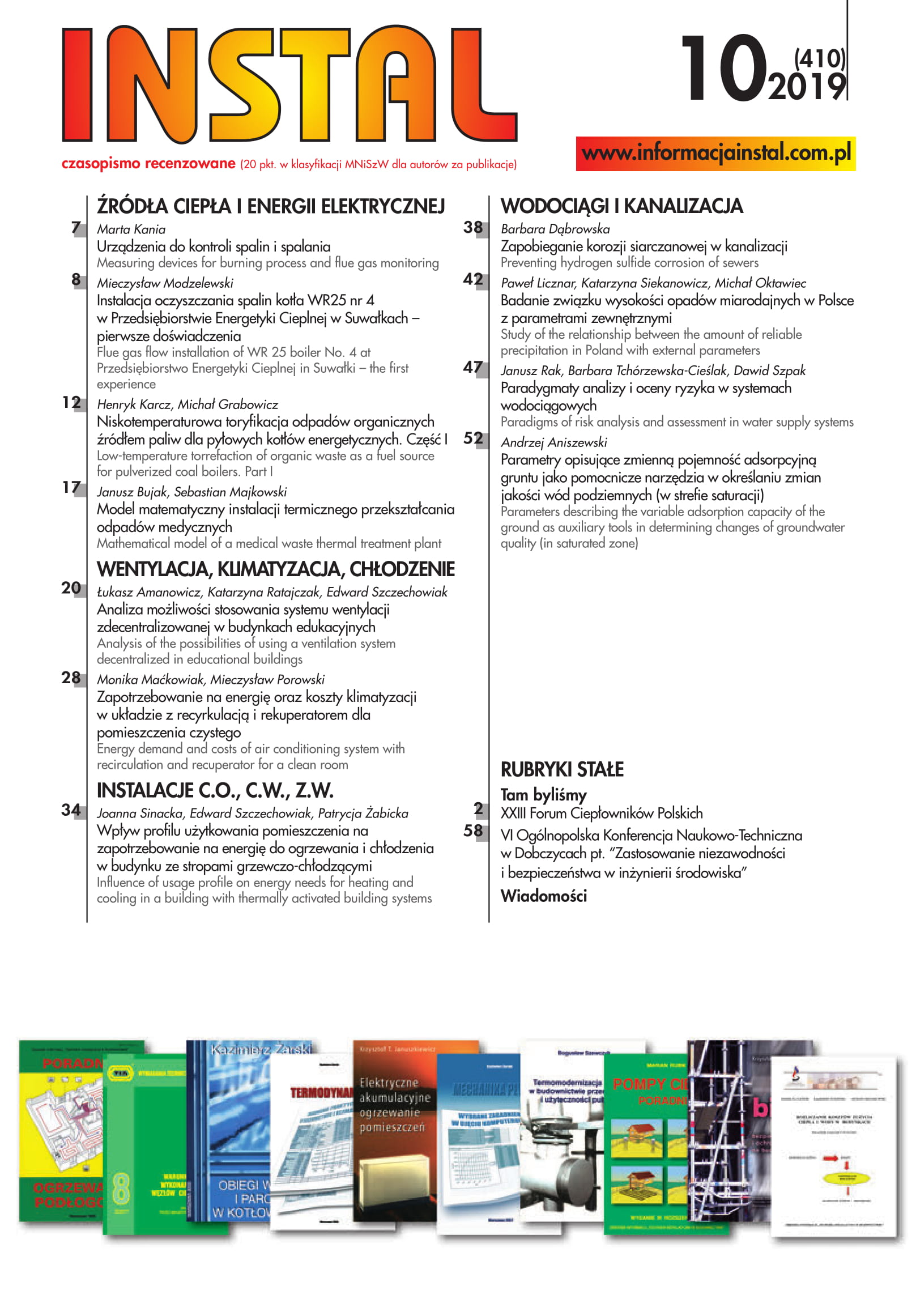
Paradigms of risk analysis and assessment in water supply systems
DOI:
https://doi.org/10.36119/15.2019.10.8Keywords:
risk, water supply, water safety planAbstract
The paper presents the main definitions related to the collective water supply systems (CWSS) safety. The measure of loss of safety is the risk associated with the functioning of SZZW. According to the basic definition, risk is defined as a three-element set of probabilities of adverse events occurrence, consequences of these events and a scenario of adverse events occurrence. The risk linked to the CWSS functioning is a measure of safety loss. According to the basic definition, risk is defined as a set of three elements: probability of undesirable events, the consequences of these events and the scenario of adverse events. Currently, an expanded definition of risk is being used increasingly, in which the protection parameter (O) is taken into account, as inversely proportional to the risk value, or alternatively, the vulnerability parameter (V). The work characterizes the risk management process and shows the benefits of CWSS managing based on risk management. The phases of the risk management cycle were presented, which take place in the following stages: design, construction and operation.
Downloads
References
Downloads
Published
License

This work is licensed under a Creative Commons Attribution 4.0 International License.
Authors retain copyright and grant the journal the right of first publication, with the work simultaneously licensed under a Creative Commons Attribution 4.0 International License, which permits others to share the work with appropriate acknowledgment of the authorship and initial publication in this journal.