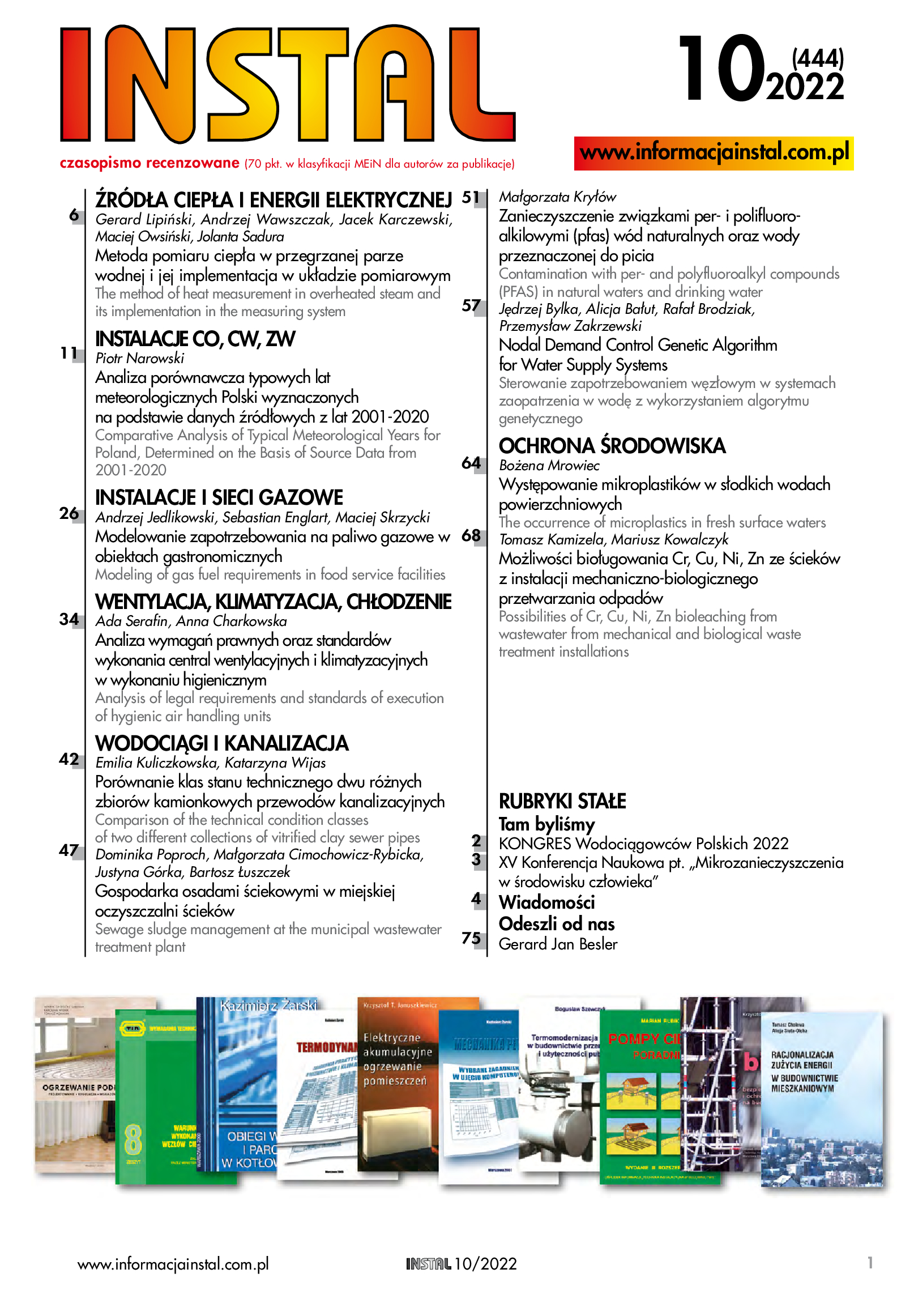
Nodal Demand Control Genetic Algorithm for Water Supply Systems
DOI:
https://doi.org/10.36119/15.2022.10.8Keywords:
intermittent water supply, genetic algorithm optimization, nodal demand control, water distribution, networks management.Abstract
The management of water distribution networks is nowadays exposed to various hazards, and their operations need to meet a range of critical conditions, new to the industry, that need to be addressed and solved. This article describes an approach that could be applied in case of intermittent deficit of water supply, by controlling the nodal demand in a water supply network. The article provides a mathematical approach to meeting minimum required water demand in case of supply shortages. Based on a simple hydraulic model case study, a genetic algorithm is implemented to find optimal valve settings which provide a minimum supply of water under water deficit conditions. The results highlight limitations and advantages relating to the time taken to perform calculations. Moreover, some practical aspects are pinpointed in the discussion section.
Downloads
References
United Nations. Sustainable Development Goal 6: Synthesis Report 2018 on Water and Sanitation. [Internet]. 2018 [cited 2021 Jun 4]. Available from: http://www.unglobalcompact.org/docs/publications/SDG6_
SR2018.pdf
International Water Association. IWA Review of international water efficiency labelling. [Internet]. 2019 [cited 2021 Nov 3]. Available from: https://waterwise.org.uk/knowledge-base/iwa-review-of-international-
water-efficiency-labelling-2019/
Sousa V., Silva C.M., Meireles I. Performance of water efficiency measures in commercial buildings. Resources, Conservation and Recycling. 2019, Apr 1;143:251–259
Downloads
Published
License

This work is licensed under a Creative Commons Attribution 4.0 International License.
Authors retain copyright and grant the journal the right of first publication, with the work simultaneously licensed under a Creative Commons Attribution 4.0 International License, which permits others to share the work with appropriate acknowledgment of the authorship and initial publication in this journal.