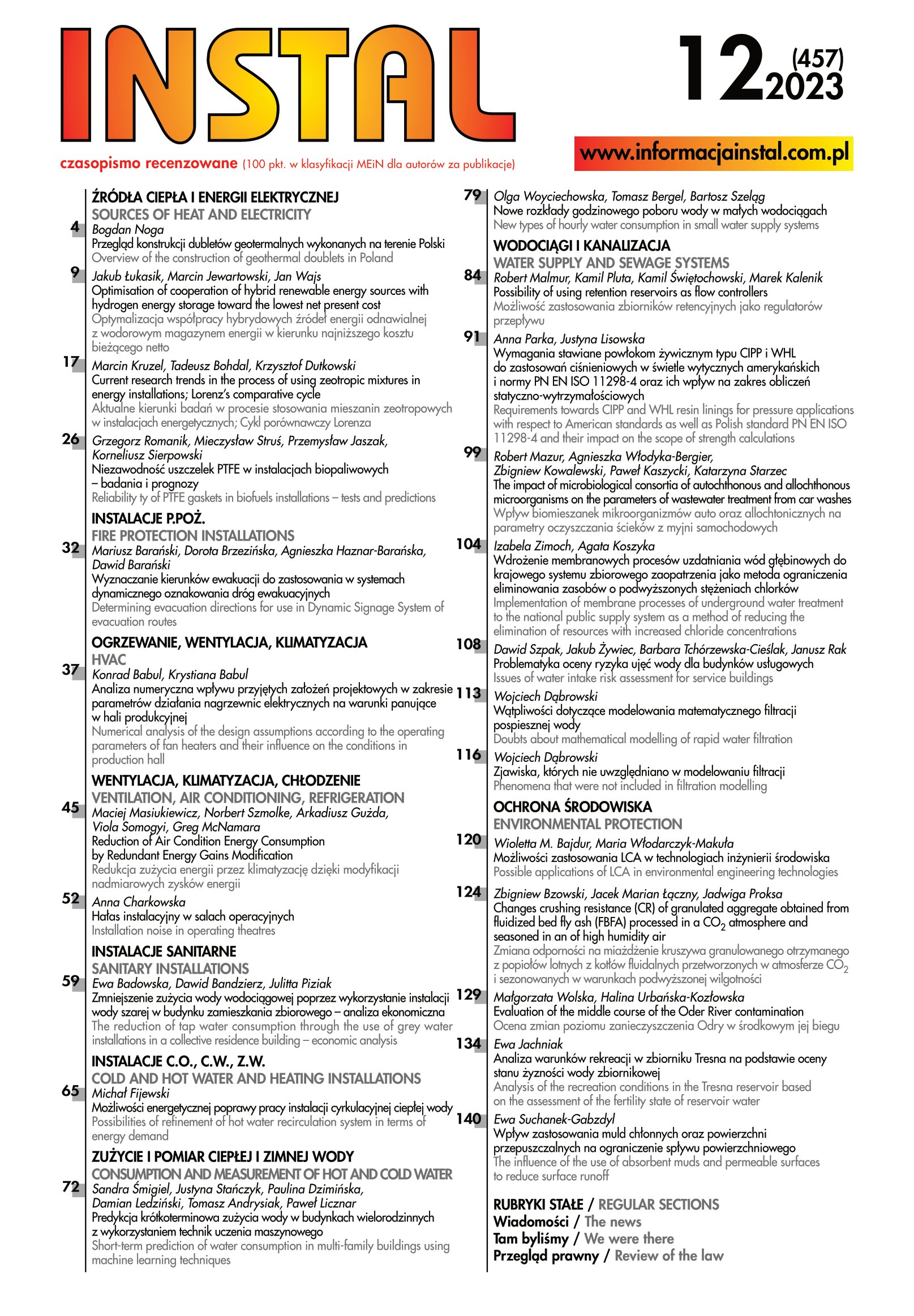
Issues of water intake risk assessment for service buildings
DOI:
https://doi.org/10.36119/15.2023.12.17Keywords:
water intake, threat, riskAbstract
In accordance with the requirements of the Polish Water Law Act of July 20, 2017 (Journal of Laws of 2017, item 1566, as amended), on the need to designate an indirect protection zone for groundwater intakes, a risk analysis is required, including the assessment of health threats identified in the abstracted water based on an analysis of the dynamics of changes in the quality of abstracted water and hydrogeological documentation. The risk analysis should be carried out for water intakes supplying more than 10 m3 of water per day or supplying the water for more than 50 people. The Polish Water Law Act imposes such an obligation also on owners of individual water intakes, if water supplied is intended for human consumption as part of commercial, service, industrial activities or to public utility buildings. Despite the amended Water Law Act being in force for 5 years, many entrepreneurs only took
action in this matter in the last quarter of 2022. The paper identifies the main factors that should be taken into account when assessing the risk of groundwater intakes, i.e. sources of threat to water quality, land development structure, quality of water, depth of the aquifer and covering with an insulation layer. The risk assessment of a selected water intake supplying a facility where weddings, banquets and business meetings are organized is presented. The specificity of the functioning of the facility, which is characterized by high unevenness of water demand, was taken into account. Based on the analysis, the need to establish an indirect water intake protection zone was assessed. The approach based on hazard prevention significantly reduces the probability of a failure and allows the owner of the facility to prepare for an appropriate response, in case of one.
Downloads
References
Czop M., Herbich P., Janica R., Lidzbarski M., Mulik B., Nikiel G., Prażak J., Rodzoch A., Staśko S., Woźnicka M., Zimoch I.: Strefy ochronne ujęć wód podziemnych – analiza
ryzyka i projektowanie. Część I. Analiza ryzyka dla ustanowienia stref ochronnych ujęć wód podziemnych, Państwowy Instytut Geologiczny – Państwowy Instytut Badawczy, Warszawa, 2022.
Dyrektywa Parlamentu Europejskiego i Rady (UE) 2020/2184 z dnia 16 grudnia 2020 r. w sprawie jakości wody przeznaczonej do spożycia przez ludzi.
Gucma L.: Modelowanie czynników ryzyka zderzenia jednostek pływających z konstrukcjami portowymi i pełnomorskimi. Wydawnictwo Naukowe Akademii Morskiej w Szczecinie, studia nr 44, Szczecin, 2005.
Jaźwiński J., Ważyńska-Fiok K.: Bezpieczeństwo systemów. PWN, Warszawa, 1993
Downloads
Published
License

This work is licensed under a Creative Commons Attribution 4.0 International License.
Authors retain copyright and grant the journal the right of first publication, with the work simultaneously licensed under a Creative Commons Attribution 4.0 International License, which permits others to share the work with appropriate acknowledgment of the authorship and initial publication in this journal.