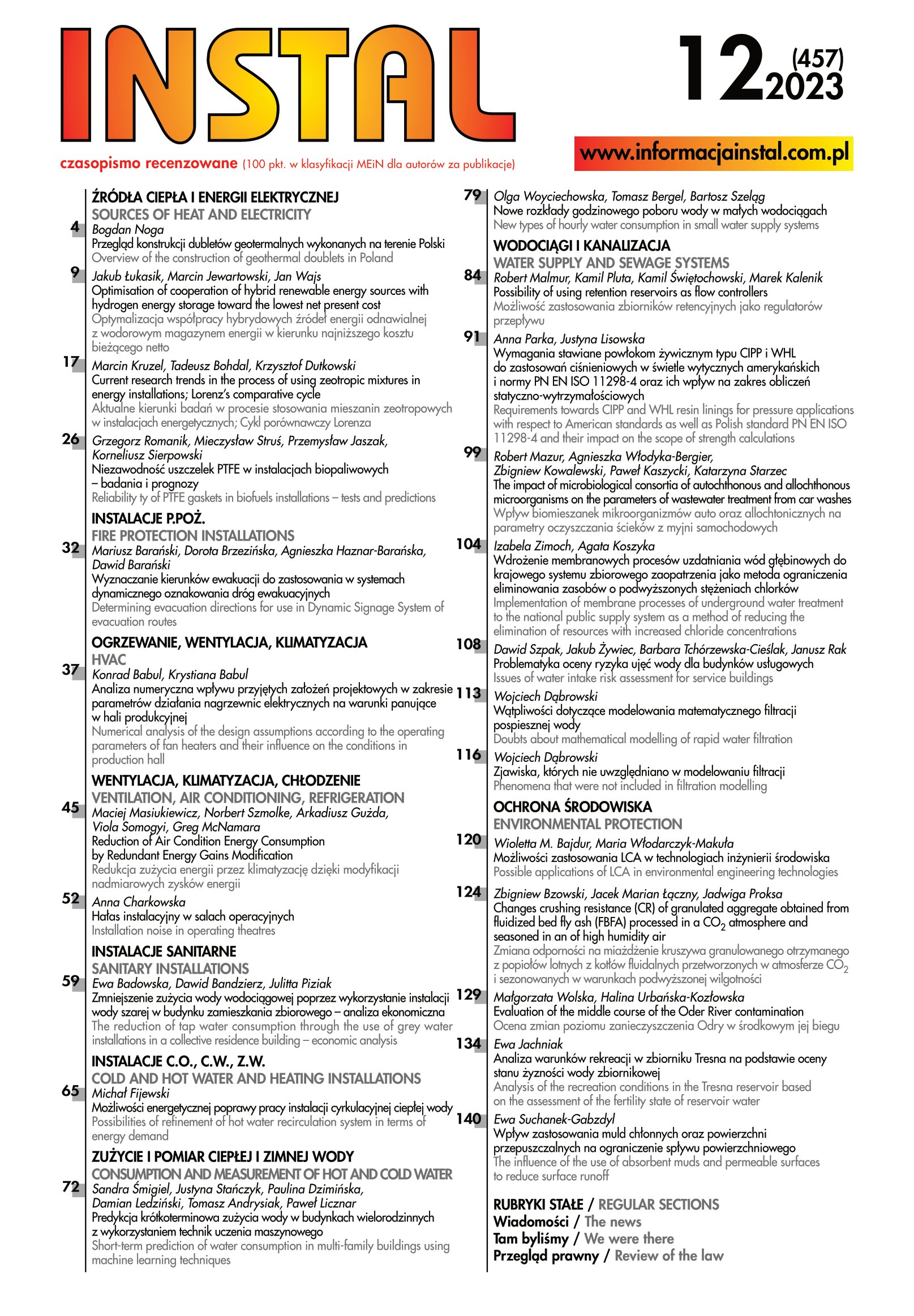
The impact of microbiological consortia of autochthonous and allochthonous microorganisms on the parameters of wastewater treatment from car washes
DOI:
https://doi.org/10.36119/15.2023.12.15Keywords:
industrial wastewater treatment, biopreparations, biological treatment, car wash wastewater (CWW)Abstract
Microbiological biopreparations as biotechnological methods support wastewater treatment processes. Unfortunately, in conditions with a short hydraulic retention time (up to 22 hours) in wastewater treatment plants, biological treatment processes are not able to effectively reduce the concentrations of COD, BOD5, and nutrients in the sewage. The authors tested both biopreparations with consortia of autochthonous and allochthonous microorganisms, and in both cases, no significantly significant differences in treatment efficiency were found compared to the control group (without the addition of biopreparations).
Downloads
References
Shalaby, E. A. (2011). Prospects of effective microorganisms technology in wastes treatment in Sangakkara, U.R. 2002 (updated 8 Jul 2002, accessed 27 Aug 2002), ‘The Technology of Effective Microorganisms – Case Studies of Application’ Royal Agricultural College, Cirencester, UK Research Activities
Szymański, N., & Patterson, R. A. (2003). Effective microorganisms (EM) and wastewater systems. Future directions for On-site Systems: Best management practice, 347-355.
Safwat, S. M., and Matta, M. E. (2021). Environmental applications of Effective Microorganisms: a review of current knowledge and recommendations for future directions. Journal of Engineering and Applied
Science, 68(1), 1-12.
Downloads
Published
License

This work is licensed under a Creative Commons Attribution 4.0 International License.
Authors retain copyright and grant the journal the right of first publication, with the work simultaneously licensed under a Creative Commons Attribution 4.0 International License, which permits others to share the work with appropriate acknowledgment of the authorship and initial publication in this journal.