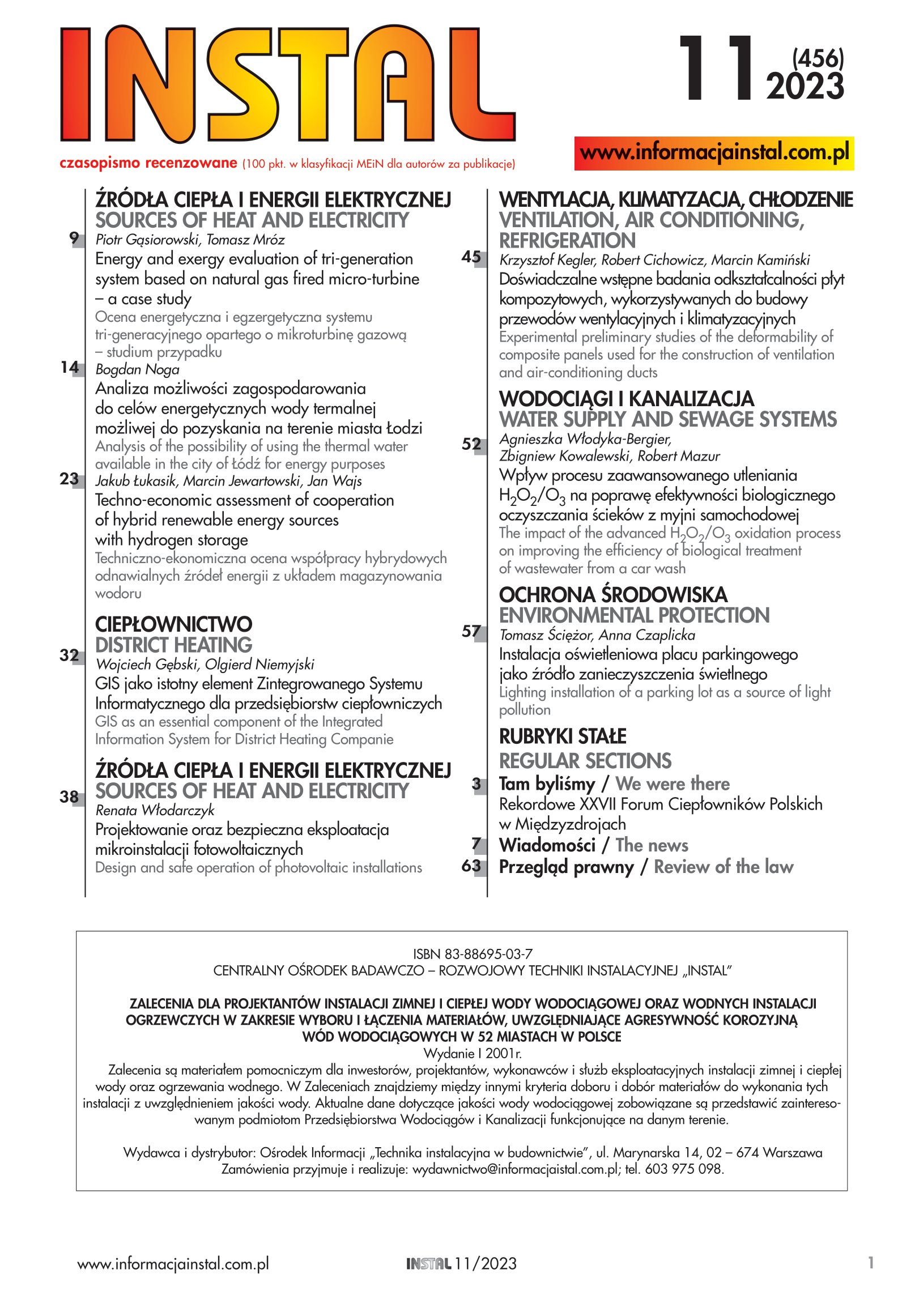
Wpływ procesu zaawansowanego utleniania H2O2/O3 na poprawę efektywności biologicznego oczyszczania ścieków z myjni samochodowej
DOI:
https://doi.org/10.36119/15.2023.11.7Słowa kluczowe:
procesy zaawansowanego utleniania, proces H2O2/O3, oczyszczanie biologiczne, ścieki z myjni samochodowejAbstrakt
Procesy zaawansowanego utleniania przed procesami biologicznego oczyszczania ścieków stosowane są w celu zwiększenia ilości frakcji biodegradowalnej, łatwo asymilowanej przez mikroorganizmy. W artykule przeanalizowano wpływ procesu H2O2/O3 zastosowanego w sekwencji z procesem biologicznego oczyszczania w bioreaktorach ze złożem ruchomym na zwiększenie efektywności oczyszczania ścieków z myjni samochodowej. W procesie H2O2/O3 zastosowano 3 dawki nadtlenku wodoru (27,5 mg/dm3, 82,5 mg/dm3, 137,5 mg/dm3) i stałą dawkę ozonu wynoszącą 100 mg/dm3. Po procesie utleniania ścieki kierowano do reaktorów w celu przeprowadzenia oczyszczania biologicznego ścieków. Czas pracy bioreaktorów wynosił 24 godziny, a próbki pobierano po 2 h, 6 h i 24 h. W ściekach oznaczano szereg parametrów fizyko-chemicznych, takich jak ChZT, BZT5, azot ogólny i fosfor ogólny, barwa i mętność, odczyn i przewodność elektryczna właściwa. Badania wykazały, że utlenienie ścieków z wykorzystaniem najmniejszej analizowanej dawki H2O2 w analizowanym procesie zaawansowanego utlenienia (27,5 mg H2O2/dm3, 100 mgO3/dm3) przyczyniło się do zwiększenia efektywności usuwania materii organicznej oraz azotu i fosforu ogólnego w procesie biologicznego ich oczyszczania.
Pobrania
Bibliografia
Gönder Z., Balcıoğlu G., Vergili I., Kaya Y., Electrochemical treatment of carwash wastewater using Fe and Al electrode: Techno-economic analysis and sludge characterization. J. Environ. Manage. 2017; 200:380-390.
Pinto A., de Barros G., de Melo R., Carwash wastewater treatment by micro and ultrafiltration membranes: effects of geometry, poresize, pressure difference and feed flow rate in transport properties. J. Water Proc. Eng. 2017; 17:143-148.
Qamar Z., Khan S., Khan A., Aamir M., Nawab J., Waqas M., Appraisement, source apportionment and health risk of polycyclic aromatic hydrocarbons (PAHs) in vehicle wash wastewater. Pakistan. Sci. Total Environ. 2017; 605–606:106-113
Pobrania
Opublikowane
Licencja

Utwór dostępny jest na licencji Creative Commons Uznanie autorstwa 4.0 Międzynarodowe.
Authors retain copyright and grant the journal the right of first publication, with the work simultaneously licensed under a Creative Commons Attribution 4.0 International License, which permits others to share the work with appropriate acknowledgment of the authorship and initial publication in this journal.