
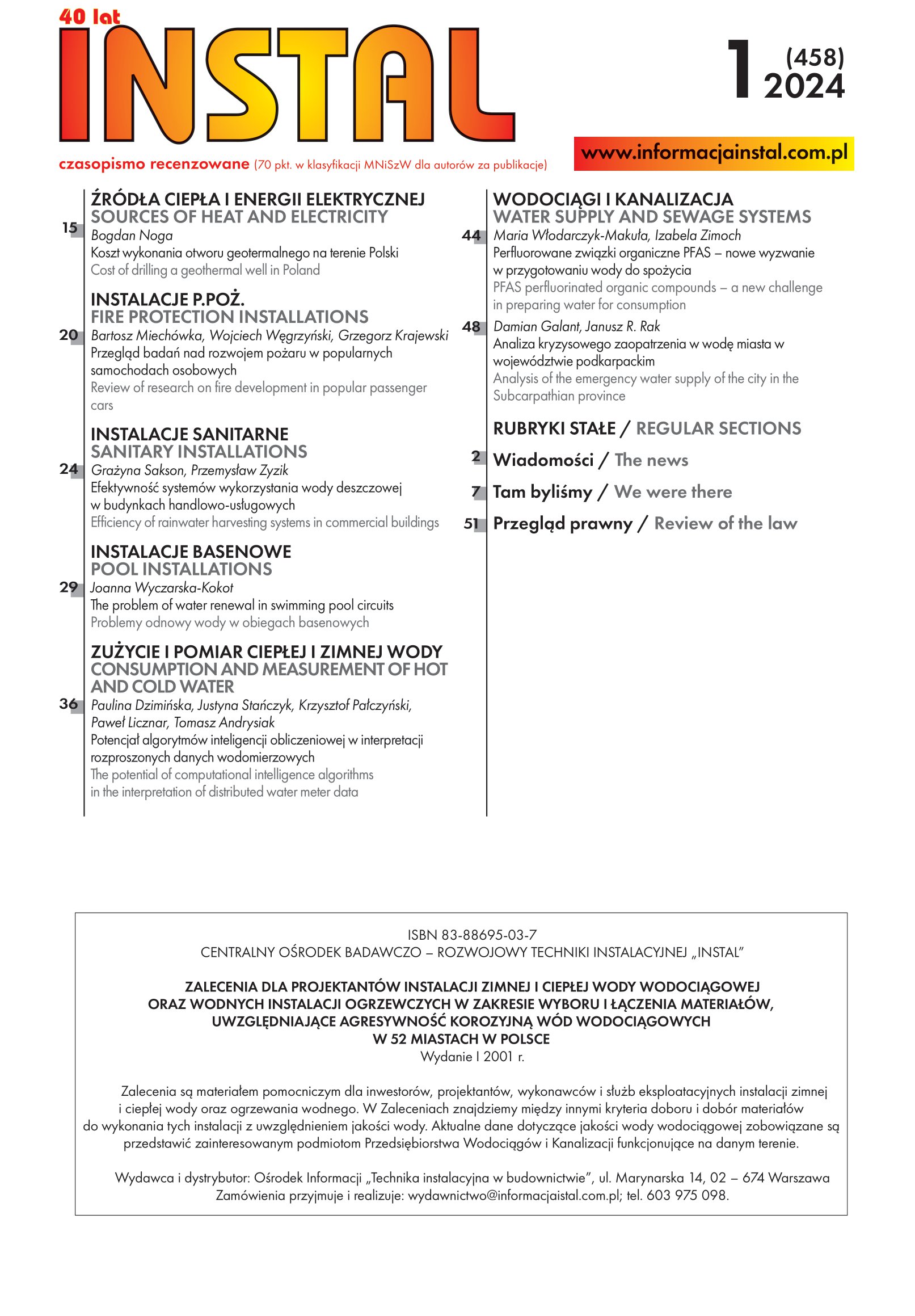
Review of research on fire development in popular passenger cars
DOI:
https://doi.org/10.36119/15.2024.1.2Keywords:
fire development, car parks, electric vehicle, passenger vehicle, fire testAbstract
The paper presents a review of research on the development of vehicle fires in the context of the evolution of the passenger car market in Europe, taking into account the increasing popularity of SUVs and electric vehicles. The study analyzes key parameters describing the fire development, such as the Heat Release Rate (HRR), Total Heat Released (THR), effective heat of combustion, and time to maximum HRR, comparing them across different types of vehicles (ICEV, BEV, PHEV). The research highlights the challenges in interpreting fire development due to its variability and unpredictability, caused by random factors such as fuel tank ruptures or battery ignitions. A statistical analysis is presented, showing that the method of vehicle ignition can have a significant impact on the study results. The main conclusion of the study is to emphasize the similar fire progression of ICE and EV cars in terms of PHRR and THR. Furthermore, the analysis indicated that the average Hceff value is 24 MJ/kg. The conclusions from the analysis
indicate the need for further research, and the current fire development curves may require revision.
Downloads
References
https://www.acea.auto/figure/fuel-types-of--new-passenger-cars-in-eu/; dostęp z 18.12.2023;
https://www.pzpm.org.pl/pl/Rynek-motoryzacyjny/Roczniki-i-raporty; dostęp z 19.12.2023
Węgrzyński W., Krajewski G. (2014). “Wykorzystanie narzędzi inżynierii bezpieczeństwa pożarowego w projektowaniu i odbiorze systemów wentylacji pożarowej garaży zamkniętych”, CNBOP; DOI:10.12845/bitp.36.4.2014.15
Downloads
Published
License

This work is licensed under a Creative Commons Attribution 4.0 International License.
Authors retain copyright and grant the journal the right of first publication, with the work simultaneously licensed under a Creative Commons Attribution 4.0 International License, which permits others to share the work with appropriate acknowledgment of the authorship and initial publication in this journal.