
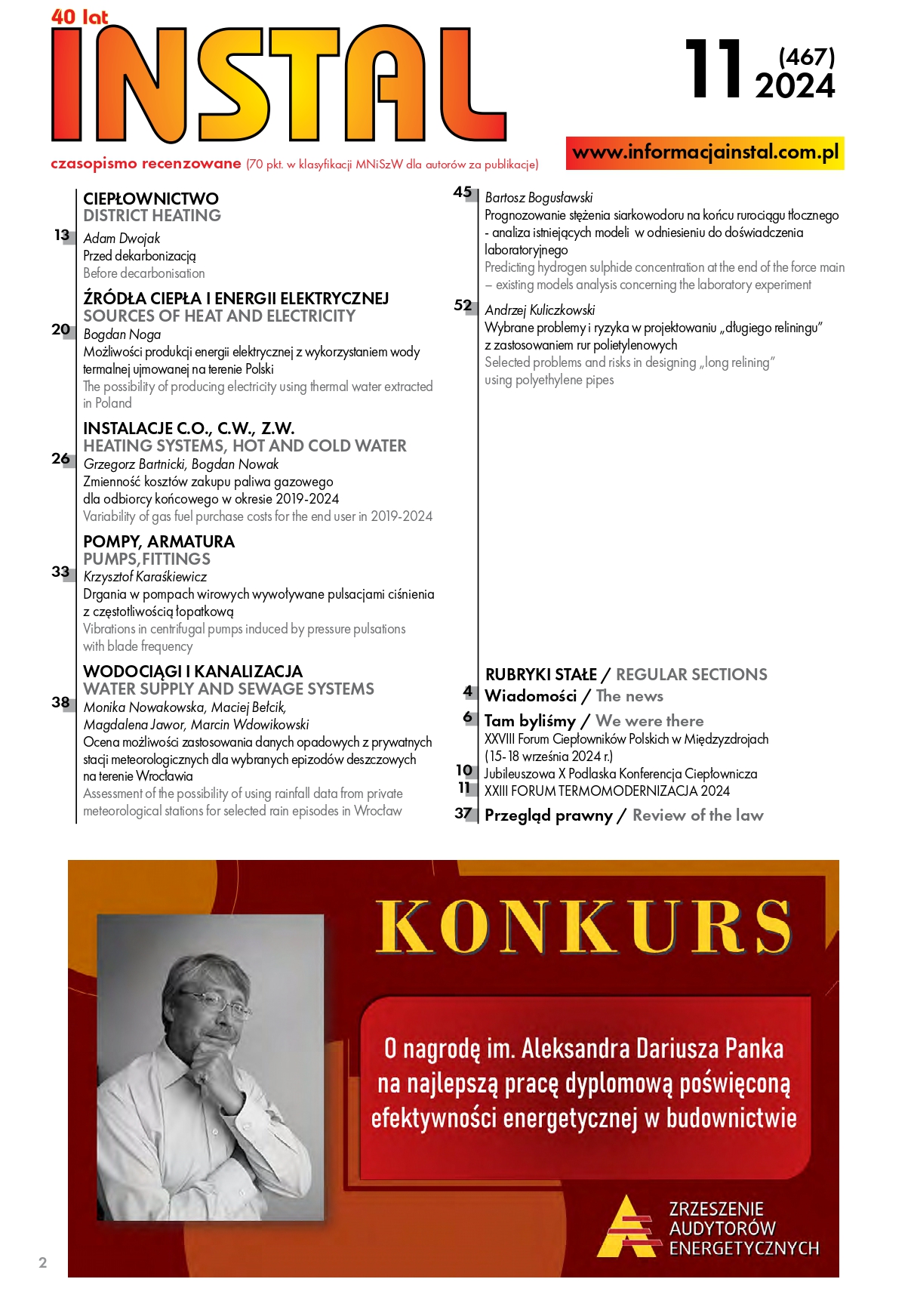
Predicting hydrogen sulphide concentration at the end of the force main – existing models analysis concerning the laboratory experime
DOI:
https://doi.org/10.36119/15.2024.11.5Keywords:
pressure sewerage system, hydrogen sulphide, concrete corrosionAbstract
The formation of hydrogen sulphide is a well-known, common and dangerous effect of biochemical transformations in wastewater. Hydrogen sulphide is recognised as a major cause of odour and corrosion in sewer systems. Despite years of research, these issues remain costly and unresolved problems. Models for predicting the increase in sulphide concentration at the end of the discharge pipeline were analysed. The aim of the study was to test the predictive performance of selected empirical models on data obtained in a laboratory experiment. A laboratory experiment was carried out, the essence of which was to reflect how sewer pressure pipelines work. For this purpose, a ‘large-laboratory’ scale test bed was set up, with a capacity of several tens of litres and a pipeline length of 28.65 m. The experiment used mechanically treated wastewater from a municipal wastewater treatment plant. The results of the increments in effluent sulphide concentrations obtained during the experiment were compared with the predictions resulting from the selected models. Most of the models used repeatedly overestimated the results compared to observations. Only the models of Hvitved Jacobsen et al. and Nielsen et al. generated results of a similar order of magnitude, but not over the entire range of observations. The EPA model was calibrated by adjusting the constant M, according to the results obtained in the experiment, using the least sum of squares method. The resulting constant is much smaller than suggested by the model authors. An equation of its own was developed, following slightly different assumptions. A non-linear effect of retention time on the increase in sulphide concentration was assumed. The resulting model is statistically significant but does not have considerable accuracy. It was also created on a relatively small sample of data. It is no less an attempt to present the issue of sulphide concentration forecasting from a slightly different angle.
Downloads
References
T. Hvitved-Jacobsen, J. Vollertsen, i A. Nielsen, Sewer Processes – Microbial and Chemical Process Engineering of Sewer Networks, 2. wyd. CRC Press, 2013.
Per Halkjaer Nielsen, K. Raunkjaer, N. H. Norsker, N. A. Jensen, i T. Hvitved-Jacobsen, „Transformation of wastewater in sewer systems – a review”, Water Sci. Technol., t. 25, nr 6, s. 17–31, 1992.
M. Maciejewska i Z. Dymaczewski, „Sieć kanalizacyjna jako reaktor przemian biochemicznych”, Technol. Wody, nr 6, s. 50–53, 2020.
Downloads
Published
License

This work is licensed under a Creative Commons Attribution 4.0 International License.
Authors retain copyright and grant the journal the right of first publication, with the work simultaneously licensed under a Creative Commons Attribution 4.0 International License, which permits others to share the work with appropriate acknowledgment of the authorship and initial publication in this journal.