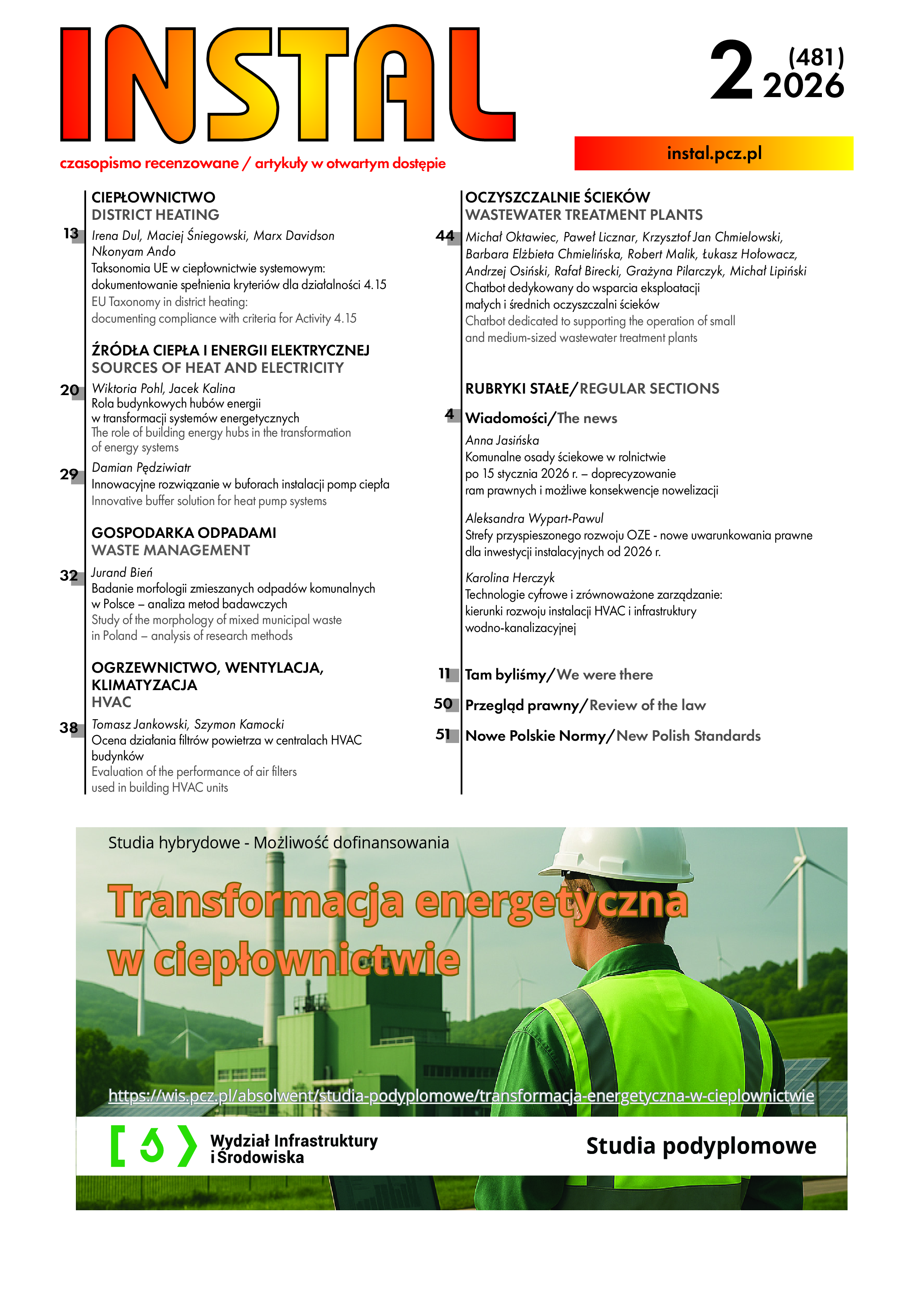
EU Taxonomy in district heating: documenting compliance with criteria for Activity 4.15
DOI:
https://doi.org/10.17512/INSTAL.2026.02.01Keywords:
EU Taxonomy, district heating distribution, activity 4.15, DNSH, energy efficiency, EED, investment processAbstract
The aim of this article is to present a practical approach to applying the EU Taxonomy using activity 4.15 “District heating/cooling distribution” as an example across the entire investment life cycle, from the conceptual phase and preparation of financing applications, through design and implementation, to operation and reporting. Based on an analysis of key legal acts, in particular Regulation (EU) 2020/852 and Commission Delegated Regulation (EU) 2021/2139, the paper identifies the requirements for demonstrating a substantial contribution to an environmental objective, compliance with the “do no significant harm” (DNSH) principle with respect to the remaining objectives, and adherence to minimum safeguards. It then proposes examples of evidence and documentation that may be used to verify compliance with EU Taxonomy criteria at successive stages of the investment process. Particular attention is given to the definition of an “efficient district heating and cooling system” under the Energy Efficiency Directive (EED), which constitutes a key eligibility condition for activity 4.15. The paper demonstrates that documenting compliance with the EU Taxonomy is relevant not only for reporting purposes but also has growing investment and financial significance, as it increasingly affects project bankability and access to financing. The study is primarily addressed to energy companies implementing investments qualifying as activity 4.15, while the proposed approach may also serve as a reference for other energy activities covered by the EU Taxonomy due to the horizontal nature of certain documentation requirements. It is further argued that taxonomy documentation should be understood not merely as a formal compliance obligation, but as a tool supporting risk management and informed investment decision-making.
Downloads
References
Rozporządzenie Parlamentu Europejskiego i Rady (UE) 2020/852 z dnia 18 czerwca 2020 r. w sprawie ustanowienia ram ułatwiających zrównoważone inwestycje oraz zmiany rozporządzenia (UE) 2019/2088, Dz.U. UE L198 z 22.06.2020, http://data.europa.eu/eli/reg/2020/852/oj
Rozporządzenie Parlamentu Europejskiego i Rady (UE) 2021/241 z dnia 12 lutego 2021 r. ustanawiające Instrument na rzecz Odbudowy i Zwiększania Odporności, Dz.U. UE L 57 z 18.02.2021, http://data.europa.eu/eli/reg/2021/241/oj
European Commission, EU Taxonomy Navigator, https://ec.europa.eu/sustainable-finance-taxonomy/home
Rozporządzenie delegowane Komisji (UE) 2021/2139 z dnia 4 czerwca 2021 r. uzupełniające rozporządzenie Parlamentu Europejskiego i Rady (UE) 2020/852 poprzez ustanowienie technicznych kryteriów kwalifikacji służących określeniu warunków, na jakich dana działalność gospodarcza kwalifikuje się jako wnosząca istotny wkład w łagodzenie zmian klimatu lub w adaptację do zmian klimatu, a także określeniu, czy ta działalność gospodarcza nie wyrządza poważnych szkód względem żadnego z pozostałych celów środowiskowych, Dz.U. UE L 442 z 9.12.2021, http://data.europa.eu/eli/reg_del/2021/2139/oj
Sulik-Górecka A., Biały W., Strojek-Filus M., The importance of EU taxonomy for sustainable development reporting. Case study of entities listed on the Warsaw Stock Exchange in Poland, Management Systems in Production Engineering, 2024, Vol. 32, No. 3, pp. 317–325, DOI: 10.2478/mspe-2024-0030
Kirschmann K., The EU Taxonomy’s (Potential) Effects on the Banking Sector and Bank Lending to Firms, Econstor Voice, 2022, Vol. 19, No. 2, pp. 275–283, DOI: 10.1515/ev-2022-0027
Platform on Sustainable Finance,, Report on the Application and Usability of the EU Taxonomy,, European Commission, Brussels, 2022, https://finance.ec.europa.eu/system/files/2022-10/221011-sustainable-finance-platform-finance-report-usability_en_1.pdf
Lygnerud, K., Gadd, A., Werner, S., Söderholm, J., Analysis of the impact of the EU Taxonomy on investments in district heating, Energy Policy, 2025, vol. 198, art. 114519. DOI: 10.1016/j.enpol.2024.114519
Munćan V., Mujan I., i in., The state of district heating and cooling in Europe - A literature-based assessment, Energy, vol. 304, 2024, DOI10.1016/j.energy.2024.132191
Żurawski, M., Mika, Ł., Kuś, J., A review of existing hybrid district heating substations and their application potential, Energies, 2025, vol. 18, nr 19, 5093. DOI: 10.3390/en18195093
Lund, H., Østergaard, P., et al., Perspectives on fourth and fifth generation district heating, Energy, 2021, vol. 227, DOI: 10.1016/j.energy.2021.120520
Buffa, S., Cozzini, M., D’Antoni, M., Baratieri, S., Fedrizzi, M., 5th generation district heating and cooling systems – a review of existing cases in Europe, Renewable and Sustainable Energy Reviews, 2019, vol. Volume104, s.504-522. DOI: 10.1016/j.rser.2018.12.059
Anania D., Russo G., et al., Thermal-hydraulic modelling of a flexible substation layout for low-temperature waste heat recovery into district heating, Energy, 2025, vol. 328, DOI10.1016/j.energy.2025.136386
Jimenez Navarro, J.P., Filippidou, F., Kavvadias, K. and Carlsson, J., Efficient District Heating and Cooling, Publications Office of the European Union, Luxembourg, 2022, DOI: 10.2760/854480, https://publications.jrc.ec.europa.eu/repository/handle/JRC126522
JASPERS, European Investment Bank, Guide to the Decarbonisation of District Heating Systems, European Investment Bank, Luxembourg, 2024.jaspers-guide-to-decarbonisation-of-district-heating-systems.pdf
Śniegowski, M., Taksonomia – narzędzie wyznaczające kierunek transformacji w ciepłownictwie, Instal, 01/2022, s. 6–9. DOI: 10.36119/15.2022.1.1
Rozporządzenie delegowane Komisji (UE) 2021/2178 z dnia 6 lipca 2021 r. uzupełniające rozporządzenie Parlamentu Europejskiego i Rady (UE) 2020/852 przez sprecyzowanie treści i prezentacji informacji dotyczących zrównoważonej środowiskowo działalności gospodarczej, które mają być ujawniane przez przedsiębiorstwa podlegające art. 19a lub 29a dyrektywy 2013/34/UE, oraz określenie metody spełnienia tego obowiązku ujawniania informacji, Dz.U. UE L 443 z 10.12.2021, http://data.europa.eu/eli/reg_del/2021/2178/oj
Dyrektywa Parlamentu Europejskiego i Rady 2012/27/UE z dnia 25 października 2012 r. w sprawie efektywności energetycznej, zmiany dyrektyw 2009/125/WE i 2010/30/UE oraz uchylenia dyrektyw 2004/8/WE i 2006/32/WE, Dz.U. UE L 315 z 14.11.2012, z późn. zm., http://data.europa.eu/eli/dir/2012/27/oj
Dyrektywa Parlamentu Europejskiego i Rady (UE) 2023/1791 z dnia 13 września 2023 r. w sprawie efektywności energetycznej oraz zmieniająca rozporządzenie (UE) 2023/955, Dz.U. UE L 231 z 20.09.2023, http://data.europa.eu/eli/dir/2023/1791/oj
Ustawa z dnia 10 kwietnia 1997 r. — Prawo energetyczne, tekst jedn. Dz.U., poz. 348, z późn. zm., https://isap.sejm.gov.pl/isap.nsf/DocDetails.xsp?id=WDU19970540348
Copernicus Climate Data Store, https://cds.climate.copernicus.eu
Portal Klimada, https://klimada2.ios.gov.pl/klimat-scenariusze-portal
ISOK — mapy zagrożenia i ryzyka powodziowego, https://wody.isok.gov.pl/imap_kzgw
Dyrektywa Parlamentu Europejskiego i Rady 2009/125/WE z dnia 21 października 2009 r. ustanawiająca ogólne zasady ustalania wymogów dotyczących ekoprojektu dla produktów związanych z energią, Dz.U. UE L 285 z 31.10.2009.
OECD (2024), Wytyczne OECD dla przedsiębiorstw wielonarodowych dotyczące odpowiedzialnego prowadzenia działalności biznesowej, OECD Publishing, Paris, https://doi.org/10.1787/9fe6d8dc-pl
United Nations, Guiding Principles on Business and Human Rights: Implementing the United Nations “Protect, Respect and Remedy” Framework, United Nations, New York–Geneva, 2011, https://www.ohchr.org/Documents/Publications/GuidingPrinciplesBusinessHR_EN.pdf
Downloads
Published
License

This work is licensed under a Creative Commons Attribution 4.0 International License.
Authors retain copyright and grant the journal the right of first publication, with the work simultaneously licensed under a Creative Commons Attribution 4.0 International License, which permits others to share the work with appropriate acknowledgment of the authorship and initial publication in this journal.