
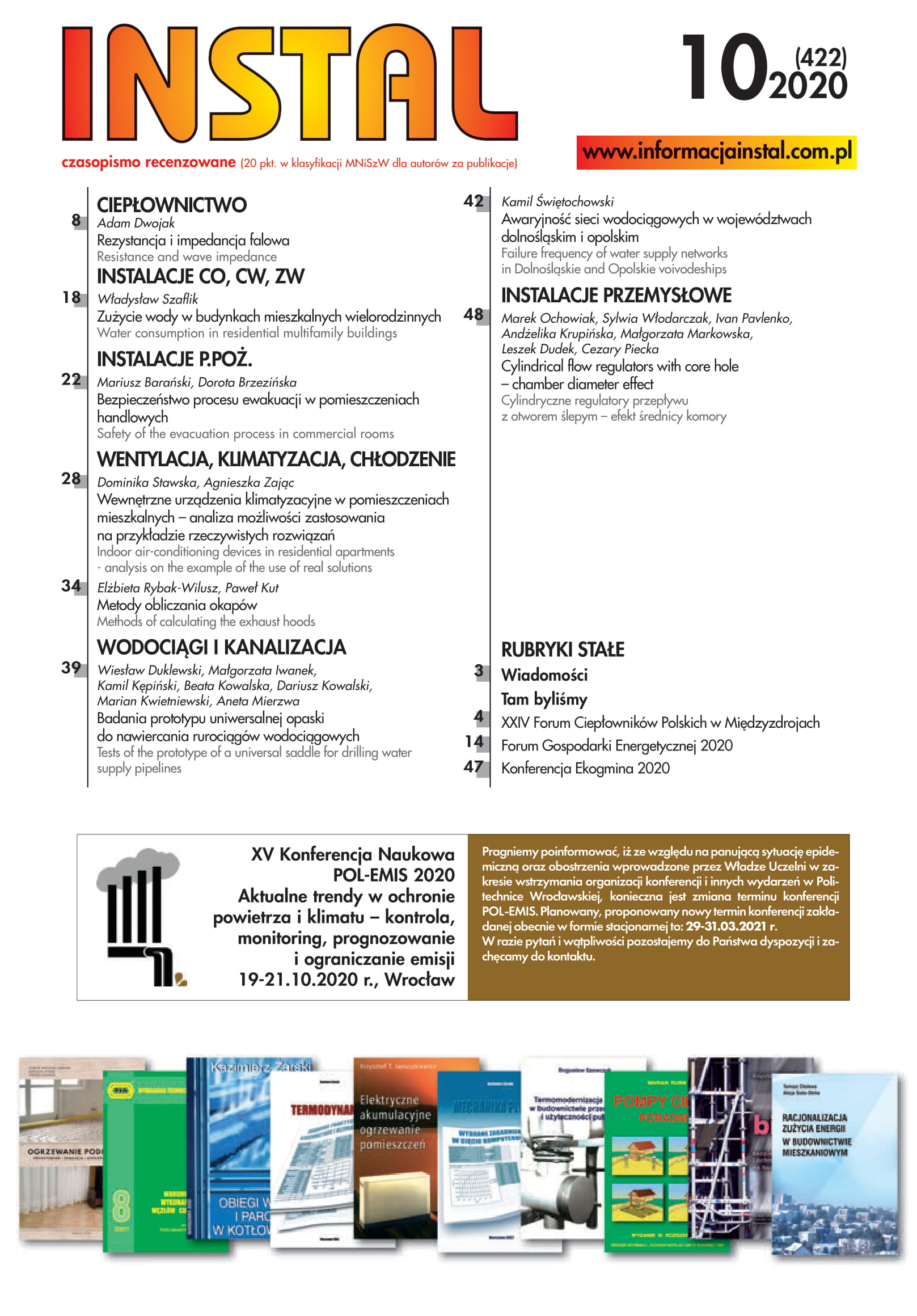
Methods of calculating the exhaust hoods
DOI:
https://doi.org/10.36119/15.2020.10.5Keywords:
local exhaust, hood, volumetric flow rate, efficiencyAbstract
Contaminants generated in technological processes cause a decrease in air quality in the internal environment. The content of harmful substances in workplaces should not exceed the maximum permissible concentrations. The local exhaust ventilation systems used in workplaces serve to reduce the content of contaminants and maintain the appropriate air quality. The key element of the local exhaust ventilation system is the canopy hood. It is located in the zone of formation of harmful substances, captures the contaminants removed together with the extracted air stream. The paper presents methods of calculating the exhaust hoods. The principles of hood dimensioning and the main factors determining the methodology of calculating the amount of extracted air were determined. It was indicated that the application of an appropriate method of calculating mainly depends on the type of source emitting the pollution, the location of the hood in relation to the source of contaminant and the nature of movement of the air stream extracted through the hood.
Downloads
References
Rozporządzenie Ministra Rodziny, Pracy i Polityki Społecznej z dnia 12 czerwca 2018 r. w sprawie najwyższych dopuszczalnych stężeń i natężeń czynników szkodliwych dla zdrowia w środowisku pracy (Dz.U. 2018 r. poz. 1286)Mierzwiński S., Aerodynamika wentylacji. Wydawnictwo Politechniki Śląskiej, Gliwice 2015.
ASHRAE Handbook – HVAC Aplication 1999, 2011, 2015.
Recknagel H., Sprenger E., Schramek E.R., Kompendium wiedzy. Ogrzewnictwo, klimatyzacja, ciepła woda, chłodnictwo 08/09. Omni Scala, Wrocław 2008.
Szymański T., Wasiluk W., Systemy wentylacji przemysłowej. Wydawnictwo Politechniki Gdańskiej, Gdańsk 2000
Downloads
Published
Issue
Section
Categories
License

This work is licensed under a Creative Commons Attribution 4.0 International License.
Authors retain copyright and grant the journal the right of first publication, with the work simultaneously licensed under a Creative Commons Attribution 4.0 International License, which permits others to share the work with appropriate acknowledgment of the authorship and initial publication in this journal.