
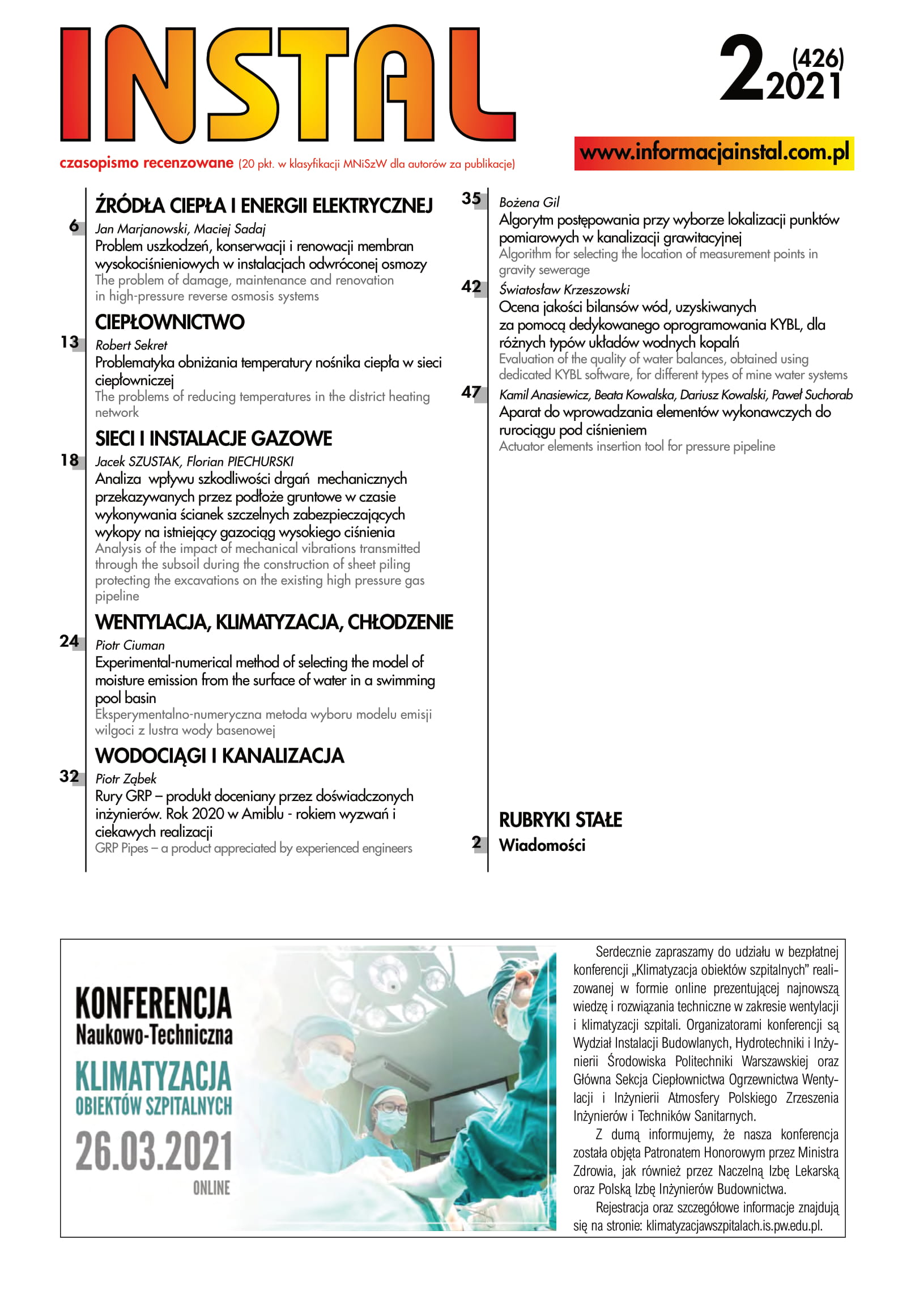
Experimental-numerical method of selecting the model of moisture emission from the surface of water in a swimming pool basin
DOI:
https://doi.org/10.36119/15.2021.2.4Keywords:
indoor swimming pool, moisture emission, experimental research, numerical modeling CFDAbstract
The issue of indoor swimming pool ventilation is very complex, which is a serious problem in their proper design and modernization. The difficulty is that in Poland there are no uniform regulations and standards regarding the required values of ventilation air parameters, the method of calculating moisture emission and the value of the venti lation air volume flow rate. In research, design and modernization of ventilation systems for swimming pools, vari ous methods are used to determine the emission of moisture from the water in the swimming pool basin and there is no complete information as to which of them best reflects the actual thermal-moisture and airflow phenomena. This paper presents a developed and validated research method related to the modeling of moisture emission from the pool water surface, which can be used for the modernization of ventilation systems in the existing indoor swimming pools, due to the need to improve thermal-moisture conditions.
Downloads
References
ANSYS, Inc. (2013). Ansys CFX-Solver Theory Guide Release 14.5. Canonsburg, PA.
Asdrubali F. (2009). A scale model to evaluate water evaporation from indoor swimming pools. Energy and Buildings, 41, 311–319, doi:10.1016/j.enbuild.2008.10.001.
ASHRAE (2011). ASHRAE Handbook: HVAC Applications, Atlanta, GA.
Besler G. (1972). Ventilation of indoor swimming pools. Ciepłownictwo Ogrzewnictwo Wentylacja, 5 (in Polish)
Downloads
Published
Issue
Section
Categories
License

This work is licensed under a Creative Commons Attribution 4.0 International License.
Authors retain copyright and grant the journal the right of first publication, with the work simultaneously licensed under a Creative Commons Attribution 4.0 International License, which permits others to share the work with appropriate acknowledgment of the authorship and initial publication in this journal.