
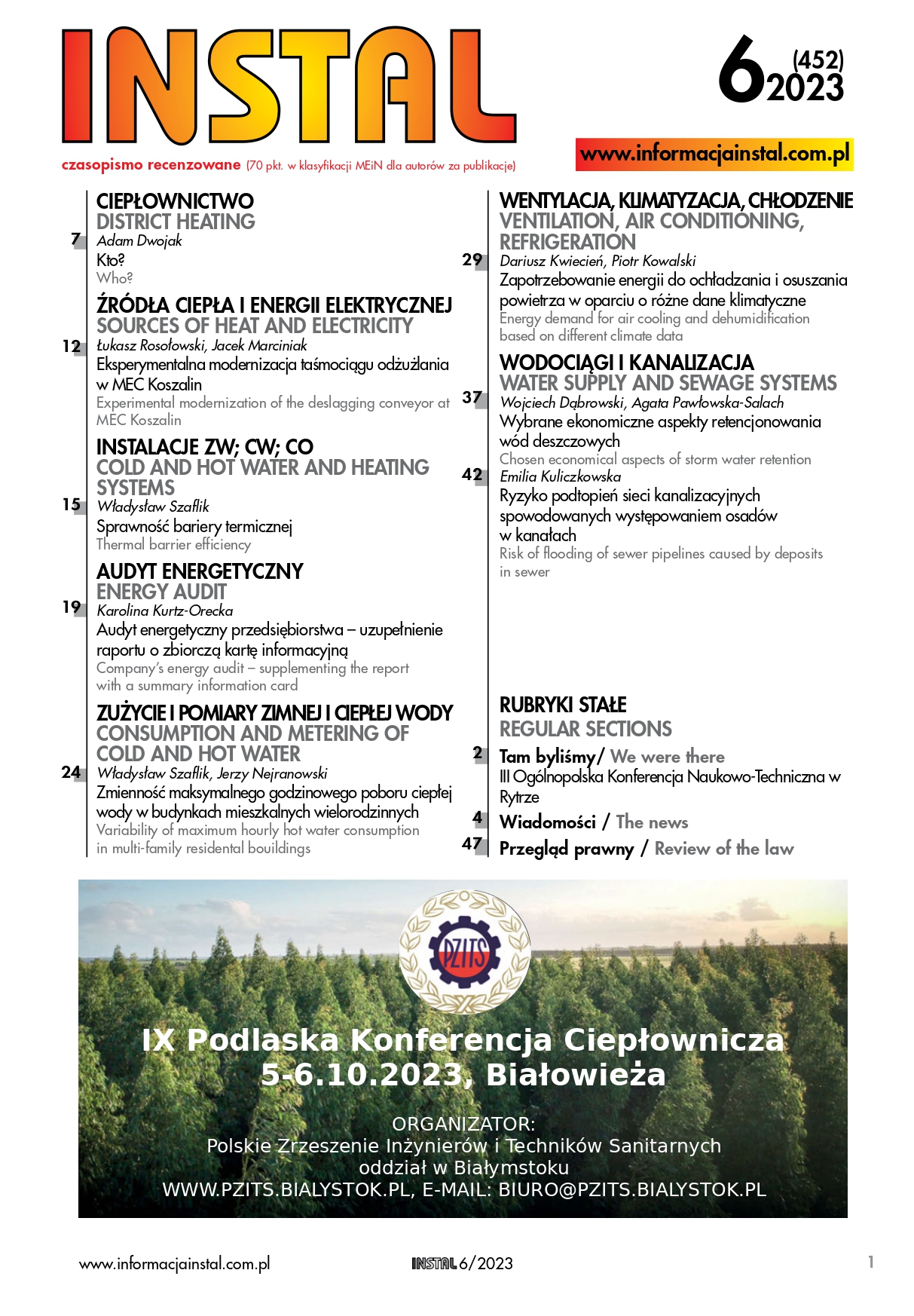
Energy demand for air cooling and dehumidification based on different climate data
DOI:
https://doi.org/10.36119/15.2023.6.5Keywords:
Typical Meteorological Year TMY, TRY, ventilation and air-conditioningAbstract
The article shows the influence of the choice of available climatic data on the results of calculating the year-round energy demand to cool and dehumidify the ventilation air. Five source data were compared with each other in terms of changes in the temperature and moisture content of outdoor air, representing so-called typical meteorological years for six selected locations in Poland. For the mass flow rate of the ventilating air m = 1.0 kg/s, the year-round demand for total and sensible energy for cooling, the frequency of the need to cool and dehumidify the air, and the amount of water vapour necessary to remove water vapour from the air were calculated. The results of the calculations determined from more recent climate databases (2001-2020) show a significant increase in energy demand and the need for air dehumidification for almost all scenarios analysed. Compared to older climate data (1971-2000), the energy demand for air cooling can be 200% higher, and the need for air drying in relation to the mass of assimilated water vapour can even exceed this value. In most of the cases analysed, the greatest differences in relation to older climatic data were obtained for the so-called warmest year.
Downloads
References
Rozporządzenie Ministra Infrastruktury i Rozwoju z dnia 27 lutego 2015 r. w sprawie metodologii wyznaczania charakterystyki energetycznej budynku lub części budynku oraz świadectw charakterystyki energetycznej
Typowe lata meteorologiczne i statystyczne dane klimatyczne dla obszaru Polski do obliczeń energetycznych budynków, https://dane.gov.pl/pl/dataset/797,typowe-lata-meteorologiczne-i-statystyczne-dane-
klimatyczne-dla-obszaru-polski-do-obliczen-energetycznych-budynkow, 12.03.2023 r.
Kwiecień D., Wpływ wyboru statystycznych danych klimatycznych na zapotrzebowanie energii do uzdatniania powietrza klimatyzującego, Instal, 20/2020, s.30–38, https://doi.org/10.36119/15.2020.2.3
Downloads
Published
Issue
Section
Categories
License

This work is licensed under a Creative Commons Attribution 4.0 International License.
Authors retain copyright and grant the journal the right of first publication, with the work simultaneously licensed under a Creative Commons Attribution 4.0 International License, which permits others to share the work with appropriate acknowledgment of the authorship and initial publication in this journal.