
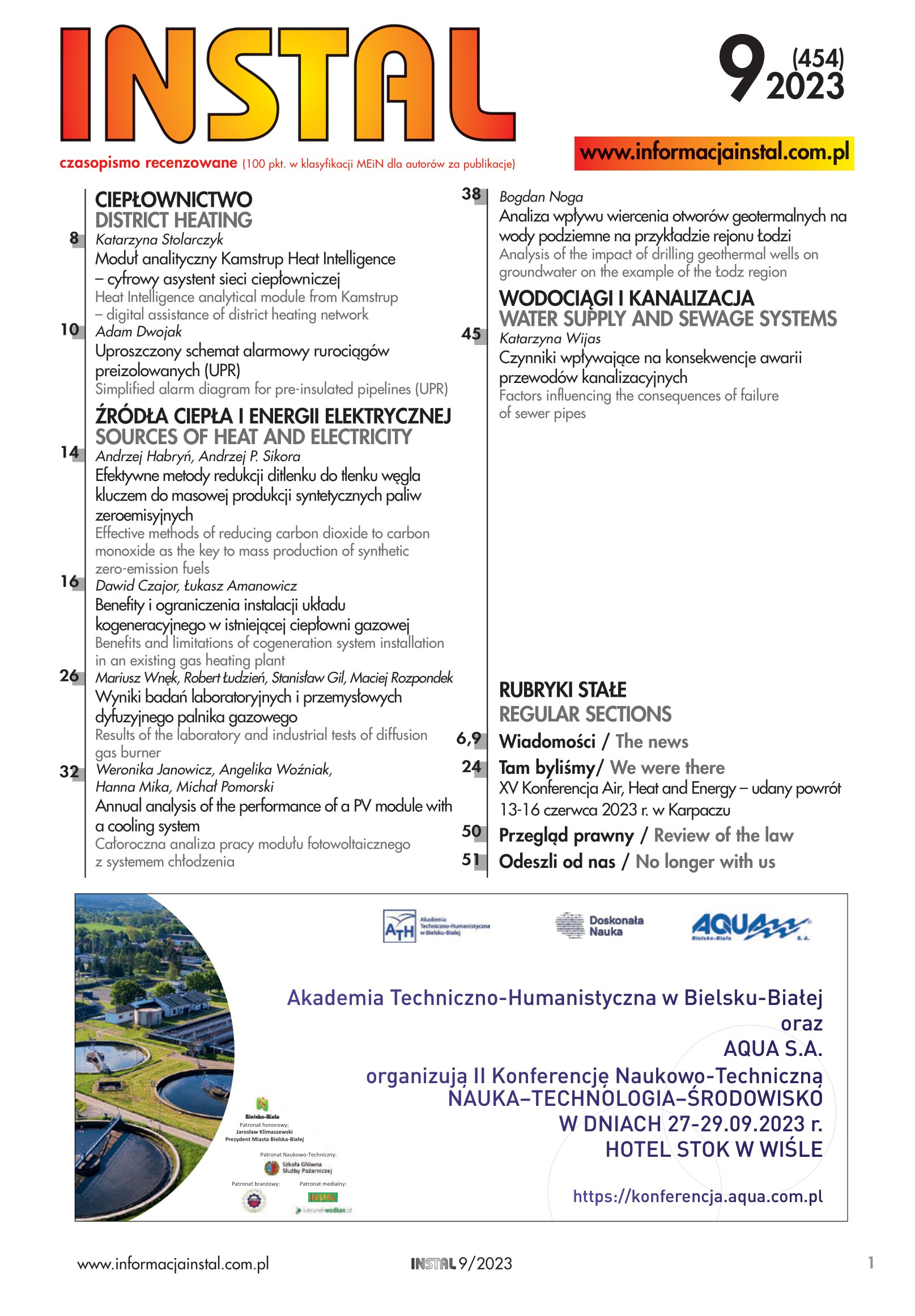
Benefits and limitations of cogeneration system installation in an existing gas heating plant
DOI:
https://doi.org/10.36119/15.2023.9.1Keywords:
gas-fired cogeneration, energy transformation, district heating, modernization of a coal-fired boiler house, combined economy, energy prices, electricity, heat, gasAbstract
According to the forecasts of the “Energy Policy of Poland until 2040” (PEP2040), the national energy strategy is to strive for climate neutrality. This goal is to be achieved by increasing energy efficiency with the use of renewable energy sources (RES) and reducing greenhouse gas emissions. The planned demand for electricity is to increase from 173.5 TWh (data for 2022) to 230.0 TWh (forecast for 2040), which will force the construction of new electricity sources, e.g. based on natural gas or its mix with hydrogen. This opens up new opportunities for heating plants, which, by installing a cogeneration gas engine, have the opportunity to: (i) diversify their sources of income by additional sales of electricity, (ii) transfer part of the fixed costs resulting from heating operations to activities related to the power industry, (iii ) obtaining the status of an effective heating network in the long term, (iv) limiting a significant increase in heat price increases, (v) generating additional income, in particular in the summer season, when heat production results mainly from the demand for hot utility water. The investment should be analyzed in terms of threats arising from unstable prices on the gas market and additional opportunities offered by the sale of electricity on the balancing market, where the sale price is updated with an hourly interval. This approach gives greater flexibility compared to the model of shaping heat tariffs approved by the President of the Energy Regulatory Office (URE). The benefits and limitations of the installation of the cogeneration system presented in the article are based on the experience from the commissioning of the CHP plant in Białogard (Zachodniopomorskie Voivodeship) based on natural gas-fired piston engines. Over the course of several years, the facility has undergone a transformation from generating heat in local boiler houses fired with hard coal, and then with gas fuel, to one central heat and power plant, which connected all local boiler houses with the municipal heating network. The experience from the modernization of existing boiler houses and the review of various aspects of the use of gas cogeneration, which are described in this article, is intended to start a discussion on amending legal acts in the field of cogeneration in order to adapt them to market dynamics.
Downloads
References
Kupczak P., Transformacja energetyczna średniej wielkości PECów, Energetyka Cieplna i Zawodowa 2021, 2, 24-27
Bandurski K., Ratajczak K., Amanowicz Ł., Transformacja energetyczna, a Metodologia sporządzania charakterystyki energetycznej…, COW 10/2021, 52, 20-26, https://doi.org/10.15199/9.2021.10.3
Bandurski K., Amanowicz Ł, Ratajczak K., Zintegrowane wykorzystanie charakterystyki energetycznej budynków w polityce energetycznej, Ciepłownictwo Ogrzewnictwo Wentylacja 2022, 53 (12), 20-25
Downloads
Published
License

This work is licensed under a Creative Commons Attribution 4.0 International License.
Authors retain copyright and grant the journal the right of first publication, with the work simultaneously licensed under a Creative Commons Attribution 4.0 International License, which permits others to share the work with appropriate acknowledgment of the authorship and initial publication in this journal.