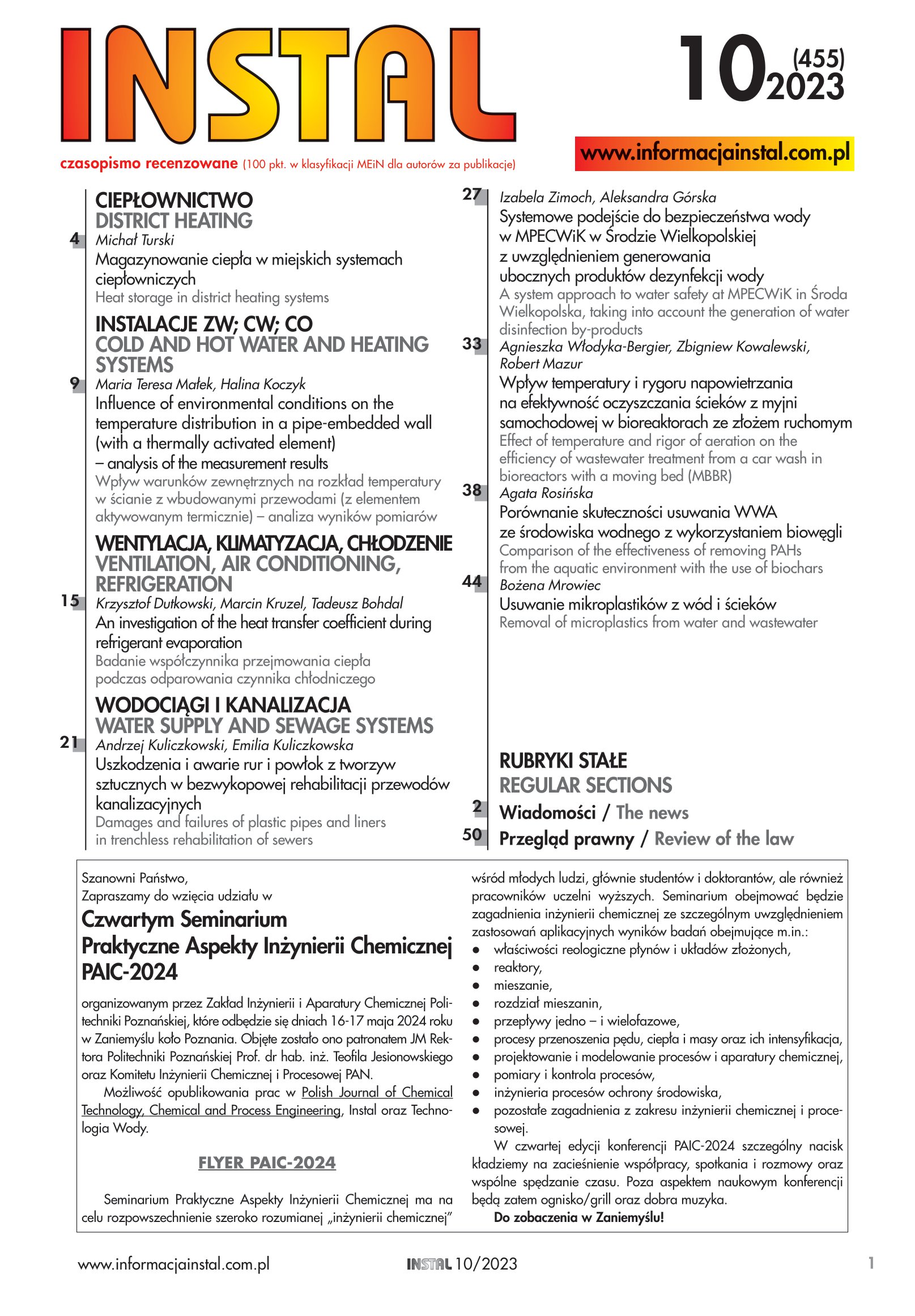
Removal of microplastics from water and wastewater
DOI:
https://doi.org/10.36119/15.2023.10.8Keywords:
waters and wastewater treatment,, plastic pollution, microplastics, microplastics removal, process efficiencyAbstract
The article presents characteristics of the processes of water and wastewater treatment in the field of microplastics (MPs) removing. Among the physical methods of treatment membrane techniques and rapid filtration are the most effective in MPs eliminating. Chemical methods such as coagulation, electrocoagulation and advanced oxidation are moderately effective, but they are being improved to higher efficiency of MPs removal. In the group of biological methods, membrane bioreactors are the most effective. The use of diversified and multi-stage water and wastewater treatment technologies makes it possible to MPs eliminate even in the range of 98-100%. The application of effective technology is limited by operating costs and the problem of waste disposal, so that the removed MPs are not returned to the environment.
Downloads
References
Pivokonsky M., Cermakova L., Novotna K., Peer P., Gajthaml T., Janda V. Occurence of microplastics in raw and treated drinking water. Science of the Total Environment 2018, 643, 1644-1651.
Mintening S.M., Löder M.G., Primpke S., Gerdts G. Low numbers of microplastics detected in drinking water from ground water sources. Science of the Total Environment. 2019, 648, 631-635.
He D., Luo Y., Lu S., Liu M., Song Y., Lei L. Microplastics in soil: Analytical methods, pollution characteristics and ecological risks. Trends in analytical chemistry 2018, 109, 163-172.
Downloads
Published
License

This work is licensed under a Creative Commons Attribution 4.0 International License.
Authors retain copyright and grant the journal the right of first publication, with the work simultaneously licensed under a Creative Commons Attribution 4.0 International License, which permits others to share the work with appropriate acknowledgment of the authorship and initial publication in this journal.