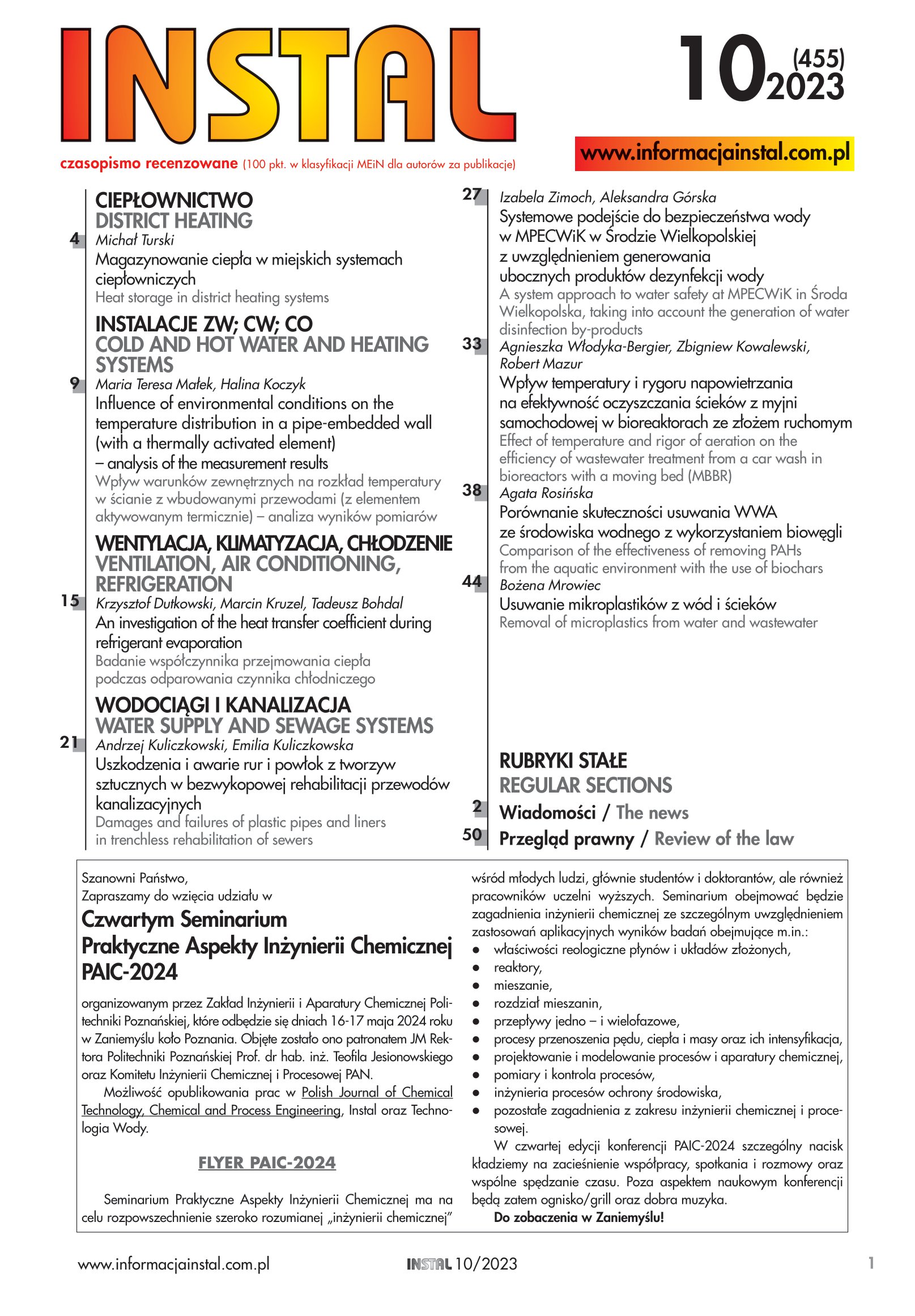
A system approach to water safety at MPECWiK in Środa Wielkopolska, taking into account the generation of water disinfection by-products
DOI:
https://doi.org/10.36119/15.2023.10.5Keywords:
disinfection by-products (DBP), disinfection, coagulation, biodegradable dissolved organic carbon (BDOC), total organic carbon (TOC), trihalomentates (THM), riskAbstract
Disinfection is one of the main parts of water treatment processes, allowing to maintain microbiological safety. However, it carries the risk of the formation of by-products in the drinking water, which in the long term, may pose a threat to consumer health. There are many methods to reduce the level of disinfection by-products (DBP) formation, depending on the type and quality of water abstraction. However, this process cannot be fully eliminated in water supply systems with a high potential for their generation. Both the need to ensure the microbiological safety of tap water and the need to reduce the formation of DBP make disinfection a technological process of particular importance in the procedures of managing the safety of water delivered to consumers. On the example of Municipal Heat Energy, Water Supply and Sewage Company Ltd in Środa Wielkopolska city, the article presents the process of identifying threats resulting from the creation of UPD and actions aimed at minimizing or eliminating this threat. In connection with the above, preliminary studies were carried out at the Company, which showed the effectiveness of using coagulation to reduce the potential of UPD formation in the treated water. These activities used a systemic approach to water safety based on risk analysis and management. The aim of the study was to analyze the potential risk of UPD formation in water intended for human consumption and to assess the technological effectiveness of coagulation as an effective protective barrier in risk management.
Downloads
References
Wytyczne dotyczące jakości wody do picia – wydanie czwarte, Wydawnictwo Izba Gospodarcza „Wodociągi Polskie”. Bydgoszcz 2014 r., str. 51
ZIMOCH I.: Niezawodnościowa interpretacja wyników monitoringu jakości wody w sieci wodociągowej. Ochrona Środowiska 2009, Vol 31. Nr 4 s. 51-55.
ŁOMOTOWSKI J.: Jak oceniać stabilność chemiczną i biologiczną wody w systemach wodociągowych. INSTAL 2018, nr 1, s. 37-40.
Downloads
Published
License

This work is licensed under a Creative Commons Attribution 4.0 International License.
Authors retain copyright and grant the journal the right of first publication, with the work simultaneously licensed under a Creative Commons Attribution 4.0 International License, which permits others to share the work with appropriate acknowledgment of the authorship and initial publication in this journal.