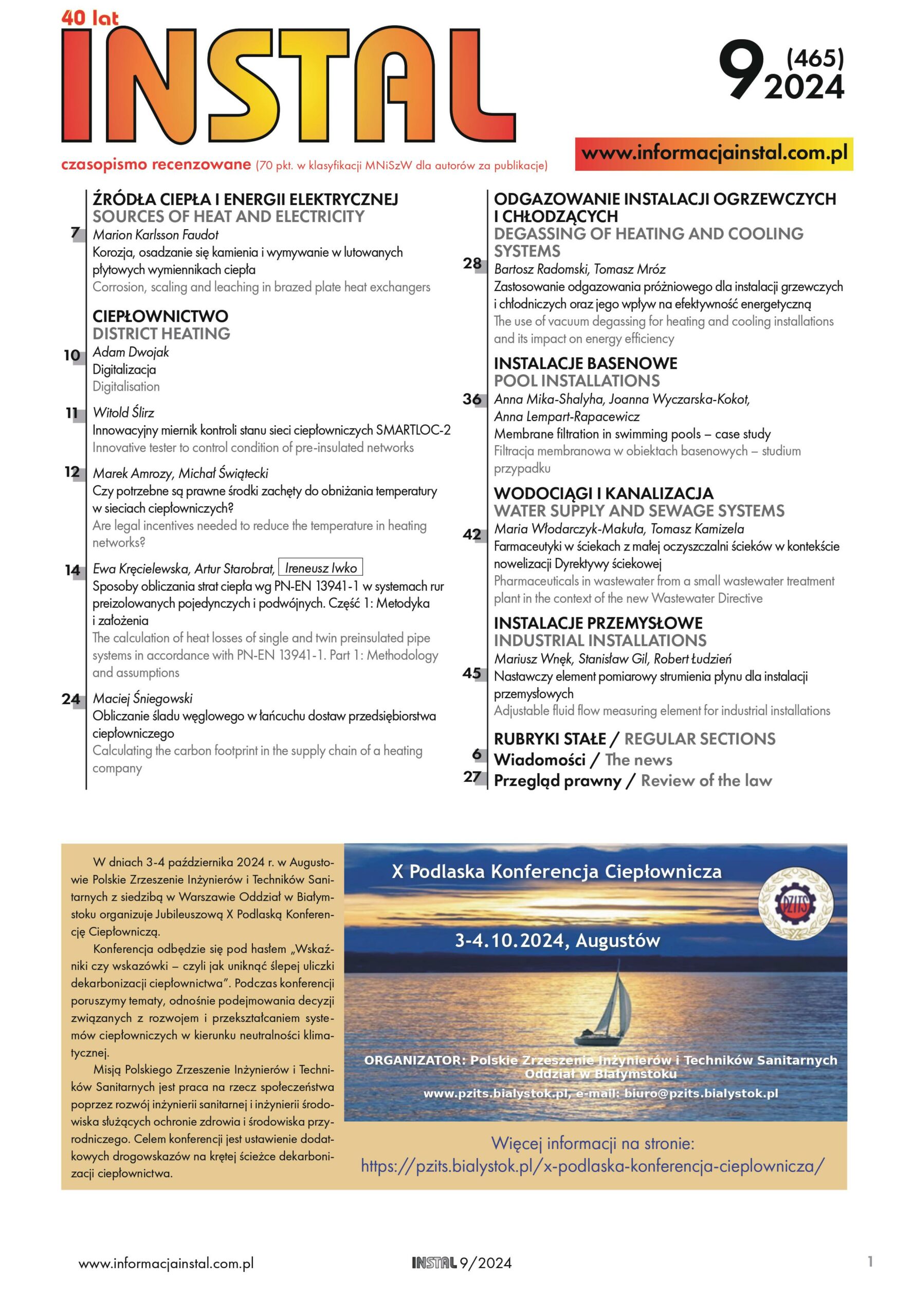
The use of vacuum degassing for heating and cooling installations and its impact on energy efficiency
DOI:
https://doi.org/10.36119/15.2024.9.3Keywords:
vacuum degassing, energy analysis, energetic efficiencyAbstract
Degassing is a critical maintenance procedure for heating and cooling water systems. By effectively removing dissolved gases and entrapped air, degassing ensures optimum heat transfer efficiency, reduces corrosion and noise, prevents airlocks and cavitation, and extends the life of system components. The use of methods such as manual venting, automatic venting, vacuum venting, thermal venting, and centrifugal separators can significantly improve the efficiency and reliability of heating systems. The use of a vacuum venting system and a dirt separator increases energy efficiency which implicates reduced energy consumption. The vacuum venting system alone can increase the energy efficiency of heating systems, up to 4.7% for radiator systems, up to 5.1% for underfloor heating systems, and up to 4.2% for refrigeration systems. The vacuum venting system together with a vacuum dirt separator can increase the energy efficiency of heating systems, up to 6.5% for radiator systems, up to 10.6% for underfloor heating systems, and up to 10.3% for refrigeration systems. The use of vacuum degassing contributes to the achievement of sustainable development goals, reduces energy consumption and thus reduces CO2 emissions into the environment, and also allows for a significant reduction in operating costs with low investment costs and ease of application of the solution.
Downloads
References
https://watertreatmentbasics.com/how-does--deaerator-work/?utm_content=cmp-true – dostęp 12.07.2024r
https://www.hydrogroup.biz/areas-of-use/industry-power-stations-commercial-enterprises/degassing.html – dostęp 12.07.2024r
https://www.veoliawatertech.com/en/solutions/technologies/whittier-filtration-separation/degasification – dostęp 12.07.2024r
PN-85/C-04601. Woda do celów energetycznych. Wymagania i badania jaskości wody dla kotłów wodnych i zamkniętych obiegów ciepłowniczych.
PN-93/C-04607. Woda w instalacjach ogrzewania. Wymagania badania dotyczące jakości wody.
PN-EN 12952-12. Kotły wodnorurowe i urządzenia pomocnicze. Część 12: Wymagania dotyczące jakości wody zasilającej i wody kotłowej
Rühling, Karin, Martin Heymann, and Felix Panitz. “Venting and degasification of solar circuits.” Energy Procedia 30 (2012).
Downloads
Published
Issue
Section
License

This work is licensed under a Creative Commons Attribution 4.0 International License.
Authors retain copyright and grant the journal the right of first publication, with the work simultaneously licensed under a Creative Commons Attribution 4.0 International License, which permits others to share the work with appropriate acknowledgment of the authorship and initial publication in this journal.