
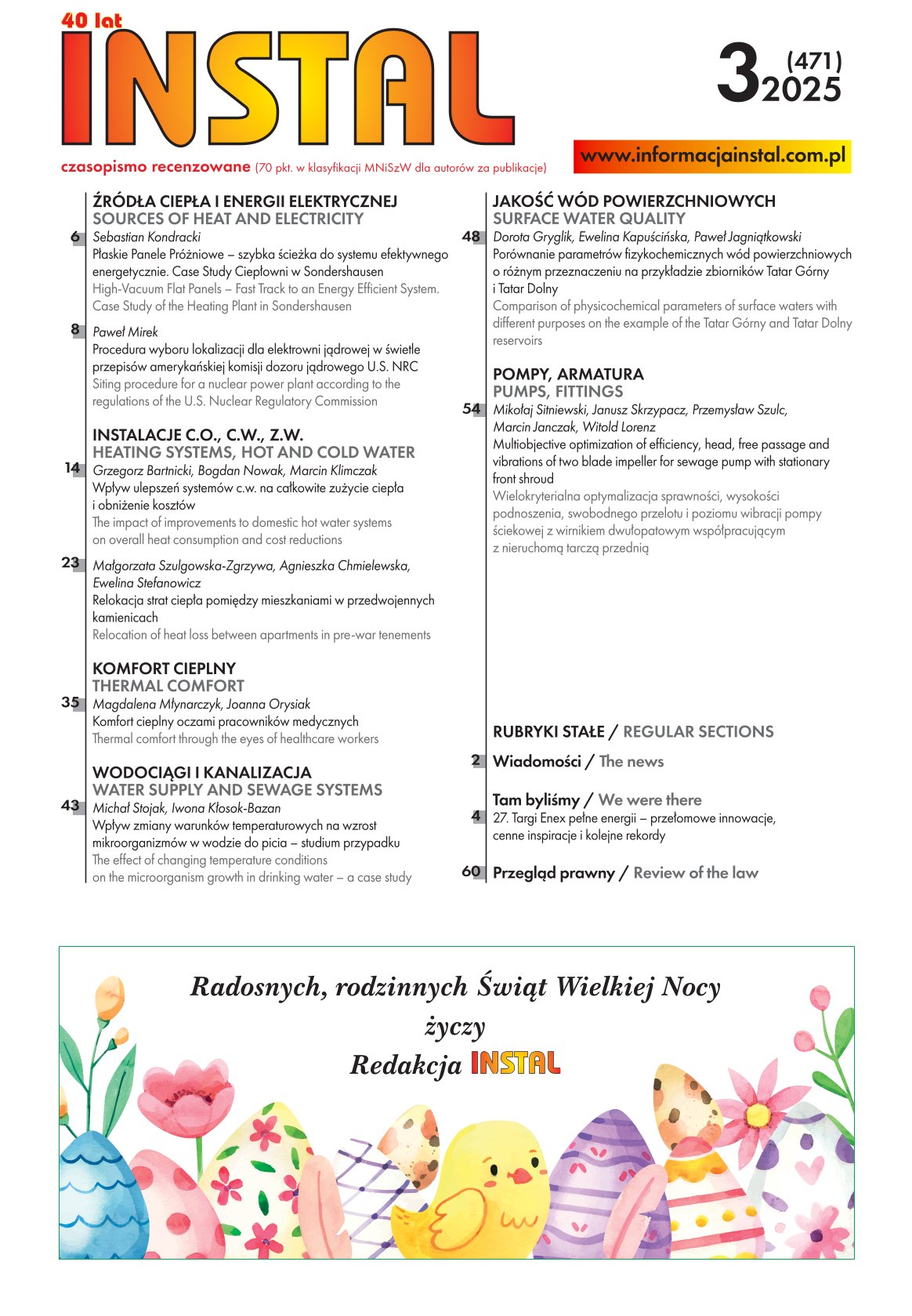
The impact of improvements to domestic hot water systems on overall heat consumption and cost reductions
DOI:
https://doi.org/10.36119/15.2025.3.2Keywords:
energy efficiency, circulation installation, Heat Input Factor, energy consumption modelingAbstract
The article presents the results of analyses of three DHW installations, which differ in technical condition, equipment and operational problems. These problems prompted the performance of measurements and analysis of the installation energy efficiency using the heat input factor – HIF [2] for its assessment. The obtained results were compared with the value theoretically calculated for DHW installations of similar size and equipment. Moreover, measurements in the building complex N (2 buildings) confirmed the lack of ensuring the required DHW temperature. However, the problem of this installation is the very high value of the HIF factor (0.42-0.48 GJ/m3), indicating low energy efficiency. Despite the extensive geometry of the installation (3 buildings) and only slightly smaller number of apartments in the building complex A, the HIF factor determined on the basis of measurements is much lower (0.28 GJ/m3). This installation is equipped with thermostatic riser valves. They limit the operating time of the circulation. Such an improvement reduces heat losses by at least 10%. The article draws attention to the possibility of using the HIF factor to identify type II failure conditions (excessive heat consumption), which are much more difficult to diagnose than an interruption in the supply of heat or domestic hot water.
Downloads
References
Ahmed K., Pylsy P., Kurnitski J., Monthly domestic hot water profiles for energy calculation in Finnish apartment buildings. Energy and Buildings nr 97. 2015, s. 77-85, https://doi.org/10.1016/j.enbuild.2015.03.051
Bartnicki G., Klimczak M, Nakład ciepła na przygotowanie ciepłej wody użytkowej na podstawie pomiarów eksploatacyjnych w budynkach wielolokalowych, INSTAL 1/2025, s. 14-22. DOI 10.36119/15.2025.1.2
Bartnicki G., Nowak, B., Zmienność kosztów zakupu paliwa gazowego dla odbiorcy końcowego w okresie 2019-2024, INSTAL 11/2024, s. 26-32. DOI 10.36119/15.2024.2
Downloads
Published
Issue
Section
Categories
License

This work is licensed under a Creative Commons Attribution 4.0 International License.
Authors retain copyright and grant the journal the right of first publication, with the work simultaneously licensed under a Creative Commons Attribution 4.0 International License, which permits others to share the work with appropriate acknowledgment of the authorship and initial publication in this journal.