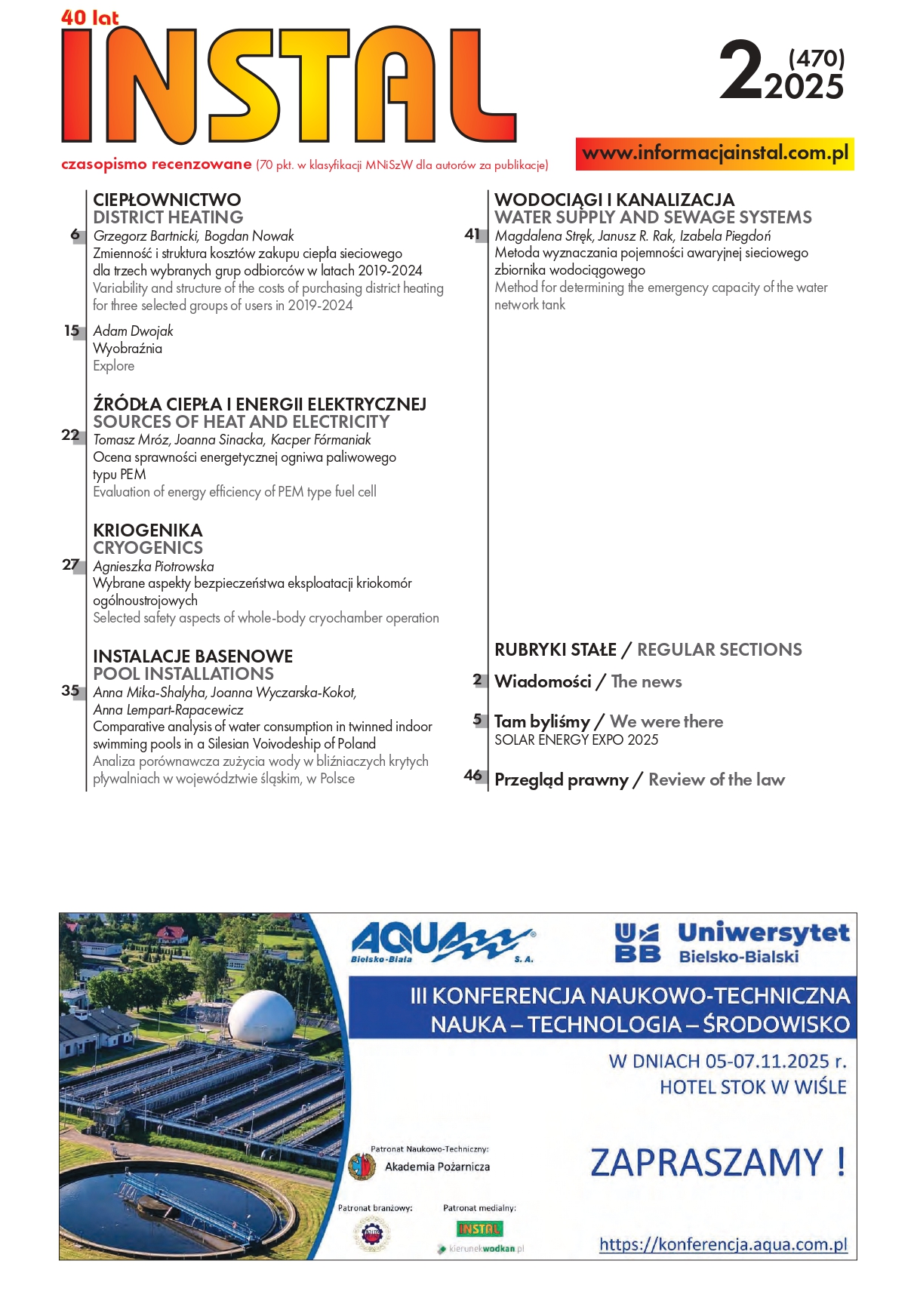
Comparative analysis of water consumption in twinned indoor swimming pools in a Silesian Voivodeship of Poland
DOI:
https://doi.org/10.36119/15.2025.2.5Keywords:
swimming pools, water consumption, effective management, sustainability, technology optimisationAbstract
Swimming pools, due to their specific nature, are sports facilities for which demand is highest for water of a quality subject to restrictive regulations. The objective of this study is to provide a detailed characterisation of the structure of water consumption in three ‘twin’ swimming pool facilities located in Poland, in the Silesian Voivodeship. Each of the analysed facilities includes a sports pool, a recreational pool with water attractions, a water slide, a whirlpool and a children’s paddling pool. The findings of this study demonstrate a strong correlation between water consumption and the type of users and water management practices employed. In particular, it was found that recreational pools with water attractions (slides, whirlpools) used significantly more water than traditional sports pools. The findings of this case study offer a valuable foundation for the development of strategies aimed at enhancing the efficiency of water management in swimming pool facilities.
Downloads
References
S.C. Addanki and H. Venkataraman, Greening the economy: A review of urban sustainability measures for developing new cities, Sustain Cities Soc. 32 (2017) 1–8. https://doi.org/10.1016/j.scs.2017.03.009.
A. Lewandowska and D. Szymańska, Ecologisation of Polish cities in the light of selected parameters of sustainable development, Susta in Cities Soc. 64 (2021) 102538. https://doi.org/10.1016/j.scs.2020.102538.
R.F.M. Ameen and M. Mourshed, Urban sustainability assessment framework development: The ranking and weighting of sustainability indicators using analytic hierarchy process, Sustain Cities Soc. 44 (2019) 356–366 https://doi.org/10.1016/j.scs.2018.10.020.
Published
License

This work is licensed under a Creative Commons Attribution 4.0 International License.
Authors retain copyright and grant the journal the right of first publication, with the work simultaneously licensed under a Creative Commons Attribution 4.0 International License, which permits others to share the work with appropriate acknowledgment of the authorship and initial publication in this journal.