
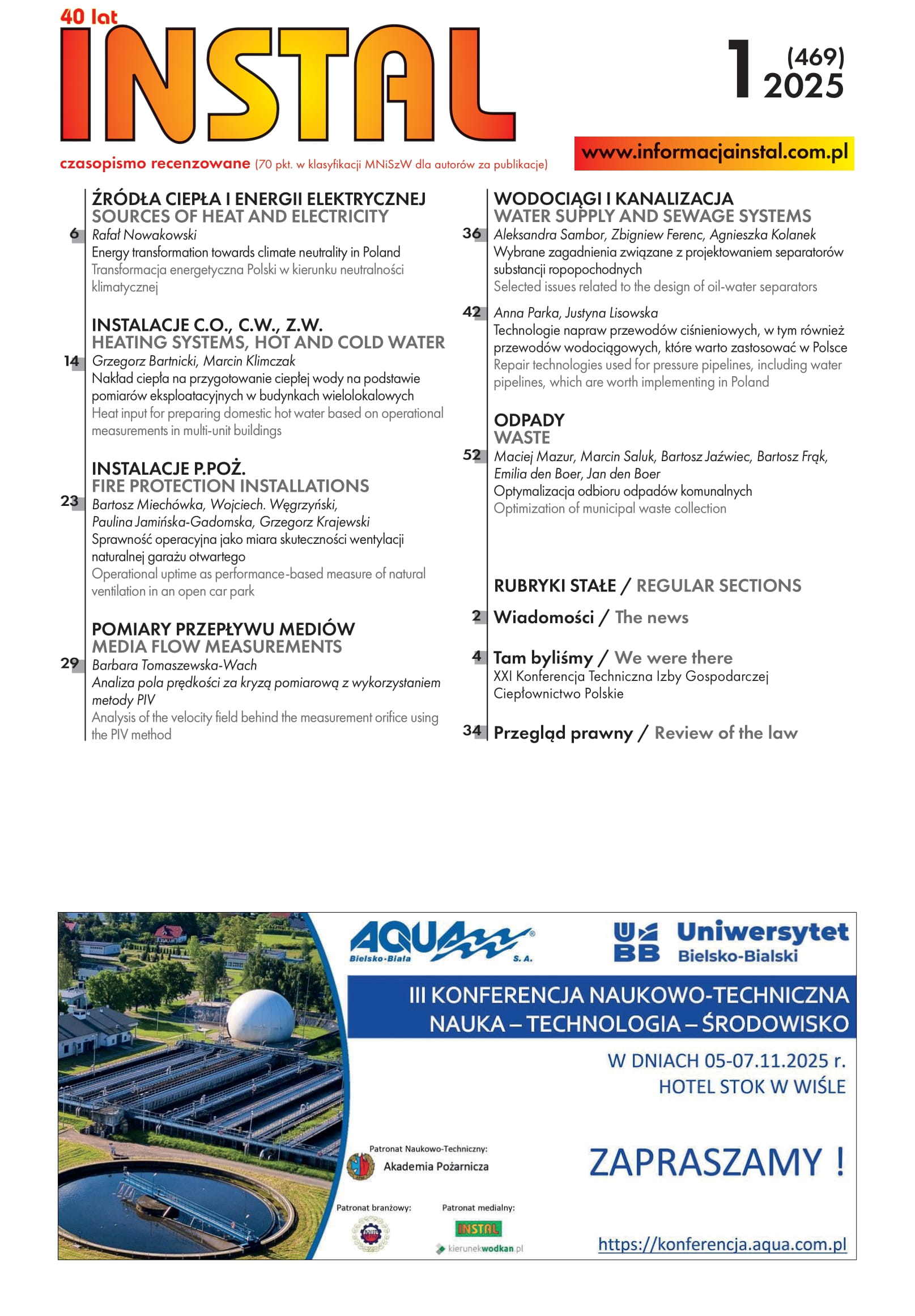
Selected issues related to the design of oil-water separators
DOI:
https://doi.org/10.36119/15.2025.1.5Keywords:
pollution, rainwater, oil substances, separatorsAbstract
Pollution of water and soil environment with oil substances results from the common use of oil and its derivatives, as a basic raw material for energy production, in the chemical industry, in industrial plants and in transportation vehicles. Oil-water separators are devices used to separate petroleum substances (such as oils, fuels, lubricants, etc.) from rainwater or industrial wastewater. Their design is crucial for environmental protection, as they allow the effective removal of hazardous substances from water that can enter the environment, causing groundwater and surface water pollution. No information on a consistent, computational method for designing separators was found in the literature reviewed. PN-EN 858-1 only provides assumptions for the selection of these devices. The design of oil-water separators requires the analysis of many factors, including consideration of relevant standards and legislation to ensure efficiency and compliance with environmental requirements. This paper presents a new path forward in the design of oil-water separators, which could be an extension of PN-EN 858-1 to include the formulas used in the hydraulic calculations of these devices, and allow the sizing of separators to be optimized according to the size of the available land for their installation, while maintaining the required separation efficiency.
Downloads
References
Adamski W., Modelowanie systemów oczyszczania wód, PWN, Warszawa 2002.
Adynkiewicz-Piragas M., Kolanek A., Kryza J., i inni., Gospodarka starymi zanieczyszczeniami na terenie lotniska powojskowego od badań historycznych do koncepcji rewitalizacji (lotnisko Krzywa, Polska), IMGW-PIB, Wrocław, 2014
American Petroleum Institute, API PUBLICATION 421, Monographs on Refinery Environmental Control-Management of Water Discharges: Design and Operation of Oil-Water Separators, First Edition, February 1990
Downloads
Published
License

This work is licensed under a Creative Commons Attribution 4.0 International License.
Authors retain copyright and grant the journal the right of first publication, with the work simultaneously licensed under a Creative Commons Attribution 4.0 International License, which permits others to share the work with appropriate acknowledgment of the authorship and initial publication in this journal.