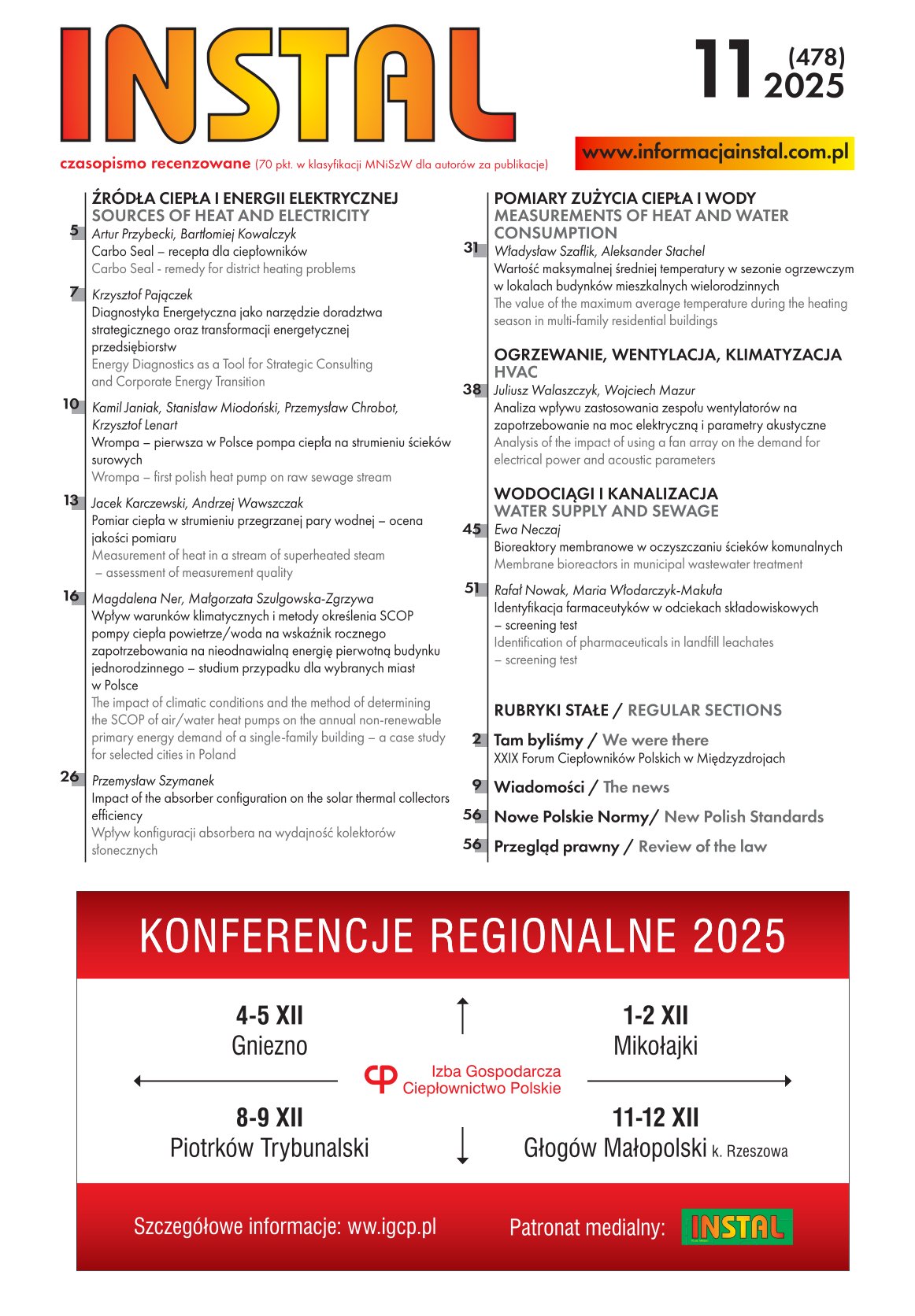
Membrane bioreactors in municipal wastewater treatment
DOI:
https://doi.org/10.36119/15.2025.11.7Keywords:
sewage treatment, sewage, sludgeAbstract
Due to legislative changes in the water and wastewater sector aimed at reducing anthropogenic pressure on the aquatic environment, the coming years are expected to see the implementation of modern technological solutions in wastewater treatment systems. These systems must address current and future challenges through a holistic approach to water retention and efficient wastewater treatment, not only by removing nutrients but also micropollutants, while maximizing the potential for wastewater reuse. One of the most modern technologies are membrane bioreactors MBR. Due to their ability to simultaneously remove inorganic, microbiological, and organic pollutants, including a wide range of micropollutants, this technology can treat both municipal and industrial wastewater. This article presents the development of MBR technology over the years, discusses bioreactors’ operating principles and configurations, and presents examples of full-scale reactor applications and their operational efficiency.
Downloads
References
Unia Europejska, “Dyrektywa Parlamentu Europejskiego i Rady (UE) 2024/3019 z dnia 27 listopada 2024 r. dotycząca oczyszczania ścieków komunalnych (wersja przekształcona),” 2024.”.
M. Włodarczyk-Makuła and T. Kamizela, “Farmaceutyki w ściekach z małej oczyszczalni ścieków w kontekście nowelizacji Dyrektywy ściekowej,” Instal, pp. 42–44, 2024, doi: 10.36119/15.2024.9.5.
European Comission, “Water reuse.” https://environment.ec.europa.eu/topics/water/water-reuse_en
Downloads
Published
License

This work is licensed under a Creative Commons Attribution 4.0 International License.
Authors retain copyright and grant the journal the right of first publication, with the work simultaneously licensed under a Creative Commons Attribution 4.0 International License, which permits others to share the work with appropriate acknowledgment of the authorship and initial publication in this journal.