
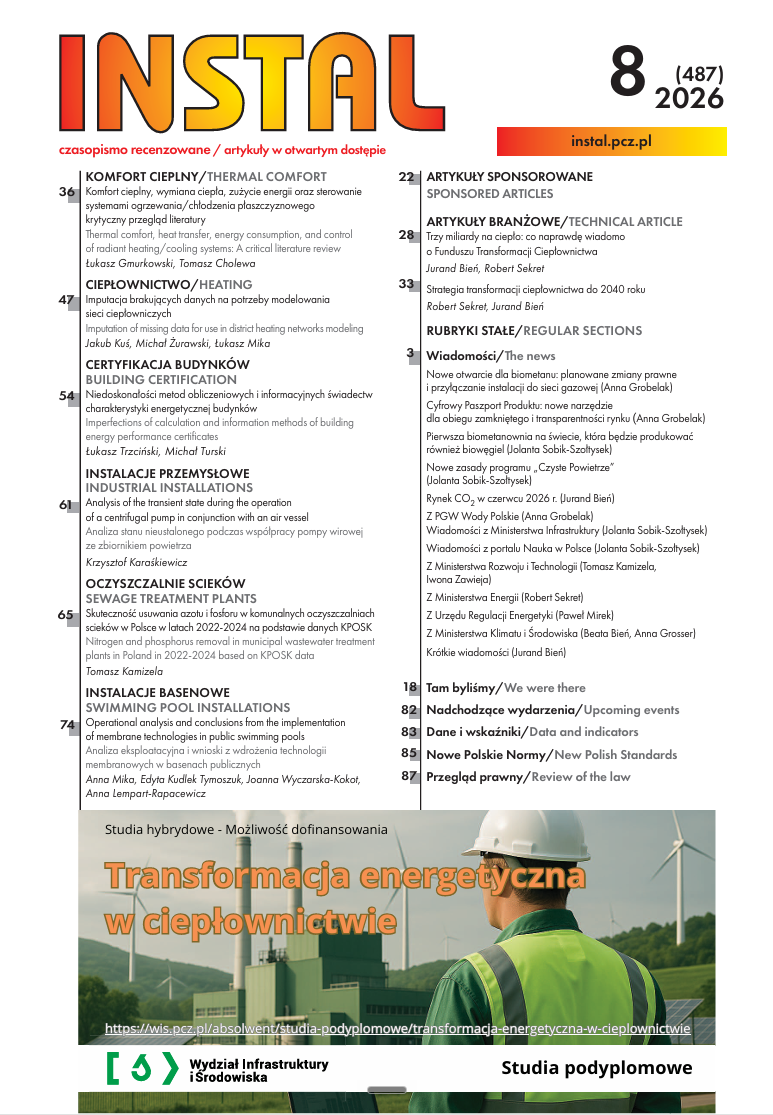
Imperfections of calculation and information methods of building energy performance certificates
DOI:
https://doi.org/10.17512/INSTAL.2026.08.03Keywords:
energy performance certificate, EP, primary energy, technical requirements, cooling, overheating, biomass, formal optimization, informational value of the certificateAbstract
The annual non-renewable primary energy demand indicator EP performs both a regulatory and an informational function in the Polish system for assessing the energy performance of buildings. It is a criterion for compliance with the technical requirements and the main parameter presented in the energy performance certificate. This accumulation of functions creates methodological tension, because EP describes the building’s burden in terms of non-renewable primary energy, but it does not always inform the user about final energy consumption, operating costs, or thermal comfort. The aim of the article is to demonstrate the imperfections of the current methodology for assessing the energy performance of buildings and to indicate that the proposed amendments to the technical requirements of 9 June 2025, despite tightening some requirements, do not eliminate the problems related to the structure of EP, the assessment of cooling, lighting, and actual operation. In a residential building without a cooling system, the ΔEPC component may be equal to zero, while the built-in lighting component ΔEPL does not affect the result. The article analyses two calculation examples. In the first example, a building with poor thermal performance and EK = 180 kWh/(m²·year), heated with natural gas, obtained EP = 198.0 kWh/(m²·year). After assigning 80% of the energy balance to biomass and 20% to gas, EP decreased to 68.4 kWh/(m²·year). The reduction amounted to 129.6 kWh/(m²·year), i.e. 65.5%, despite no improvement in insulation, windows and doors, airtightness, or final energy demand. In the second example, a building with EP = 70.0 kWh/(m²·year), after the application of a photovoltaic installation, obtained EP = 65.55 kWh/(m²·year), which means a decrease of 4.45 kWh/(m²·year), i.e. 6.4%. This results from the fact that, in residential buildings, the electricity used by household appliances and lighting is not included in the calculations for the energy performance certificate. The results confirm that a low EP value does not necessarily indicate low final energy consumption or high building performance in use. The energy performance certificate should therefore be supplemented with indicators of overheating risk, cooling demand, final energy demand, and the operational scenario.
Downloads
References
[1] Obwieszczenie Marszałka Sejmu RP z dnia 24 stycznia 2024 r. w sprawie ogłoszenia jednolitego tekstu ustawy o charakterystyce energetycznej budynków, Dz.U. 2024 poz. 101.
[2] Rozporządzenie Ministra Rozwoju i Technologii z dnia 28 marca 2023 r. zmieniające rozporządzenie w sprawie metodologii wyznaczania charakterystyki energetycznej budynku lub części budynku oraz świadectw charakterystyki energetycznej, Dz.U. 2023 poz. 697.
[3] BPIE (2024), Energy Performance Certificates: Policy needs and best practices.
[4] Andaloro, A.P.F., Salomone, R., Ioppolo, G., Andaloro, L. (2010), Energy certification of buildings: A comparative analysis of progress towards implementation in European countries, Energy Policy, 38(10).
[5] Obwieszczenie Ministra Rozwoju i Technologii z dnia 15 kwietnia 2022 r. w sprawie ogłoszenia jednolitego tekstu rozporządzenia Ministra Infrastruktury w sprawie warunków technicznych, jakim powinny odpowiadać budynki i ich usytuowanie, Dz.U. 2022 poz. 122.
[6] Projekt z dnia 9 czerwca 2025 r. rozporządzenia Ministra Rozwoju i Technologii w sprawie warunków technicznych, jakim powinny odpowiadać budynki i ich usytuowanie.
[7] ISO 52016-1:2017, Energy performance of buildings — Energy needs for heating and cooling, internal temperatures and sensible and latent heat loads — Part 1: Calculation procedures.
[8] ISO 52010-1:2017, Energy performance of buildings — External climatic conditions — Part 1: Conversion of climatic data for energy calculations.
[9] ISO 52000-1:2017, Energy performance of buildings — Overarching EPB assessment — Part 1: General framework and procedures.
[10] Cichowicz, R. i in. (2023), Comparison of calculation and consumption methods for building energy certification in the case of multi-family residential buildings in Poland, Energy.
[11] CIBSE TM59, Design Methodology for the Assessment of Overheating Risk in Homes.
[12] McLeod, R.S., Hopfe, C.J., Kwan, A. (2013), An investigation into future performance and overheating risks in Passivhaus dwellings, Building and Environment, 70.
[13] BRE (2015), Overheating in dwellings.
[14] Cozza, S. i in. (2020), Do energy performance certificates allow reliable predictions of actual energy consumption and savings? Learning from the Swiss national database, Energy and Buildings.
[15] de Wilde, P. (2014), The gap between predicted and measured energy performance of buildings: A framework for investigation, Automation in Construction, 41.
[16] Menezes, A.C., Cripps, A., Bouchlaghem, D., Buswell, R. (2012), Predicted vs. actual energy performance of non-domestic buildings: Using post-occupancy evaluation data to reduce the performance gap, Applied Energy, 97.
[17] van Dronkelaar, C., Dowson, M., Spataru, C., Mumovic, D. (2016), A Review of the Regulatory Energy Performance Gap and Its Underlying Causes in Non-domestic Buildings, Frontiers in Mechanical Engineering, 1:17.
[18] Mahdavi, A. i in. (2021), The Role of Occupants in Buildings’ Energy Performance Gap: Myth or Reality, Sustainability, 13(6).
[19] IEA EBC Annex 79 Final Report (2024), Occupant-Centric Building Design and Operation.
[20] Gupta, R., Kapsali, M. (2016), Empirical assessment of indoor air quality and overheating in low-carbon social housing dwellings in England, UK, Advances in Building Energy Research, 10(1).
[21] Moreno, B. i in. (2018), Analytical solutions to evaluate solar radiation overheating through building glazing, Building and Environment.
[22] Szabó, G.L. i in. (2018), Parametric Analysis of Buildings’ Heat Load Depending on the Ratio and the Properties of the Glazing Area, Energies, 11(12).
[23] DESNZ / UK Government (2025), Understanding secondary heating behaviours.
[24] Fedoruk, L.E., Cole, R.J., Robinson, J.B., Cayuela, A. (2015), Learning from failure: understanding the anticipated–achieved building energy performance gap, Building Research & Information, 43(6).
[25] BPIE (raport), Energy performance certificates across the EU.
[26] Dyrektywa Parlamentu Europejskiego i Rady (UE) 2024/1275 z dnia 24 kwietnia 2024 r. w sprawie charakterystyki energetycznej budynków (wersja przekształcona).
[27] Coyne, B. i in. (2021), Mind the Energy Performance Gap: testing the accuracy of EPCs against metered energy consumption in Irish dwellings, Energy and Buildings.
Downloads
Published
License
Copyright (c) 2026 Łukasz Trzciński, Michał Turski (Autor)

This work is licensed under a Creative Commons Attribution 4.0 International License.
Authors retain copyright and grant the journal the right of first publication, with the work simultaneously licensed under a Creative Commons Attribution 4.0 International License, which permits others to share the work with appropriate acknowledgment of the authorship and initial publication in this journal.