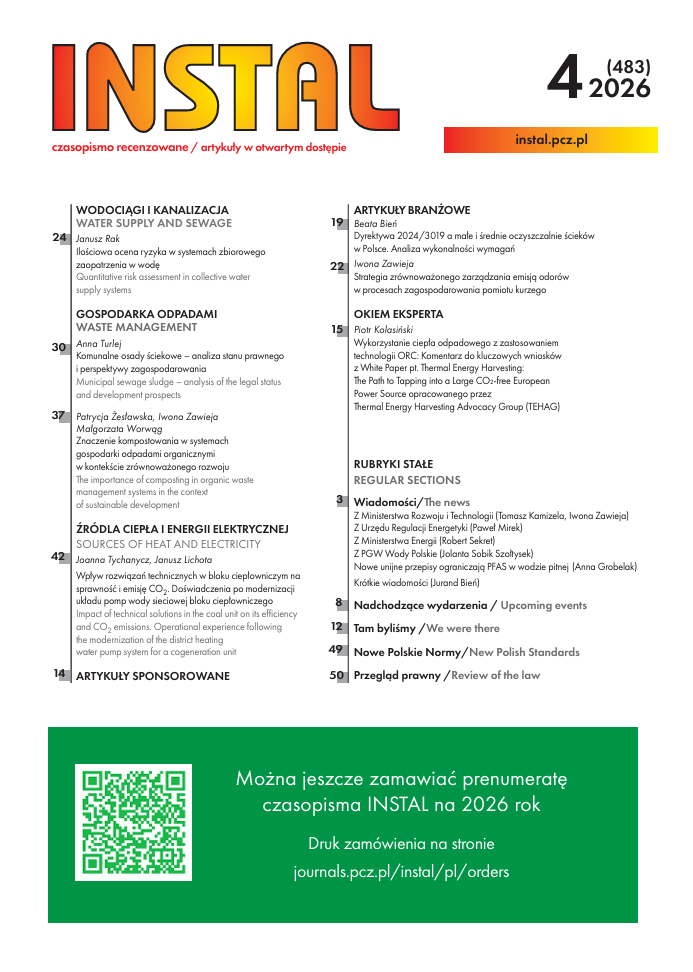
Quantitative risk assessment in collective water supply systems
DOI:
https://doi.org/10.17512/instal.2026.04.01Keywords:
milli-risk, micro-risk, nano-risk, health risk, water supplyAbstract
Risk assessment is the basis for managing technical systems from a safety perspective. The classical quantitative definition of risk is based on the probability of an undesirable event P multiplied by the associated losses C. Assuming C = 1 for fatalities, risk can be expressed as the probability of an undesirable event occurring. The aim of the study was to analyze the numerical values of risk, taking into account milli-risk (mr = 10-3), micro-risk (µr = 10-6), and nano-risk (nr = 10-9). The health risk associated with water supply use is addressed, including fatalities, chronic health impairment, and gastrointestinal complaints. Values for both individual and group risk are also presented. This paper is a review and covers standards for quantitative risk assessment related to water intended for human consumption. Health risk analysis can be used during the implementation of the Water Safety Plan.
Downloads
References
[1] Słownik języka polskiego. Wydawnictwo PWN. Warszawa 2005.
[2] Rak. J.R.: Istota ryzyka w funkcjonowaniu systemów zaopatrzenia w wodę. Oficyna Wydawnicza Politechniki Rzeszowskiej. Rzeszów 2004.
[3] Rak J.R.: Podstawy bezpieczeństwa systemów zaopatrzenia w wodę. Monografie Komitetu Inżynierii Środowiska Polskiej Akademii Nauk.vol.28. Lublin 2005.
[4] Wieczysty A. i inni: Metody oceny i podnoszenia niezawodności działania komunalnych systemów zaopatrzenia w wodę. Monografie Komitetu Inżynierii Środowiska PAN. Kraków 2001.
[5] EN 15975-1:2011+A1:2016; Security of Drinking Water Supply—Guidelines for Risk and Crisis Management—Part 1: Crisis Management. European Committee for Standardization: Brussels, Belgium, 2016.
[6] EN 15975-2:2013; Security of Drinking Water Supply. Guidelines for Risk and Crisis Management Risk Management. European Committee for Standardization: Brussels, Belgium, 2013.
[7] Dyrektywa Parlamentu Europejskiego i Rady (UE) 2020/2184 z dnia 16 grudnia 2020 r. w sprawie jakości wody przeznaczonej do spożycia przez ludzi. Dz.U. UE L 435 z 23.12.2020.
[8] World Health Organization (WHO). 2022. Guidelines for drinking-water quality: fourth edition incorporating the first and second addenda, Geneva: World Health Organization.
[9] Haas Ch.N., Rose J.B., Gerba Ch.P.: Quantitative microbial risk assessment. John Wiley & Sons, 2014. DOI:10.1002/9781118910030.
[10] Elliott J.G., Taylor-Edmonds L., Andrews R.C.: Quantitative microbial risk assessments for drinking water facilities: evaluation of a range of treatment strategies. Environmental Science: Water Research & Technology, 2019, 5, 1943-1955. https://doi.org/10.1039/C9EW00348G.https://doi.org/10.1039/C9EW00348G
[11] Smeets P.W., Rietveld L.C., van Dijk J.C., Medema G.J.: Practical applications of quantitative microbial risk assessment (QMRA) for water safety plans. Water Science and Technology, 2010, 61(6), 1561-1568. doi: 10.2166/wst.2010.839.
[12] Petterson S.R., Ashbolt N.J.: QMRA and water safety management: review of application in drinking water systems. Journal of Water and Health, 2016, 14(4), 571-589. doi: 10.2166/wh.2016.262.
[13] Taghipour M., Sylvestre É., Shakibaeinia A., Tolouei S., Kammoun R., Prévost M., Dorner S.: Quantitative microbial risk assessment for drinking water intake threat prioritization: a comparison of vulnerability and threat assessment according to source water protection regulations of two Canadian provinces, Environmental Challenges, 20, 2025, 101193, https://doi.org/10.1016/j.envc.2025.101193.
[14] Hamouda M.A., Jin X., Xu H., Chen F.: Quantitative microbial risk assessment and its applications in small water systems: A review. Science of the Total Environment, 2018, 645, 993-1002. https://doi.org/10.1016/j.scitotenv.2018.07.228
[15] Cheng Y., Wei-di W., Rui-ning W., Tian-nuo L., Wajid A., Shan-shan H., Sai L., Xiang L., Zaheer Ahmad N., Frederic C.: Quantitative health risk assessment of microbial hazards from water sources for community and self-supply drinking water systems, Journal of Hazardous Materials, 465, 2024, https://doi.org/10.1016/j.jhazmat.2023.133324.
[16] Zimoch I.: Hazardous event analysis of microbiological contamination in risk management of large water supply systems, Desalination and Water Treatment, 247, 2022, 72-81, https://doi.org/10.5004/dwt.2022.27879.
[17] Jurczynski Y., Passos R., Campos L.C.: A Review of the Most Concerning Chemical Contaminants in Drinking Water for Human Health. Sustainability 2024, 16, 7107. https://doi.org/10.3390/su16167107.
[18] Wang L., Fang Z., Zhou X., Cheng K., Ren Y., Li C., Gao B., Lv Y., Xu S., Xu H.: Health risk assessment via ingestion of disinfection by-products in drinking water. Scientific Reports, 2025, 15(1), 1793. doi: 10.1038/s41598-024-84094-9.
[19] Santos A.M., Coutinho J.J., Soares S.A.R., Oliveira O.M.C.d., Queiroz A.F.S., Lemos V.A., FerreiraS.L.C.: Health Risk Assessment of Chemical Elements in Drinking Water Consumed in a Brazilian City Impacted by Mining Activities. Water 2026, 18, 230. https://doi.org/10.3390/w18020230.
[20] Domoń A., Kowalska B., Papciak D., Wojtaś E., Kamińska I.: Safety of Tap Water in Terms of Changes in Physical, Chemical, and Biological Stability. Water 2024, 16, 1221. https://doi.org/10.3390/w16091221.
[21] Zio E.: An Introduction to the Basics of Reliability and Risk Analysis. World Scientific Publishing, Singapore, 2007.
[22] Aven T.: On how to define, understand and describe risk. Reliability Engineering & System Safety, 2010, 95(6), 623-631. https://doi.org/10.1016/j.ress.2010.01.011.https://doi.org/10.1016/j.ress.2010.01.011
[23] Ross S. M.: Introduction to Probability Models. Academic Press, Amsterdam–Boston, 2014.
[24] Aven T.: Risk analysis. John Wiley & Sons, 2015.
[25] Howard, R.A.: On Making Life and Death Decisions. In: Schwing, R.C., Albers, W.A. (eds) Societal Risk Assessment. General Motors Research Laboratories. Springer 1980, Boston, MA. https://doi.org/10.1007/978-1-4899-0445-4_5
[26] Health and Safety Executive (HSE): Reducing Risks, Protecting People. HSE’s Decision-Making Process. HSE Books, Norwich, 2001.
[27] ISO 31000:2018. Zarządzanie ryzykiem - Wytyczne (Risk management - Guidelines). International Organization for Standardization, Geneva, 2018.
[28] Rak J. Tchórzewska-Cieślak B., Studziński A., Pietrucha-Urbanik K., Boryczko K. Niezawodność i bezpieczeństwo systemów zbiorowego zaopatrzenia w wodę. Oficyna Wydawnicza Politechniki Rzeszowskiej, Rzeszów 2012.
Downloads
Published
License
Copyright (c) 2026 Janusz Rak (Autor)

This work is licensed under a Creative Commons Attribution 4.0 International License.
Authors retain copyright and grant the journal the right of first publication, with the work simultaneously licensed under a Creative Commons Attribution 4.0 International License, which permits others to share the work with appropriate acknowledgment of the authorship and initial publication in this journal.