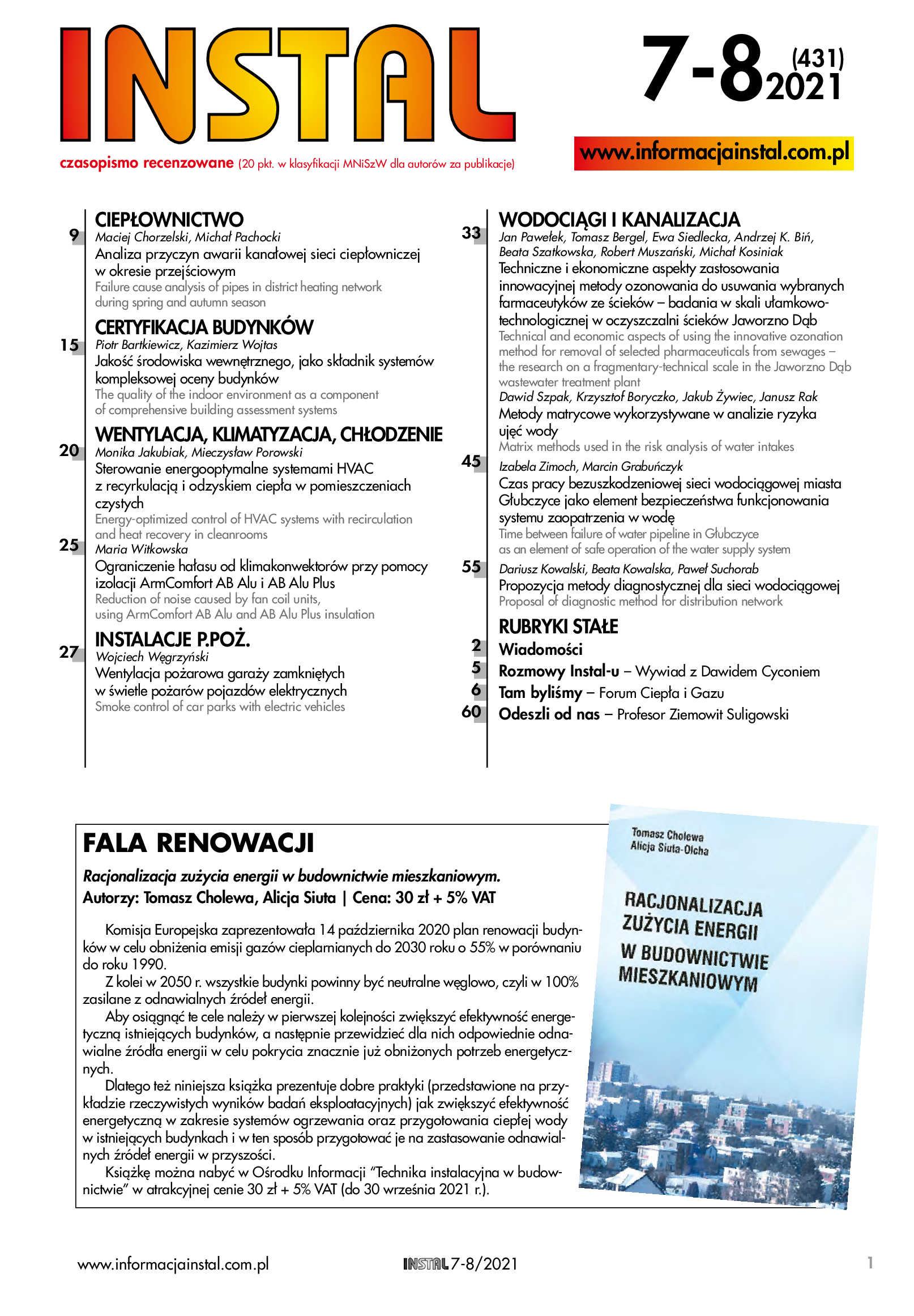
Technical and economic aspects of using the innovative ozonation method for removal of selected pharmaceuticals from sewages – the research on a fragmentary-technical scale in the Jaworzno Dąb wastewater treatment plant
DOI:
https://doi.org/10.36119/15.2021.7-8.5Keywords:
sewage, pharmaceuticals, ozone, energy consumptionAbstract
This paper focused on the technological efficiency of removal the pharmaceuticals, inluding diclofenac, carbamazepine and sulphametoxazole from the sewages with the use of innovative ozone technology. The research was conducted for 9 months at a pilot research station (a capacity of 2 to 5 m3/hr) on the site of Dąb sewage treatment plant in Jaworzno. It was found that the average reduction of the pharmaceuticals at individual ozone doses (6.0; 6.4 and 7.2 g O3 ∙ m-3) was as follows: for diclofenac – 89,3; 94,9; 96,4%; for carbamazepine – 88.7; 92.5; 96.3% and for sulfamethaxazole – 68.2; 81.2; 92.6%. Moreover, in this paper also the reduction of the basic pollution indicators: BOD and COD was analyzed. In order to answer the question of whether there is a practical justification in the use of the proposed technologial layout for this pro cess, there was carried the analysis of energy consumption that is the largest cost factor at removal of pharmaceuticals. It was analyzed for the volume of 1 m3 of treated sewages. The average energy consumption was 0.96 kWh ∙ m-3.
Downloads
References
Mao D., Yu S., Rysz M., Luo Y., Yang F., Li F., Prevalence and proliferation of antibiotic resistance genes in two municipal wastewater treatment plants. Water Res. 85, 458–466. https://doi.org/10.1016/j.watres.2015.09.010.
Antoniou M.G., Hey G., Vega S.R., Spiliotopoulou A., Fick J., Tysklind M., la Cour Jansen J., Andersen H.R., Required ozone doses for removing pharmaceuticals from wastewater effluents. Science of the Total Environment, 2013, 456–457, 42–49.
Huber M.M., Göbel A., Joss A., Hermann N., Löffler D., McArdell Ch.S., Ried A., Siegrist H.R., Ternes Th.A., von Gunten U., Oxidation
of pharmaceuticals during ozonation of municipal wastewater effluents: A pilot study. Environmental Science & Technology, 2005, 39, 4290-4299.
Downloads
Published
License

This work is licensed under a Creative Commons Attribution 4.0 International License.
Authors retain copyright and grant the journal the right of first publication, with the work simultaneously licensed under a Creative Commons Attribution 4.0 International License, which permits others to share the work with appropriate acknowledgment of the authorship and initial publication in this journal.