
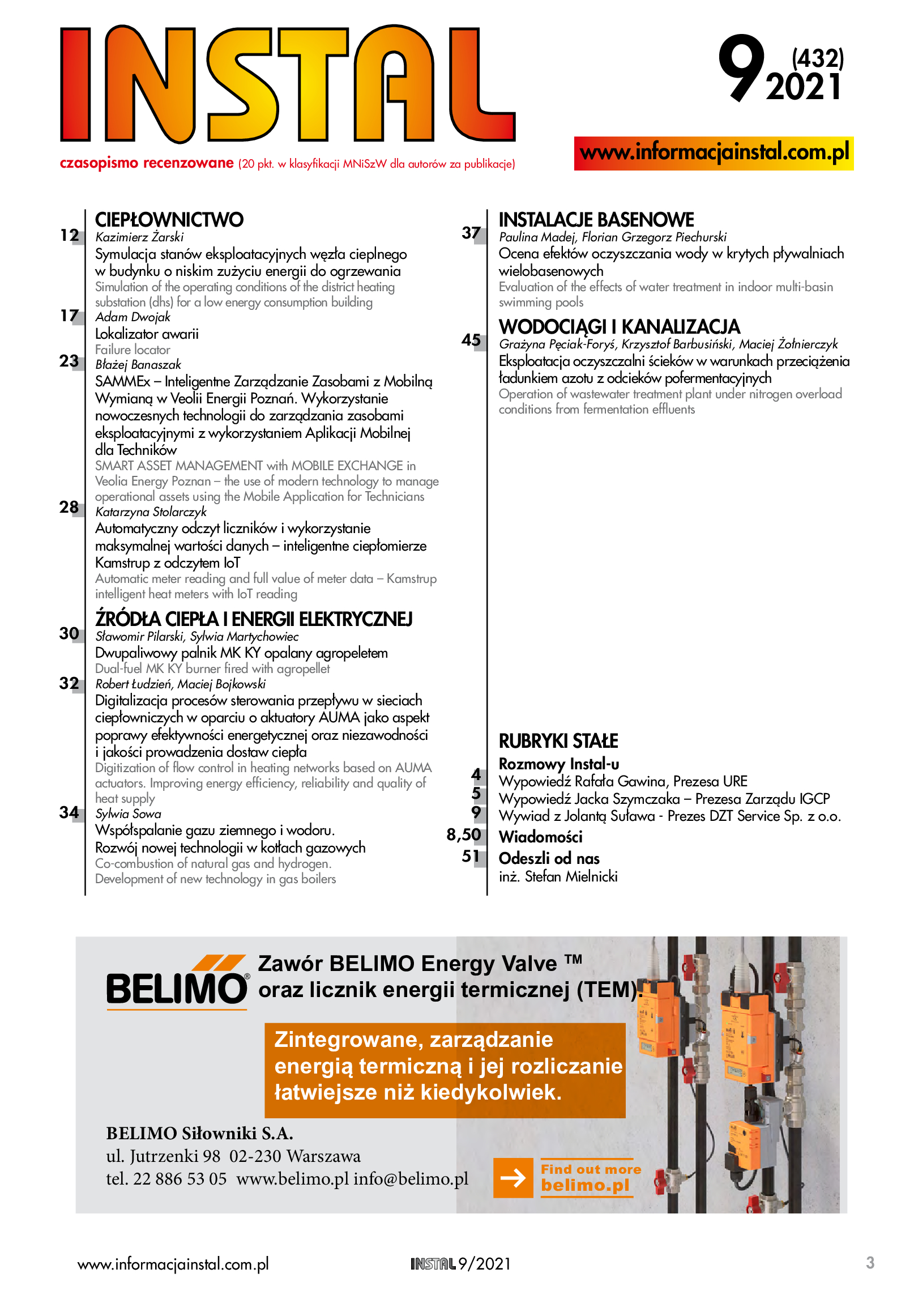
Simulation of the operating conditions of the district heating substation (dhs) for a low energy consumption building
DOI:
https://doi.org/10.36119/15.2021.9.1Keywords:
district heating substation, domestic warm water priority, simulation hour by hour, variation of mass flowAbstract
Law regulations in Poland require the design of buildings and their infrastructure with energy saving principles and rationality. Energy consumption (heat load) for heating buildings that meet the high standard of thermal protection is much lower than the demand of heat flux for preparing hot water, even if the conditions of the 20-minute demand are used as a reliable condition for the selection of the heat exchanger. The article presents the results of simulation of the operating conditions of a heat exchanger substation in a residential building with 18 apartments at 3 selected climatic conditions of the heating season. It has been shown that a DHS in a building with a high standard of thermal protection is characterized by a high daily variability of mass flow in a district heating network. There is a small variability of the maximum daily mass flow in a year.
Downloads
References
Żarski K.: „Charakterystyka cieplna i hydrauliczna wymienników płytowych w układach przygotowania ciepłej wody”, XIII Konferencja Ciepłowników „Efektywność dystrybucji i wykorzystania ciepła”, Rzeszów-Jawor 27-29.09. 2001 r.
Żarski K.: “Influence of heat gains in building on pumping energy consumption in boiler plant”, China-USA Business Reviev, No 3/2014, p. 206-215
Rozporządzenie Ministra Inwestycji i Rozwoju z dnia 7 czerwca 2019 r. w sprawie warunków technicznych, jakim powinny odpowiadać budynki i ich usytuowanie (Dz, U. poz. 1065)
Downloads
Published
License

This work is licensed under a Creative Commons Attribution 4.0 International License.
Authors retain copyright and grant the journal the right of first publication, with the work simultaneously licensed under a Creative Commons Attribution 4.0 International License, which permits others to share the work with appropriate acknowledgment of the authorship and initial publication in this journal.