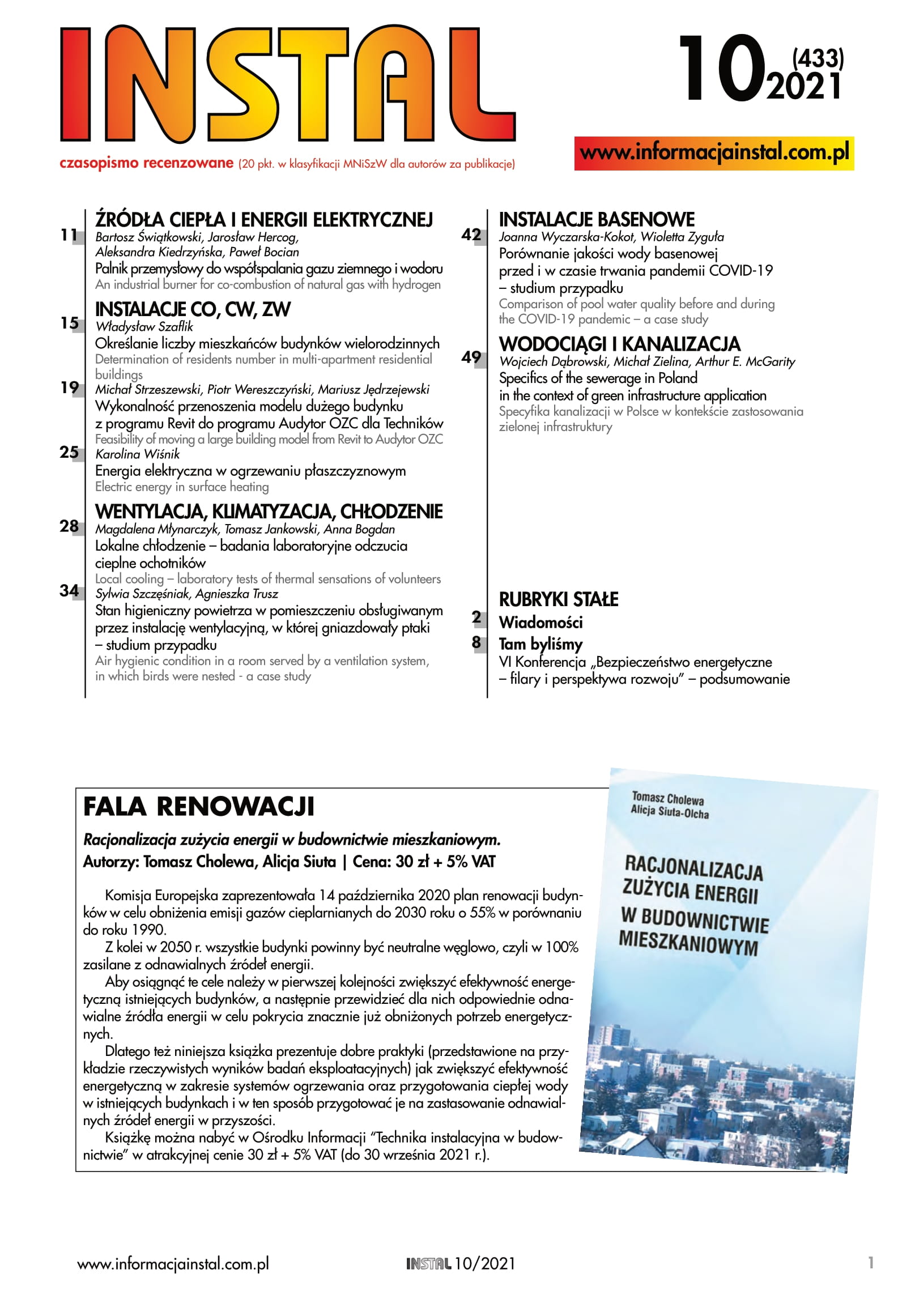
Air hygienic condition in a room served by a ventilation system, in which birds were nested - a case study
DOI:
https://doi.org/10.36119/15.2021.10.6Keywords:
UV-C radiation, air sterilisation, portable disinfection unitsAbstract
The article presents the results of microbiological tests carried out in the exhaust duct where the birds were nesting, in the air handling unit and in the room it serves. The research was carried out in order to determine the hygienic condition of the air in the room served by the ventilation system in which the birds nested. The effectiveness of a portable device for
disinfecting air in rooms, which uses UV-C radiation of overstandard power 330 W, was also tested.
Downloads
References
R. Górny, „Biologiczne czynniki szkodliwe: normy, zalecenia i propozycje.,” Podstawy i Metody Oceny Środowiska Pracy, pp. 17-39, 2004.
N. E. Klepeis,, W. C. Nelson, W. R. Ott, J. P. Robinson, A. M. Tsang, P. Switzer, J. V. Behar, S. C. Hern I W. H. Engelmann, „The National Human Activity Pattern Survey (NHAPS): a resource for assessing exposure to environmental pollutants,” Journal of Exposure Analysis and Environmental Epidemiology, pp. 231-252, 2001.
M. Gołofit-Szymczak, A. Ławniczek-Wałczyk i R. Górny, „Bioaerozole w pomieszczeniach.,” Bezpieczeństwo Pracy, pp. 9-11, 2013
Downloads
Published
Issue
Section
Categories
License

This work is licensed under a Creative Commons Attribution 4.0 International License.
Authors retain copyright and grant the journal the right of first publication, with the work simultaneously licensed under a Creative Commons Attribution 4.0 International License, which permits others to share the work with appropriate acknowledgment of the authorship and initial publication in this journal.