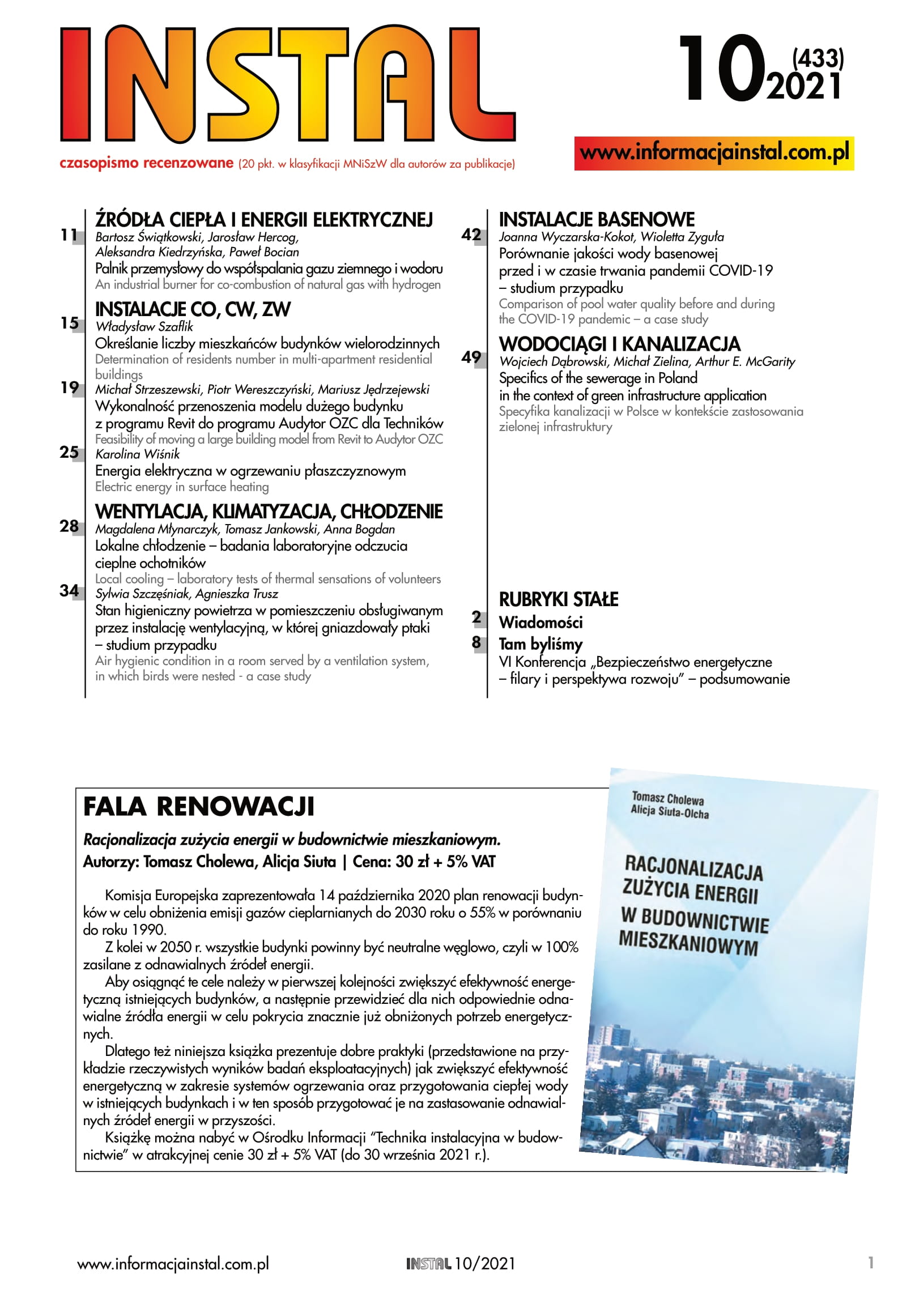
Determination of residents number in multi-apartment residential buildings
DOI:
https://doi.org/10.36119/15.2021.10.2Keywords:
multi-apartment residential buildings, number of residents in multi-apartment residential buildings,, number of residents in apartmentsAbstract
In order to determine the daily water consumption in a multi-apartment residential building, the number of residents must be determined. The paper presents a method of determining the number of residents with a specific probability of occurrence. It was assumed that the average number of residents in a multi-apartment residential building inhabiting a single apartment, is a random variable with a normal distribution with the expected value ml and standard deviation Sml . Then, based on those assumptions, the distribution parameters of the number of residents inhabiting a single apartment were determined. The number of residents determined in 2019 of sixty-five residential buildings located in several districts in Szczecin in one of the housing cooperatives were used for the calculations. By knowing the distribution parameters, it was possible to determine the population of a residential building depending on the probability. The population was calculated for probability of occurring of 90%, 95% and 99% in relation to the number of residents in the building. The obtained results are presented in the figures.
Downloads
References
Beniamin J. R., Cornell C. A.: Probability, Statistics and Decision for Civil Engineers. Mc Graw-Hill, 1970
Jaszewska M., Szaflik W.: Zużycie ciepłej i zimnej wody w gospodarstwach domowych w Szczecinie w latach 2006 – 2019. INSTAL 4/2020, str. 22-25, DOI
10.36119/15.2020.4.4
Szaflik W.: Bilansowanie zapotrzebowania na ciepłą wodę do określania układów jej przygotowania. Materiały IV krajowej Konferencji Modernizacja Miejskich Systemów Ciepłowniczych w Polsce, Międzyzdroje, 18-20 września 1995, str. 214 – 219
Downloads
Published
Issue
Section
Categories
License

This work is licensed under a Creative Commons Attribution 4.0 International License.
Authors retain copyright and grant the journal the right of first publication, with the work simultaneously licensed under a Creative Commons Attribution 4.0 International License, which permits others to share the work with appropriate acknowledgment of the authorship and initial publication in this journal.