
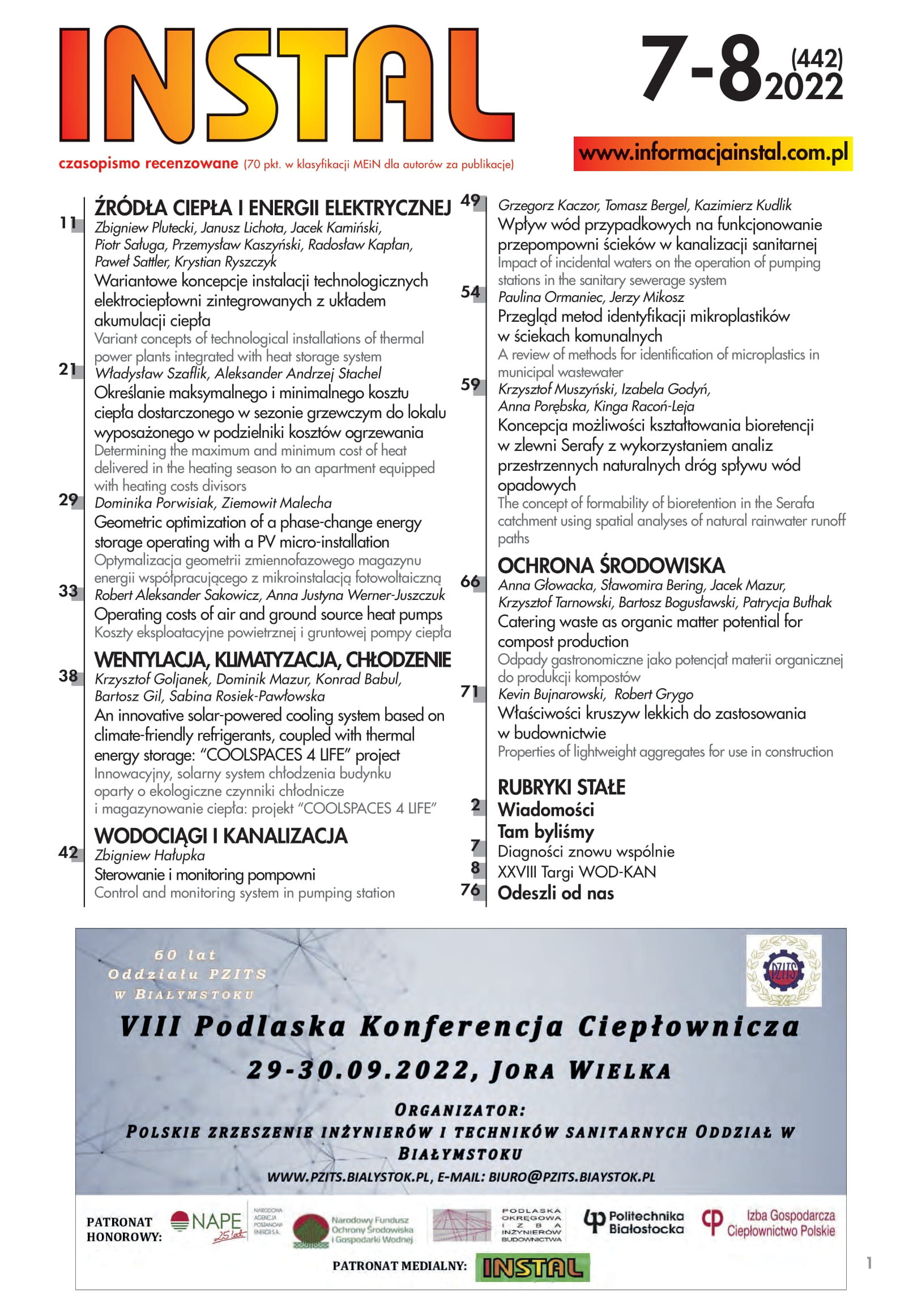
Impact of incidental waters on the operation of pumping stations in the sanitary sewerage system
DOI:
https://doi.org/10.36119/15.2022.7-8.6Keywords:
sanitary sewerage system, wastewater, pumping stations, incidental watersAbstract
The study, which included a 7-month period of observation during dry and wet weather, analysed the operation of three wastewater pumping stations working in a selected gravity sewer network located in the southern part of the Małopolskie Province. The aim of the study was to analyse the hydraulic loads on wastewater pumping stations with incidental waters. The study analysed parameters characterising the operation of the pumping station, such as the volume of pumped incidental waters, the number of pump starts, their operating time, energy consumption and the resulting carbon footprint. During the entire study period, a total of 205 m3 of incidental waters flowed into the P1 pumping station, 187.8 m3 into the P2 pumping station, and 99.8 m3 of these waters into the P3 pumping station. The share of incidental waters in the inflow to all analysed pumping stations was almost identical and accounted for about 25%. The incidental waters caused a significant increase in the number of pumps started at the analysed pumping stations. This was between 32 and 95 more switches per month. Depending on the pumping station, the monthly operating time of the pumps, due to the pumping of incidental waters, has increased from 0.6 to 1.1 hours. Research has shown that between 4.8 and 10.8 kg more CO2 may be released into the environment each year due to the energy used to pump incidental waters mixed with the wastewater.
Downloads
References
R. Pecher, „Wody przypadkowe w kanalizacji – Problem gospodarki wodnej”, Gaz, Woda Technika Sanitarna, Nr 12, s. 1–6, 1999.
G. Weiss, H. Brombach, B. Haller, „Infiltration and inflow in combined sewer systems: long – term analysis”, Water Science & Technology, vol. 45 (7), s. 227–230, 2002.
J. B. Ellis, J. Bertrand-Krajewski, „Assessing Infiltration and Exfiltration on the Performance of Urban Sewer Systems”, IWA Publishing, UK, London, pp. 200, 2010.
Downloads
Published
License

This work is licensed under a Creative Commons Attribution 4.0 International License.
Authors retain copyright and grant the journal the right of first publication, with the work simultaneously licensed under a Creative Commons Attribution 4.0 International License, which permits others to share the work with appropriate acknowledgment of the authorship and initial publication in this journal.