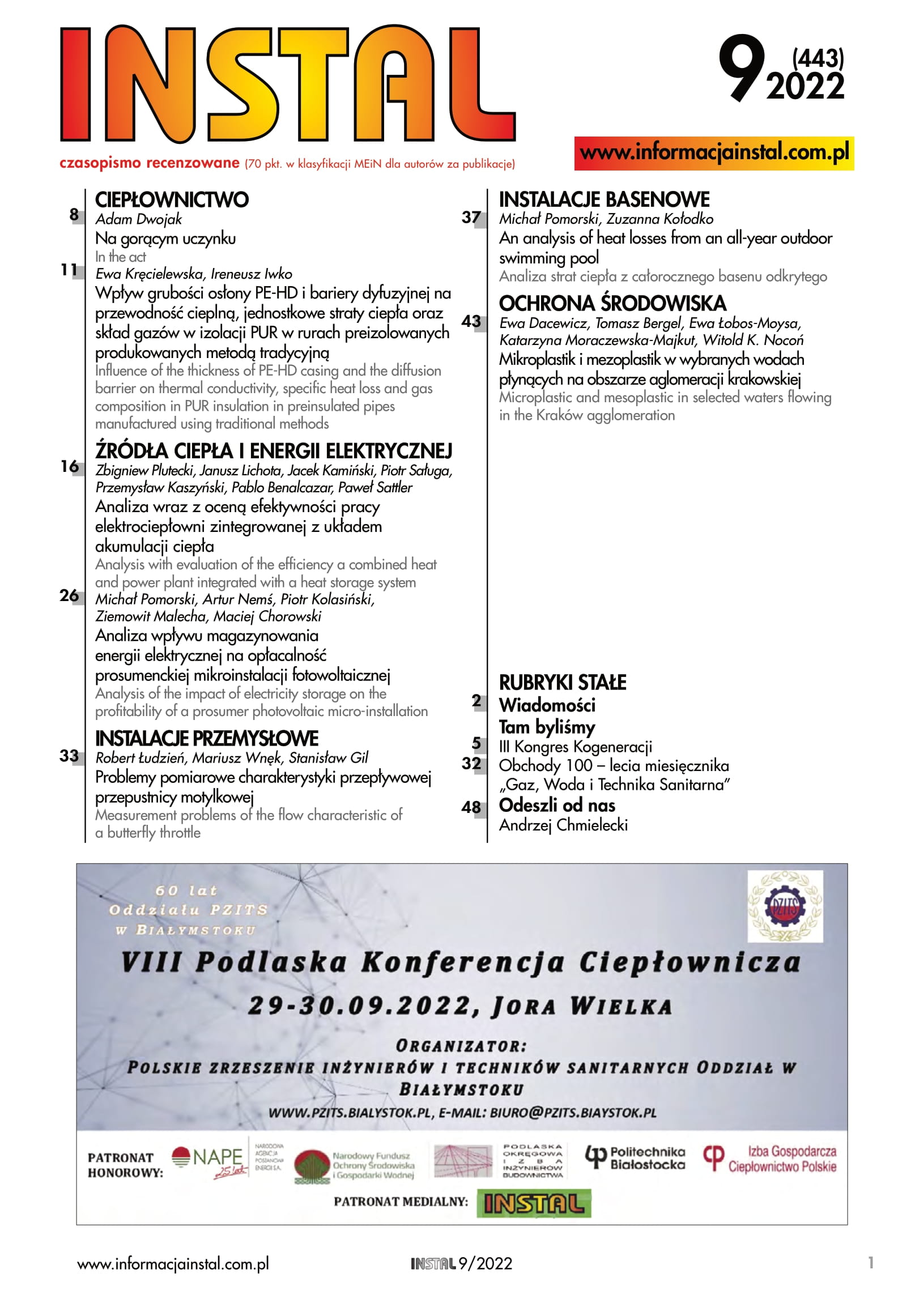
Microplastic and mesoplastic in selected waters flowing in the Kraków agglomeration
DOI:
https://doi.org/10.36119/15.2022.9.5Keywords:
microplastic, mesoplastic, surface water, stagnationAbstract
In the article, the assessment of the occurrence of plastic particles in the reservoirs of the Vistula River flowing through the Krakow agglomeration was made. In the collected water samples, the presence of plastic particles according to their origin, size, color and shape was determined. The presence of plastic particles in all the tested stagnations was found. Based on the size, two main groups were distinguished, i.e. microplastic and mesoplastic. Due to the color of the particles, six main groups of plastic are distinguished: white, black, red, blue, gray and others. In terms of shape, the plastic particles are classified into five groups, i.e. foil, granules, flakes, scraps and fibers.
Downloads
References
https://plasticseurope.org, dostęp 08.04.2022
https://inwestycje.pl/gospodarka/popyt-na-tworzywa-sztuczne-w-polsce-wzrosl-o-3-4-r--r-w-2020/, dostęp 08.04.2022
www.plasticseurope.org, dostęp 20.03.2021
Mintenig S.M., Int-Veen I., Löder M. G.,Primpke S., Gerdts G. (2017). Identification of microplastic in effluents of waste water treatment plants using focal plane array-based micro-Fourier-transform infrared imaging. Water Research, 108, s. 365-372. https://doi.org/10.1016/j.watres.2016.11.015
https://www.plasticseurope.org/en/resources/publications/4312-plastics-facts-2020, dostęp 20.03.2022.
[6] Simon M., van Alst N., Vollertsen, J. (2018). Quantification of microplastic mass and removal rates at wastewater treatment plants applying Focal Plane Array (FPA)-based Fourier Transform Infrared (FT-IR) imaging. Water Research, 142, s. 1-9. https://doi.org/10.1016/j.watres.2018.05.019
Downloads
Published
License

This work is licensed under a Creative Commons Attribution 4.0 International License.
Authors retain copyright and grant the journal the right of first publication, with the work simultaneously licensed under a Creative Commons Attribution 4.0 International License, which permits others to share the work with appropriate acknowledgment of the authorship and initial publication in this journal.