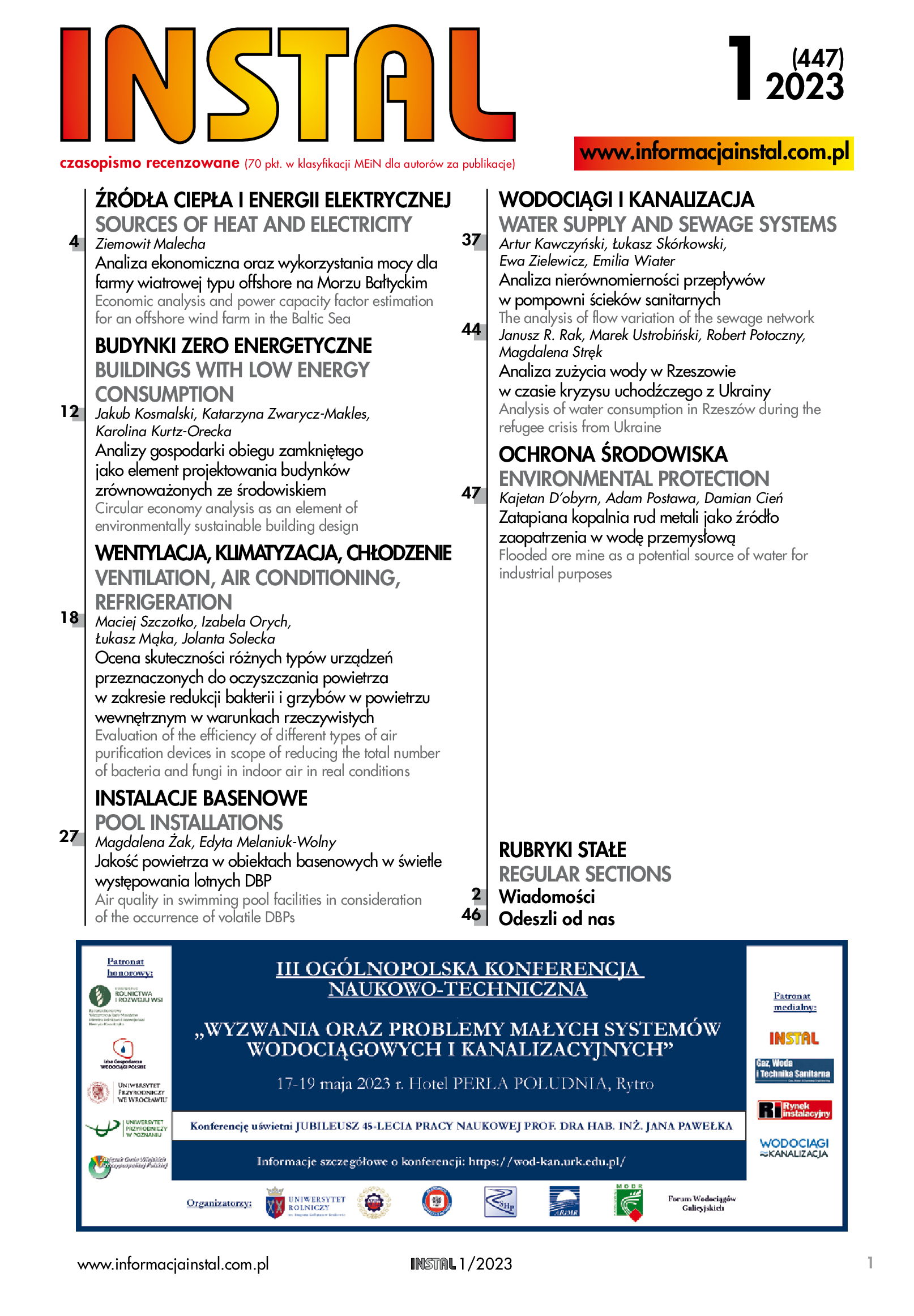
Evaluation of the efficiency of different types of air purification devices in scope of reducing the total number of bacteria and fungi in indoor air in real conditions
DOI:
https://doi.org/10.36119/15.2023.1.3Keywords:
indoor air, airborne bacteria, airborne fungi, air purifiers, microbial air contaminationAbstract
This article presents results of research on the effectiveness of three types of air purification devices in scope of reducing the total number of bacteria and the total number of fungi. The tested devices used the following purification technologies: Device A - cold plasma generator and mechanical air filtration, Device B - multi-stage mechanical filtration and photocatalysis process, Device C - UV-C flow lamp with carbon filter. The total number of bacteria and fungi in air samples was determined using impact method. The measurements were performed before the devices started to work, during air purification and after the end of the process. The analyzes were carried out in real conditions: one device was used in a pre-Intensive Care Unit room at the Accident and Emergency hospital department, the two others were tested in office rooms. Obtained results show, that the effectiveness of air purifiers in reduction of the total number of bacteria and fungi tested in real conditions was lower than the effectiveness declared by purifier manufacturers. The use of air purifiers to improve indoors air microbiological quality should always be preceded by the appropriate selection of the device. It should take into account the parameters of the target room and the number of people staying in it.
Downloads
References
Fields, B.S.; Benson, R.F.; Besser, R.E. Legionella and Legionnaires’ Disease: 25 years of investigation. Clin. Microbiol. Rev. 2002, 15, 506–526; DOI: 10.1128/CMR.15.3.506-526.2002.
Douwes, J.; Thorne, P.; Pearce, N.; Heederik, D. Bioaerosol health effects and exposure assessment: Progress and prospects. Ann. Occup. Hyg. 2003, 47: 187–200; DOI: 10.1093/annhyg/meg032.
Li, Y.; Leung, G.M.; Tang, J.W.; Yang, X.; Chao, C.Y.H.; Lin, J.Z; Lu, J.W; Nielsen, P.V.; Niu, J.; Qian, H.; Sleigh, A.C.; Su, H.-J.J.; Sundell, J.; Wong, T.W.; Yuen, P.L. Role of ventilation in airborne transmission of infectious agents in the built environment – a multidisciplinary systematic review. Indoor Air. 2007, 17: 2–18; DOI: 10.1111/j.1600-0668.2006.00445.x
Downloads
Published
Issue
Section
Categories
License

This work is licensed under a Creative Commons Attribution 4.0 International License.
Authors retain copyright and grant the journal the right of first publication, with the work simultaneously licensed under a Creative Commons Attribution 4.0 International License, which permits others to share the work with appropriate acknowledgment of the authorship and initial publication in this journal.