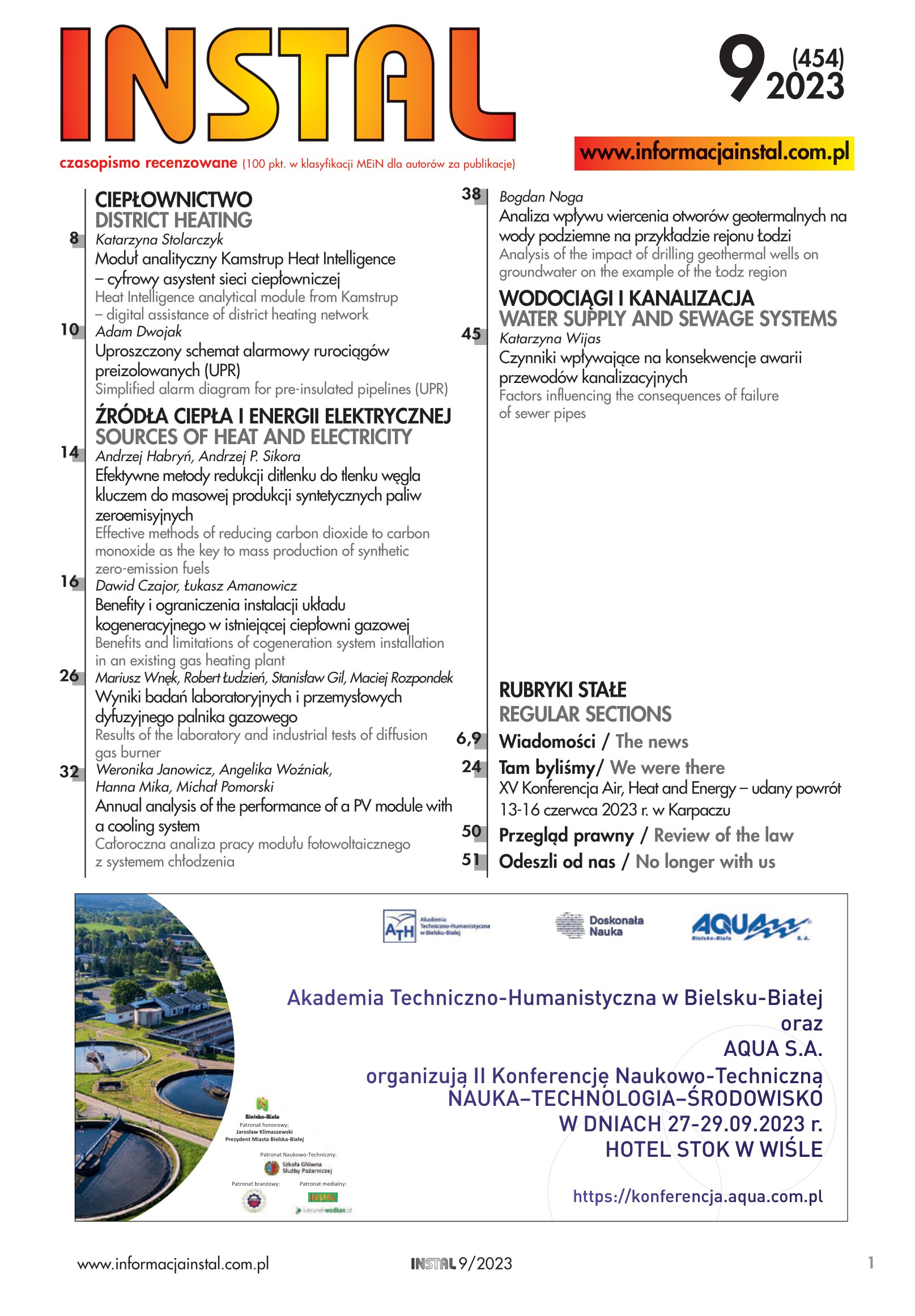
Analysis of the impact of drilling geothermal wells on groundwater on the example of the Łodz region
DOI:
https://doi.org/10.36119/15.2023.9.4Keywords:
geothermal, geothermal borehole, geothermal heat, geothermal installationAbstract
The article presents an analysis of the possibility of groundwater (mainly thermal water) up to a depth of 2,800 meters located in the Lodz area. During the drilling of a geothermal well, several aquifers are drilled and in the Lodz region, the highest aquifers contain water for drinking purposes for the city of Lodz. The work was created as a result of emerging theories that the exploitation of thermal waters located at a depth of about 2,800 meters could affect the contamination of drinking water located at a depth of about 800. To dispel any doubts in this regard, the process of drilling a geothermal well was analyzed. The absence of the possibility of mixing of water from the various aquifers, both at the stage of drilling the well and during its subsequent operation, is ensured by a properly designed and constructed geothermal well.
Downloads
References
Biernat H., Kulik S., Noga B., Kosma Z.: Problemy korozji przy zatłaczaniu wykorzystanych wód termalnych, Modelowanie Inżynierskie 39, 2010, 13 – 18.
Dayczak-Calikowska K.: Stratygrafia, litologia, paleogeografia. Jura środkowa. W: Budowa geologiczna niecki szczecińskiej i bloku Gorzowa, Prace IG 1979, XCVI, 57–62.
Dayczak-Calikowska K.: Jura środkowa. W: Budowa geologiczna wału pomorskiego i jego podłoża, Prace IG 1987, CXIX, 116–123.
Downloads
Published
License

This work is licensed under a Creative Commons Attribution 4.0 International License.
Authors retain copyright and grant the journal the right of first publication, with the work simultaneously licensed under a Creative Commons Attribution 4.0 International License, which permits others to share the work with appropriate acknowledgment of the authorship and initial publication in this journal.