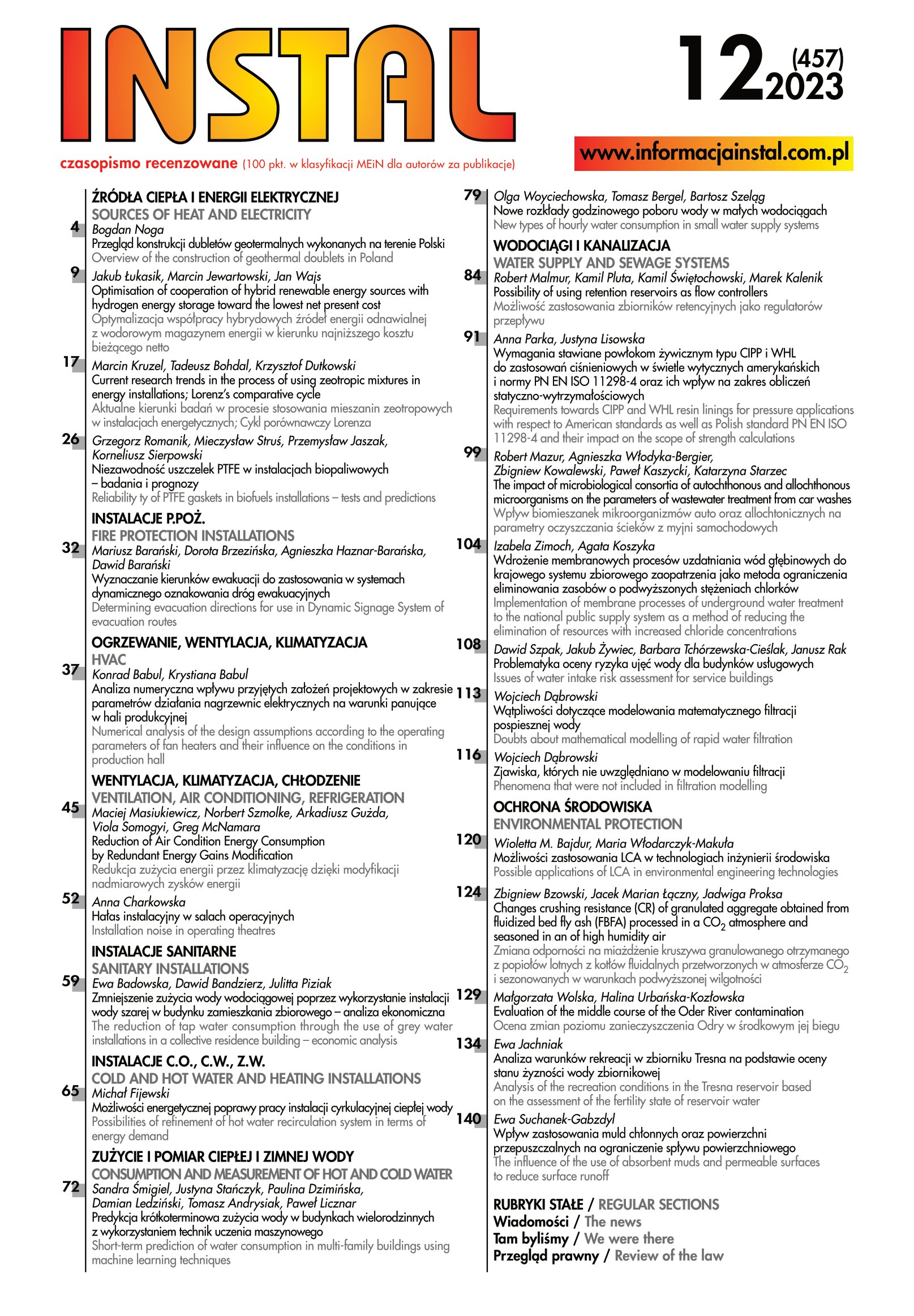
Reduction of Air Condition Energy Consumption by Redundant Energy Gains Modification
DOI:
https://doi.org/10.36119/15.2023.12.7Keywords:
building air-conditioning, energy consumption, energy saving, heat gainsAbstract
For a selected building in a specific location and conditions encountered, heat gains from sun exposure, resident people, equipment, lighting, and window partitions were calculated depending on the time of day (hourly for a year), the number, and the activity of people in the building. The heat and humidity balance was performed. This allowed the cooling and heating demand to be determined. The air conditioning system was adjusted to the demand. The operation of the system was simulated by showing the loads (hourly for a year). The load flexibility of the air conditioners was presented. Heat gains have been determined and ranked according to which has the greatest influence on the air conditioning load. Solutions were proposed to reduce the heat load in the building. As a result of the research, methods were presented for reducing the energy consumption of air conditioning by
modifying the factors causing redundant energy gains.
Downloads
References
DIRECTIVE (EU) 2018/2002 OF THE EUROPEAN PARLIAMENT AND OF THE COUNCIL of 11 December 2018 amending Directive 2012/27/EU on energy efficiency,” Official Journal of the European Union, 2018. .
DIRECTIVE 2012/27/EU OF THE EUROPEAN PARLIAMENT AND OF THE COUNCIL of 25 October 2012 on energy efficiency, amending Directives 2009/125/EC and 2010/30/EU and repealing Directives 2004/8/EC and 2006/32/EC,” Official Journal of the European Union, 2012. .
COMMUNICATION FROM THE COMMISSION TO THE EUROPEAN PARLIAMENT, THE COUNCIL, THE EUROPEAN ECONOMIC AND SOCIAL COMMITTEE, THE COMMITTEE OF THE REGIONS AND THE EUROPEAN INVESTMENT BANK A Framework Strategy for a Resilient Energy Union with a Forward-Looking C.
Downloads
Published
Issue
Section
Categories
License

This work is licensed under a Creative Commons Attribution 4.0 International License.
Authors retain copyright and grant the journal the right of first publication, with the work simultaneously licensed under a Creative Commons Attribution 4.0 International License, which permits others to share the work with appropriate acknowledgment of the authorship and initial publication in this journal.