
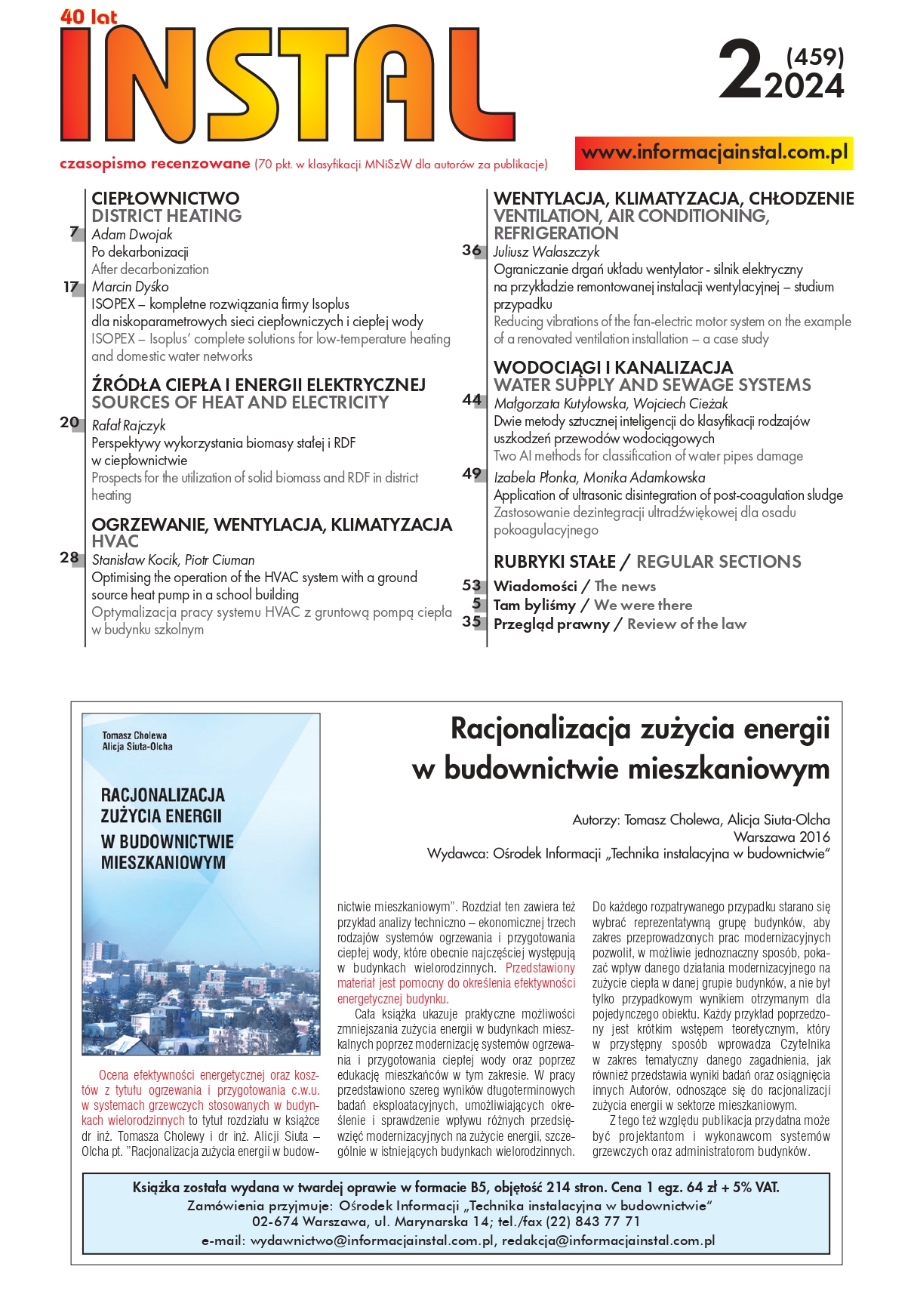
After decarbonization
DOI:
https://doi.org/10.36119/15.2024.2.1Keywords:
pre-insulated heating networks, surveillance systemAbstract
The article presents the problem of the failure rate of district heating networks, with particular emphasis on preinsulated technology. Nearly 60% of all networks that operate with this modern technology require a change in operating philosophy. The existing methods associated with the diagnosis of duct networks are not reflected in the case of pre-insulated pipelines, a different approach is required. An attempt is made to redefine the concept of heating pipeline failure and to define the rules for the organization of an enterprise focused on security of supply. Using practical examples, the author presents diagnostic methods and determines the usefulness of one of the two surveillance systems used in the Polish district heating industry. In terms of the service life of pre-insulated networks, the problem of operational negligence and the anticipated consequences of such behavior are illustrated in a vivid manner. The advantages and disadvantages of the two surveillance systems in place are presented, as well as
a pessimistic long-term outlook for the non-compliant.
Downloads
References
Urząd Regulacji Energetyki, „Energetyka Cieplna w liczbach – 2022, Warszawa październik 2023
Maciej Chorzelski, Michał Pachocki. „Analiza przyczyn awarii kanałowej sieci ciepłowniczej w okresie Przejściowym”. Instal 7-8/2021 str. 9 – 14. DOI 10.36119/15.2021.7-8.1.
Elektroniczny Zakład Usługowo – Produkcyjny LEVR, Instrukcja obsługi przyrządu LP10S ver. 17.05 str. 3
Materiały firmy Brandes „Ader-Einbauanweisung. Kunststoffmantelrohr (TH 70 004 0001F) str. 2-5
Downloads
Published
License

This work is licensed under a Creative Commons Attribution 4.0 International License.
Authors retain copyright and grant the journal the right of first publication, with the work simultaneously licensed under a Creative Commons Attribution 4.0 International License, which permits others to share the work with appropriate acknowledgment of the authorship and initial publication in this journal.