
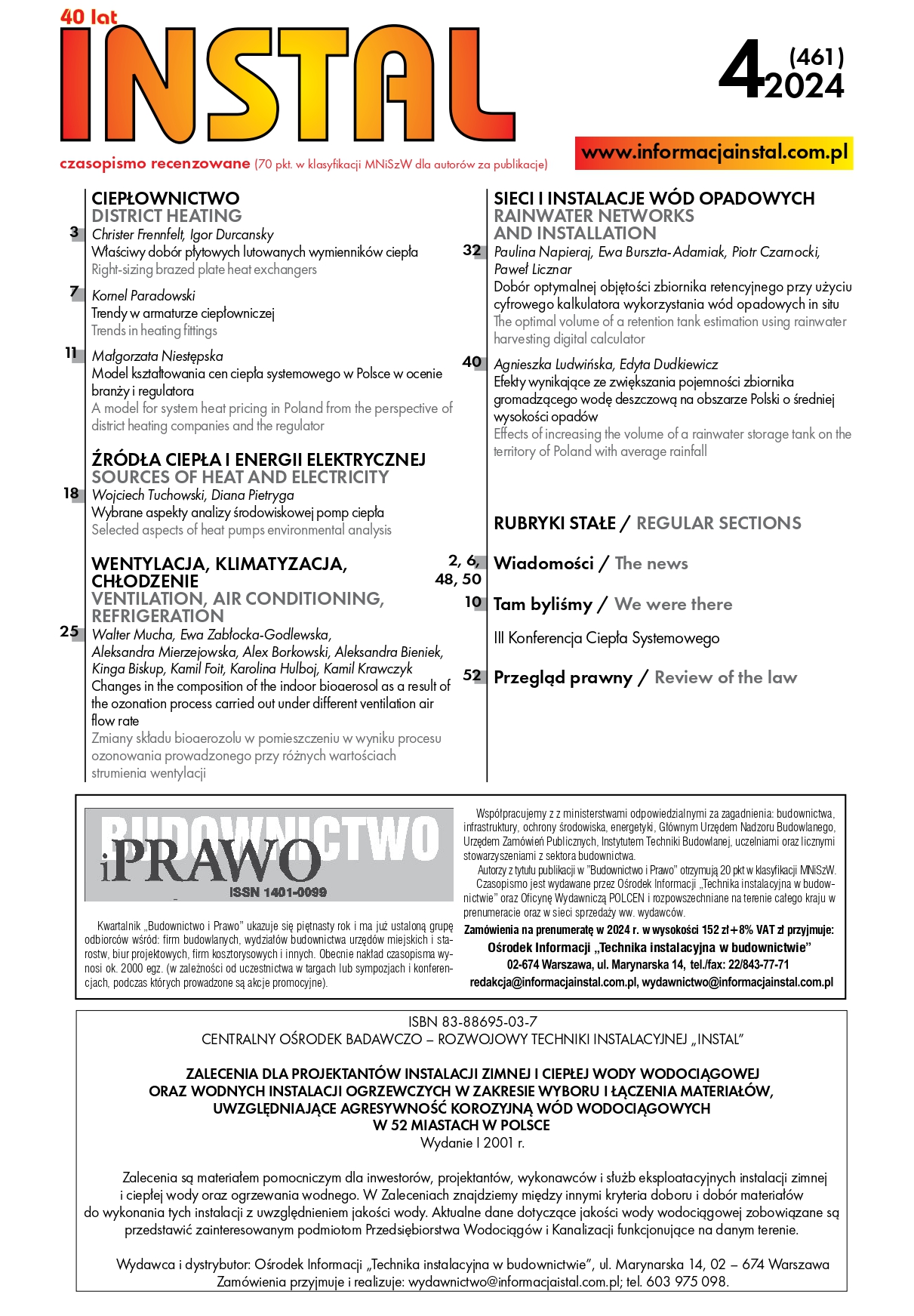
Effects of increasing the volume of a rainwater storage tank on the territory of Poland with average rainfall
DOI:
https://doi.org/10.36119/15.2024.4.5Keywords:
rainwater harvesting, single-family building, hourly rainfall distribution, rainwater distribution profile, precipitation in WrocławAbstract
In the case of the use of rainwater for domestic and gardening purposes in a single-family house, the capacity of rainwater, depending on the chosen calculation method, can be range from 5,000 l to 15,000 l. The threefold difference requires consideration of the benefits and effects of using tanks with different capacities. The paper analyses the performance of eleven rainwater storage tanks with different capacities depending on rainfall distribution and six profiles of rainwater distribution dynamics in a single-family house. The key is the inclusion of lawn watering or its absence. An innovative approach is the hourly step analysis, which showed that each 1,000 litre increase in tank capacity allows for an increase in water yield of 1 to 5%. The percentage of recovered rainwater in the total rainwater demand for the domestic and gardening purposes increases from 66% to 83%. Rainwater demand only for
washing and toilet flushing can be fully covered by using a tank with a capacity of 6,000 l.
Downloads
References
Amanowicz Ł., Wojtkowiak J., Comparison of single-and multipipe earth-to-air heat exchangers in terms of energy gains and electricity consumption: A case study for the temperate climate of central Europe, Energies. 14 (2021). https://doi.org/10.3390/en14248217.
Bator M., Piechurski F., Analiza kosztów systemu odzysku wody deszczowej dla budynku biurowego. Cost analysis of rainwater recovery system for an office building, Instal. 3 (2019).
BS 8515:2009 Rainwater harvesting systems – Code of practice,
Canales F.A., Gwoździej-Mazur J., Jadwiszczak P., Struk-Sokołowska J., Wartalska K., Wdowikowski M., Kaźmierczak B., Long-term trends in 20-day cumulative precipitation for residential rainwater harvesting in Poland, Water (Switzerland). 12 (2020). https://doi.org/10.3390/w12071932.
DIN 1989-1:2002-04 Regenwassernutzung-sanlagen Teil 1: Planung, Ausfuhrung, Betrieb und Wartung
Downloads
Published
Issue
Section
Categories
License

This work is licensed under a Creative Commons Attribution 4.0 International License.
Authors retain copyright and grant the journal the right of first publication, with the work simultaneously licensed under a Creative Commons Attribution 4.0 International License, which permits others to share the work with appropriate acknowledgment of the authorship and initial publication in this journal.