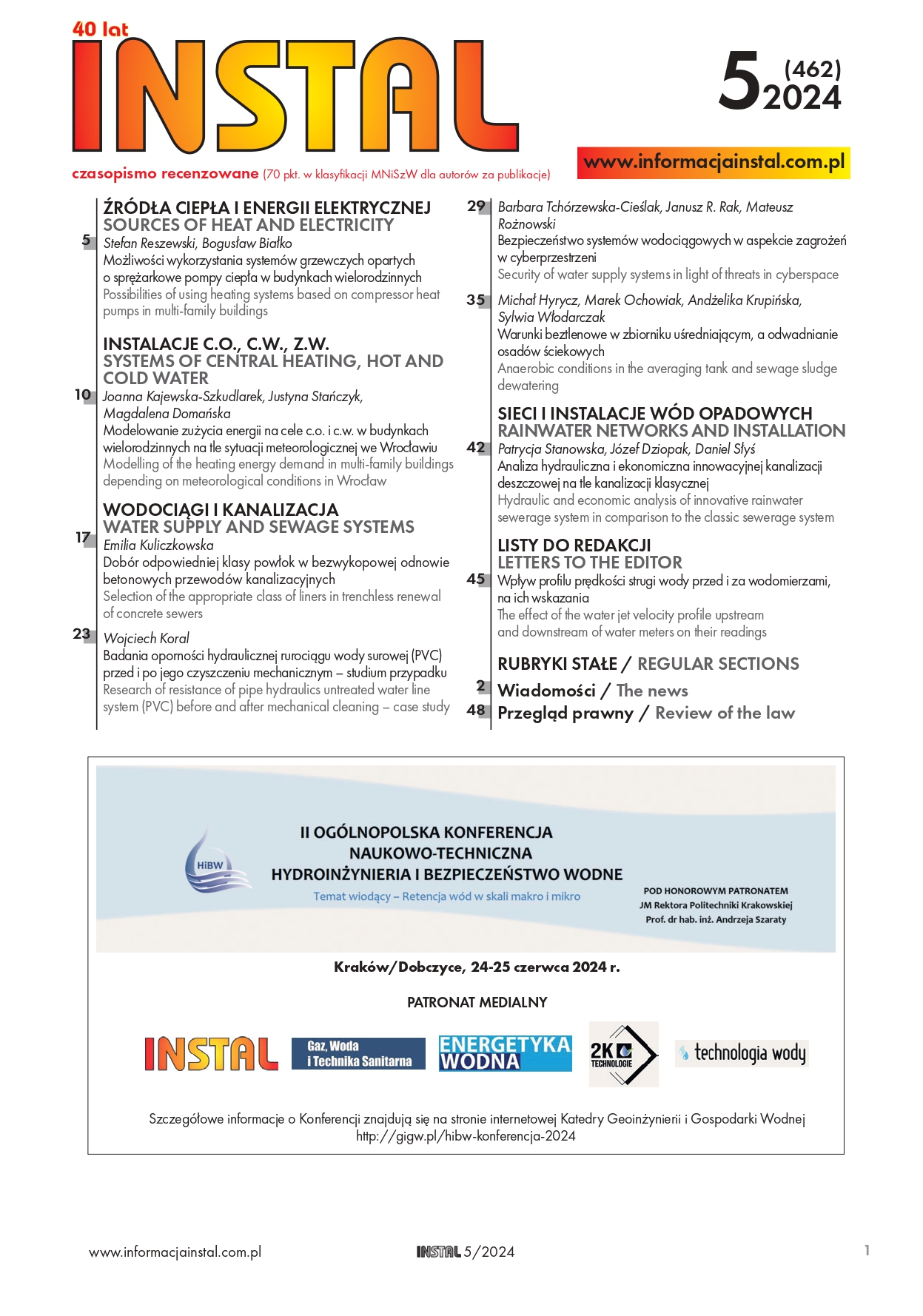
Anaerobic conditions in the averaging tank and sewage sludge dewatering
DOI:
https://doi.org/10.36119/15.2024.5.6Keywords:
sewage, sludge, dewateringAbstract
The paper presents the results of research on the influence of the retention time of waste activated sludge and digested sludge on their dewaterability and the quality of the obtained centrate. Sludge samples taken from a local municipal wastewater treatment plant were used for the study. The samples were kept in a model holding tank. At specific time intervals, the concentration of total phosphorus, COD, ammonium nitrogen and capillary suction time were determined in the samples. The results obtained for waste activated sludge showed that as the retention time increases, the load of pollutants in the centrate increases and dewaterability deteriorates. In the case of digested sludge, a longer retention time causes a decrease in capillary suction time and COD in the centrate. Appropriate control of the sludge retention time is therefore an easy way to reduce the recycled load and the amount of sludge produced, and thus reduce the operating costs of the treatment plant.
Downloads
References
Z. Lei, X. Luo, Z. Zhang, i N. Sugiura, „Effects of Variations of Extracellular Polymeric Substances and Soluble Microbial Products on Activated Sludge Properties During Anaerobic Storage”, Environmental Technology, t. 28, nr 5, Art. nr 5, maj 2007, doi: 10.1080/09593330.2007.9619781.
G. Pęciak-Foryś, K. Barbusiński, i M. Żołnierczyk, „Eksploatacja oczyszczalni ścieków w warunkach przeciążenia ładunkiem azotu z odcieków pofermentacyjnych”, Instal, t. 432, nr 9, s. 45–49, wrz. 2021, doi: 10.36119/15.2021.9.6.
D. Poproch, M. Cimochowicz-Rybicka, J.Górka, i B. Łuszczek, „Gospodarka osadami ściekowymi w miejskiej oczyszczalni ścieków”, Instal, t. 444, nr 10, s. 47–50, paź. 2022, doi:10.36119/15.2022.10.6
I. Płonka i M. Adamkowska, „Application of ultrasonic disintegration of post-coagulation sludge Zastosowanie dezintegracji ultradźwiękowej dla osadu pokoagulacyjnego”, Instal, t. 459, nr 2, s. 49–52, luty 2024, doi:10.36119/15.2024.2.6
Downloads
Published
License

This work is licensed under a Creative Commons Attribution 4.0 International License.
Authors retain copyright and grant the journal the right of first publication, with the work simultaneously licensed under a Creative Commons Attribution 4.0 International License, which permits others to share the work with appropriate acknowledgment of the authorship and initial publication in this journal.