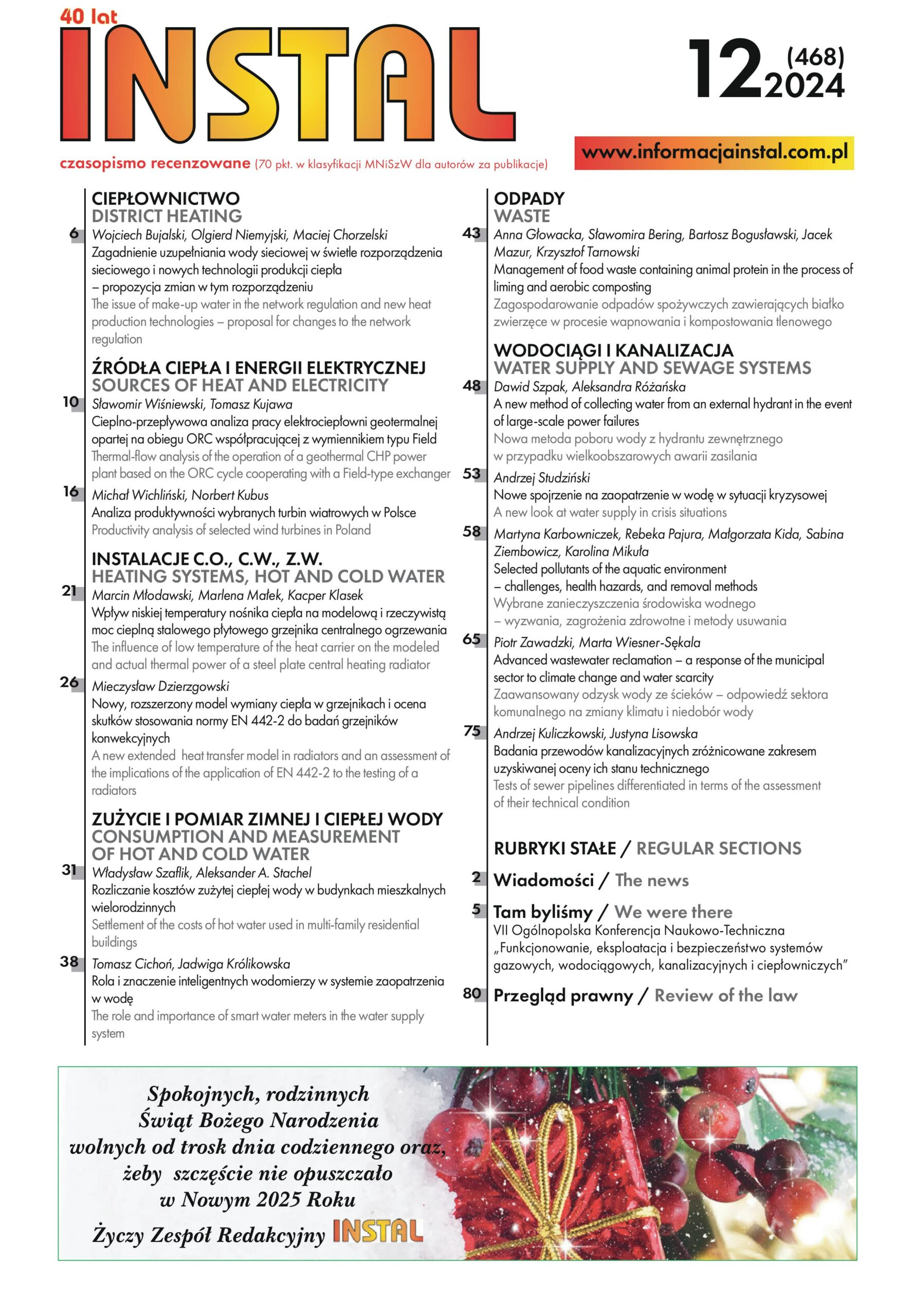
Selected pollutants of the aquatic environment – challenges, health hazards, and remova
DOI:
https://doi.org/10.36119/15.2024.12.11Keywords:
pollutants, pollution removal, public health, environmental protectionAbstract
The current challenge for environmental protection is pollution from the group of emerging pollutants (ECs). Emerging contaminants are a group of highly toxic substances present in the environment at very low concentrations. These contaminants often enter aquatic ecosystems from various sources, such as pharmaceuticals, cosmetics, and industrial chemicals. Due to their bioaccumulative properties, ECs can move through the food chain, eventually reaching human bodies. Due to their bioaccumulative properties, ECs can move through the trophic chain, eventually reaching the human body. The aim of the article was to indicate the need for further research on the toxicity of these pollutants, their impact on the environment and human health, and to develop guidelines regulating their permissible concentrations. The importance of developing effective methods for removing ECs from various environmental components was also pointed out. Implementing these removal techniques, alongside regulations limiting the use of these substances, is essential to protect water quality and public health.
Downloads
References
Samal, K., Mahapatra, S., & Ali, M. H. (2022). Pharmaceutical wastewater as Emerging Contaminants (EC): Treatment technologies, impact on environment and human health. Energy
Nexus, 6, 100076. DOI: 10.1016/j.nexus.2022.100076
Yadav, D., Rangabhashiyam, S., Verma, P., Singh, P., Devi, P., Kumar, P., ... & Kumar, K. S. (2021). Environmental and health impacts of contaminants of emerging concerns: Recent treatment challenges and approaches. Chemosphere, 272, 129492. DOI: 10.1016/j.chemosphere.2020.129492
Rodriguez-Narvaez, O. M., Peralta-Hernandez, J. M., Goonetilleke, A., & Bandala, E. R. (2017). Treatment technologies for emerging contaminants in water: A review. Chemical Engineering Journal, 323, 361-380. DOI: 10.1016/j.cej.2017.04.106
Downloads
Published
License

This work is licensed under a Creative Commons Attribution 4.0 International License.
Authors retain copyright and grant the journal the right of first publication, with the work simultaneously licensed under a Creative Commons Attribution 4.0 International License, which permits others to share the work with appropriate acknowledgment of the authorship and initial publication in this journal.