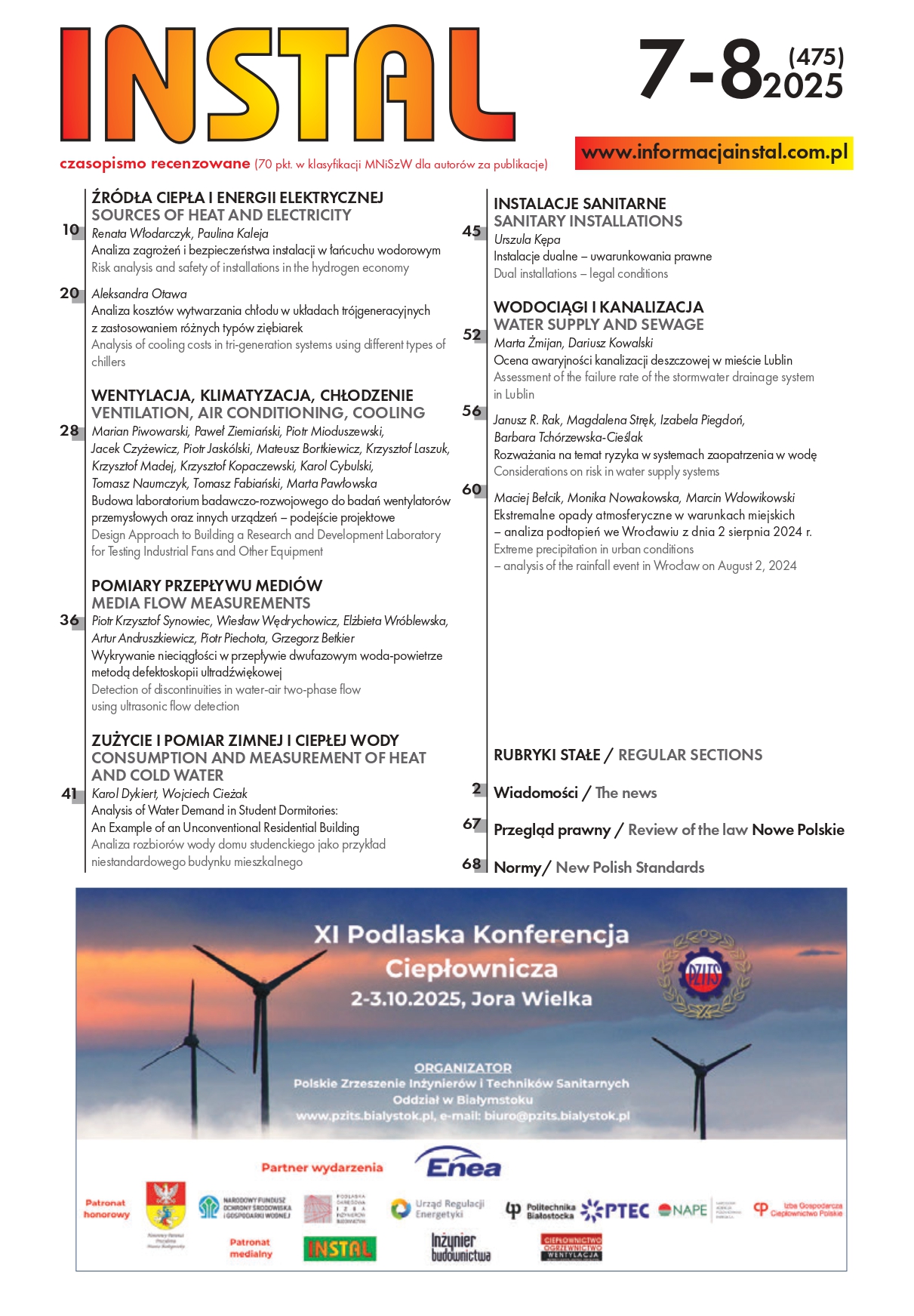
Extreme precipitation in urban conditions – analysis of the rainfall event in Wrocław on August 2, 2024
DOI:
https://doi.org/10.36119/15.2025.7-8.9Keywords:
extreme precipitation, flash flood, urban hydrology, kriging, Personal Weather StationsAbstract
The article analyzes the case of extreme precipitation that occurred on August 2, 2024, in Wrocław. This phenomenon led to numerous floods, transport disruptions, and emergency service interventions. The aim of the study was to determine the spatial distribution of rainfall intensity, its impact on urban infrastructure, and to identify areas particularly prone to flash floods. The analysis utilized data from 37 rain gauge stations, including 36 private stations (PWS) and a state station operated by IMGW-PIB. Kriging interpolation was applied to create a map of rainfall distribution. The highest values – exceeding 100 mm – were recorded in the northwestern districts of the city. Data on 36 interventions by the State Fire Service were correlated with the rainfall interpolation results. Using the Scalgo Live tool, a hydrological analysis was conducted to estimate the volume of surface runoff, infiltration, and retention. In more than half of the locations, infiltration did not exceed 15%, indicating a high degree of surface sealing. The need to modernize the stormwater drainage system and to implement blue-green infrastructure in Wrocław was confirmed. The study also demonstrated the usefulness of private meteorological stations in effectively monitoring weather-related hazards and supporting adaptive planning in cities.
Downloads
References
Agonafir, C., Lakhankar, T., Khanbilvardi, R., Krakauer, N., Radell, D., & Devineni, N.; A review of recent advances in urban flood research; Water Security; 2023; 19; 100141; DOI: 10.1016/j.wasec.2023.100141
Chen, A. B., Behl, M., & Goodall, J. L.; Assessing the trustworthiness of crowdsourced rainfall networks: A reputation system approach; Water Resources Research; 2021; 57; e2021WR029721; DOI: 10.1029/2021WR029721
Droździoł, R.; Powódź błyskawiczna – żywioł, który nie zna litości; Obserwator. IMGW-PIB; https://obserwator.imgw.pl/2022/07/25/powodz-blyskawiczna-zywiol-ktory-nie-zna-litosci/; Opublikowano 25 lipca 2022;
Dostęp: 18.06.2025
Downloads
Published
License

This work is licensed under a Creative Commons Attribution 4.0 International License.
Authors retain copyright and grant the journal the right of first publication, with the work simultaneously licensed under a Creative Commons Attribution 4.0 International License, which permits others to share the work with appropriate acknowledgment of the authorship and initial publication in this journal.