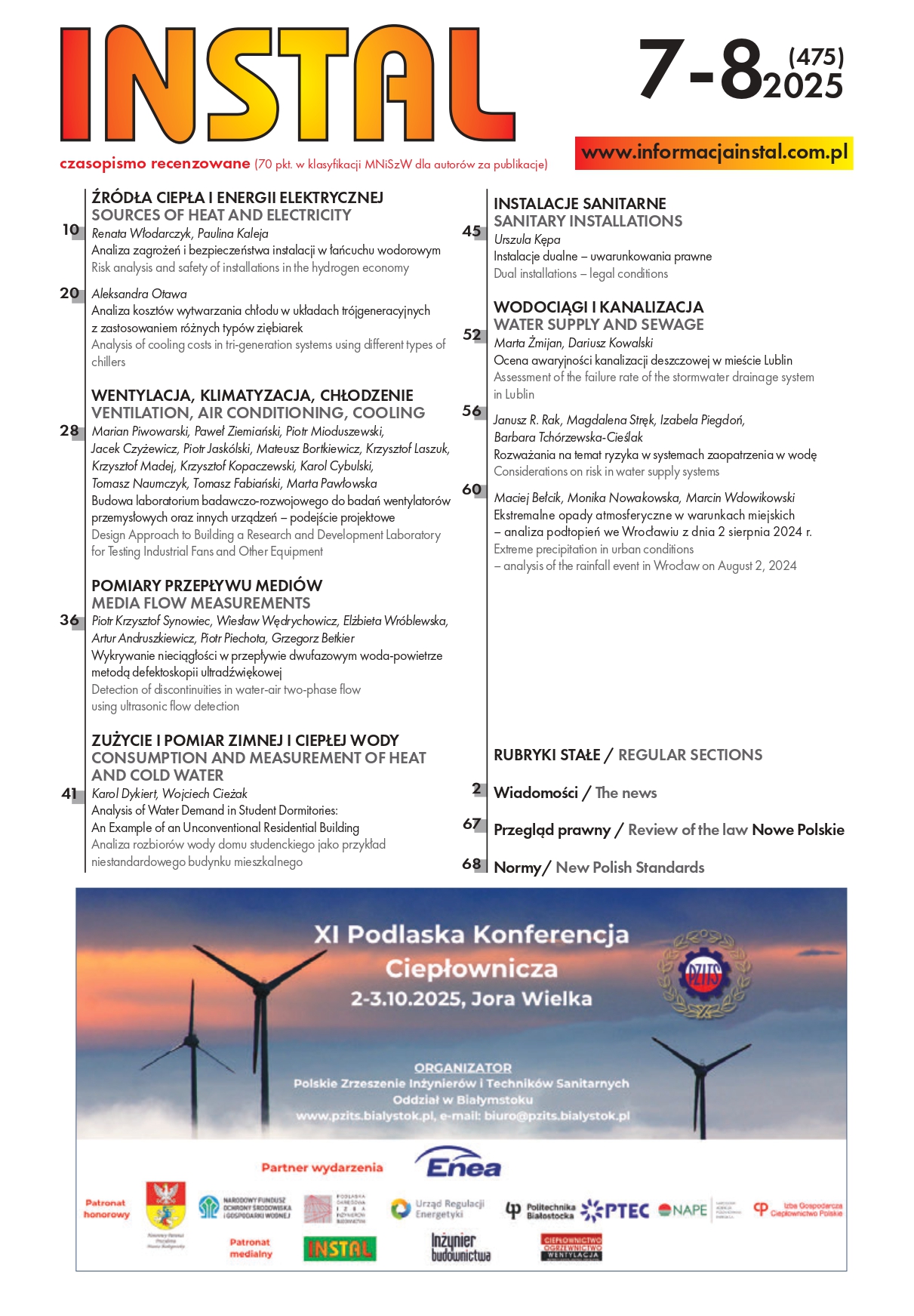
Dual installations – legal conditions
DOI:
https://doi.org/10.36119/15.2025.7-8.6Keywords:
dual installations, water reuse, greywater, rainwater, legal standardsAbstract
In the face of increasing water shortages in Poland and the frequent occurrence of hydrological droughts, it has become necessary to implement solutions that enable more sustainable water resource management. One such solution is dual installations, which allow the use of rainwater and/or treated greywater for household purposes, such as toilet flushing, irrigation, or laundry. The article discusses current legal regulations and technical standards related to such installations, highlighting significant gaps in national legislation and the need for updates. Proposed definitions for new concepts, such as “utility water” and “grey wastewater” vs. “greywater,” are presented. The requirements of standards for non-potable water installations (PN-EN 16941-1 and PN-EN 16941-2) are examined. Solutions that could enable broader practical application of these systems are suggested. Additionally, available systems on the Polish market, along with their benefits and limitations, are analyzed. Dual installations can play a key role in climate change adaptation and achieving sustainable development goals in water and wastewater management, but their widespread adoption requires legislative and financial support.
Downloads
References
Główny Urząd Statystyczny Raport 2020 „Polska na drodze zrównoważonego rozwoju”, 2020 ApexCharts, https://raportsdg.stat.gov.pl/2020/cel6.html.
The United Nations World Water Development Report 2024: water for prosperity and peace, UNESCO World Water Assessment Programme, 2024.
Rozporządzenie Ministra Zdrowia z dnia 7 grudnia 2017 r. w sprawie jakości wody przeznaczonej do spożycia przez ludzi, Dz. U. 2017 poz. 2294
Downloads
Published
License

This work is licensed under a Creative Commons Attribution 4.0 International License.
Authors retain copyright and grant the journal the right of first publication, with the work simultaneously licensed under a Creative Commons Attribution 4.0 International License, which permits others to share the work with appropriate acknowledgment of the authorship and initial publication in this journal.