
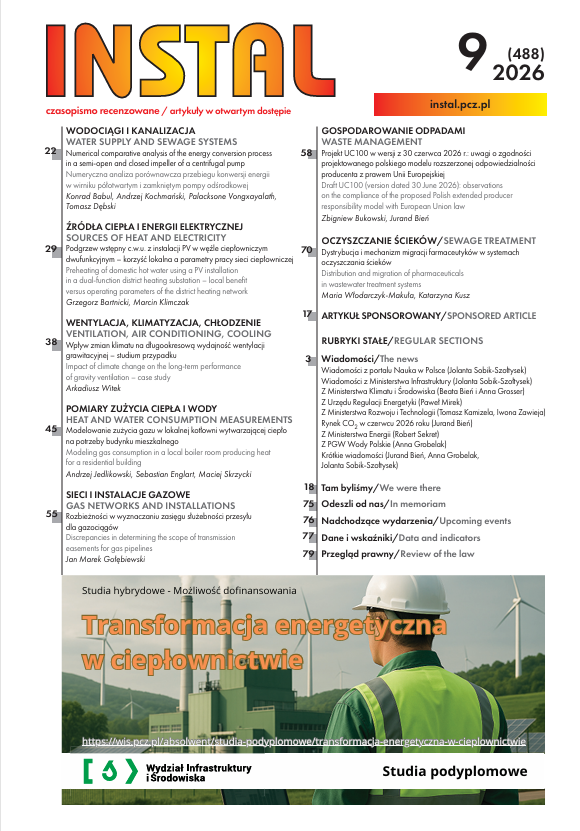
Impact of climate change on the long-term performance of gravity ventilation – case study
DOI:
https://doi.org/10.17512/INSTAL.2026.09.03Keywords:
natural ventilation, climate change, typical meteorological year (TMY), SSP2-4.5 scenario, stack effect, model sensitivity analysisAbstract
This paper investigates the impact of projected climate change on the performance of natural ventilation in a Central European climate. The Warsaw-Okęcie weather station is used as a case study. The aim was to evaluate the operation of a reference ventilation duct quantitatively for the time horizons of 2050 and 2080 under the moderate SSP2-4.5 socio-economic scenario. Hourly calculations were performed using morphed Typical Meteorological Year data. Model sensitivity analysis demonstrated that the simplified steady-state thermophysical model achieves high accuracy (annual WAPE = 2.57%), thus justifying its use in large-scale simulations. The results of the duct airflow calculations indicate a gradual degradation of the stack effect. The average annual airflow rate is expected to decrease from 50.5 m³/h to 44.0 m³/h in 2050 and to 42.0 m³/h in 2080. Meanwhile, the operating time with insufficient performance (i.e. an airflow rate of less than 25% of the nominal rate) is expected to increase from 16.9% to 24.2% and then to 26.6% per year, respectively. To replicate these conditions using steady-state design methods, new reference temperatures were established: 13.7°C for 2050 and 14.2°C for 2080 (compared to 12.0°C currently). The requirement to extend the duct length by up to 55% in extreme cases to maintain nominal capacity demonstrates that passive systems are reaching their adaptive limits and highlights the need for a gradual transition towards hybrid ventilation solutions.
Downloads
References
[1]. Narowski, P. (2022). Analiza porównawcza typowych lat meteorologicznych Polski wyznaczonych na podstawie danych źródłowych z lat 2001-2020. INSTAL, 10, 11–25. https://doi.org/10.36119/15.2022.10.2
[2]. Jędrzejuk, H. (2017). Uproszczona analiza działania wentylacji grawitacyjnej w sezonie ogrzewczym na przykładzie danych meteorologicznych Warszawy. Aparatura Badawcza i Dydaktyczna, 22, 260–268.
[3]. Radzikowska-Juś, W., & Owczarek, M. (2015). Działanie wentylacji grawitacyjnej w zależności od warunków zewnętrznych na przykładzie dwóch pomieszczeń biurowych w budynku użyteczności publicznej. Budownictwo, 15–21.
[4]. Firląg, S., & Miszczuk, A. (2016). Efektywność działania wentylacji naturalnej i możliwości jej usprawnienia. Powietrze, czerwiec 2016.
[5]. Basińska, M., & Koczyk, H. (b.d.). Metoda wyznaczania strumienia objętości powietrza infiltrującego do budynku mieszkalnego przy użyciu stopniodni dynamicznych. Instytut Inżynierii Środowiska, Politechnika Poznańska, s. 13–22.
[6] Jentsch, M. F., Bahaj, A. S., & James, P. A. B. (2008). Climate change future proofing of buildings—Generation and assessment of building simulation weather files. Energy and Buildings, 40(12), 2148–2168. https://doi.org/10.1016/j.enbuild.2008.06.005
[7] Frank, T. (2005). Climate change impacts on building heating and cooling energy demand in Switzerland. Energy and Buildings, 37(11), 1175–1185. https://doi.org/10.1016/j.enbuild.2005.06.019
[8] Lomas, K. J., & Ji, Y. (2009). Resilience of naturally ventilated buildings to climate change: Advanced natural ventilation and hospital wards. Energy and Buildings, 41(6), 629–653. https://doi.org/10.1016/j.enbuild.2009.01.001
[9] Coley, D., & Kershaw, T. (2010). Changes in internal temperatures within the built environment as a response to a changing climate. Building and Environment, 45(1), 89–93. https://doi.org/10.1016/j.buildenv.2009.05.009
[10] Holmes, M. J., & Hacker, J. N. (2007). Climate change, thermal comfort and energy: Meeting the design challenges of the 21st century. Energy and Buildings, 39(7), 802–814. https://doi.org/10.1016/j.enbuild.2007.02.009
[11]. Antczak-Jarząbska, R., & Niedostatkiewicz, M. (2017). Zwiększenie wydajności wentylacji naturalnej poprzez stosowanie nasady kominowej. Przegląd Budowlany, (12), 32–35.
[12]. Mijakowski, M. (1999). Symulacja działania wentylacji naturalnej wykorzystującej nawiewniki powietrza sterowane poziomem wilgotności. Zeszyty Naukowe Politechniki Śląskiej. Seria: Inżynieria Środowiska, (41), 63–74.
[13]. Koeroghlian, M., Hall, M. J., & Matthews, R. (2018). Calculating a viscosity correction for humid air in a laminar flow element (SAE Technical Paper 2018-01-0206). SAE International. https://doi.org/10.4271/2018-01-0206
[14]. Bzowska, D. (2019). Wpływ zmian klimatycznych na temperaturę wewnętrzną budynku. Budownictwo o Zoptymalizowanym Potencjale Energetycznym, 8(2), 27–34. https://doi.org/10.17512/bozpe.2019.2.03
[15]. Nauka o Klimacie. (b.d.). Wprowadzenie do 6. raportu IPCC. https://naukaoklimacie.pl/aktualnosci/wprowadzenie-do-6-raportu-ipcc-490
[16]. Dopke, J. (2009, 16 lutego). Obliczanie liczby stopniodni grzania według metody Eurostat. Ogrzewnictwo.pl.
[17]. PN-B-03430:1983/Az3:2000. Wentylacja w budynkach mieszkalnych zamieszkania zbiorowego i użyteczności publicznej – Wymagania
[18]. Forster, P., Storelvmo, T., Armour, K., Collins, W., Dufresne, J.-L., Frame, D., ... Palmer, M. D. (2021). The Earth’s energy budget, climate feedbacks, and climate sensitivity. W: V. Masson-Delmotte, P. Zhai, A. Pirani, S. L. Connors, C. Péan, S. Berger, ... R. Zhou (red.), Climate Change 2021: The Physical Science Basis. Contribution of Working Group I to the Sixth Assessment Report of the Intergovernmental Panel on Climate Change (s. 923–1054). Cambridge University Press. https://doi.org/10.1017/9781009157896.009
[19]. PN-EN ISO 13788:2013-05. Cieplno-wilgotnościowe właściwości komponentów budowlanych i elementów budynku -- Temperatura powierzchni wewnętrznej konieczna do uniknięcia krytycznej wilgotności powierzchni i kondensacji międzywarstwowej -- Metody obliczania
Downloads
Published
Issue
Section
Categories
License
Copyright (c) 2026 Arkadiusz Witek (Autor)

This work is licensed under a Creative Commons Attribution 4.0 International License.
Authors retain copyright and grant the journal the right of first publication, with the work simultaneously licensed under a Creative Commons Attribution 4.0 International License, which permits others to share the work with appropriate acknowledgment of the authorship and initial publication in this journal.