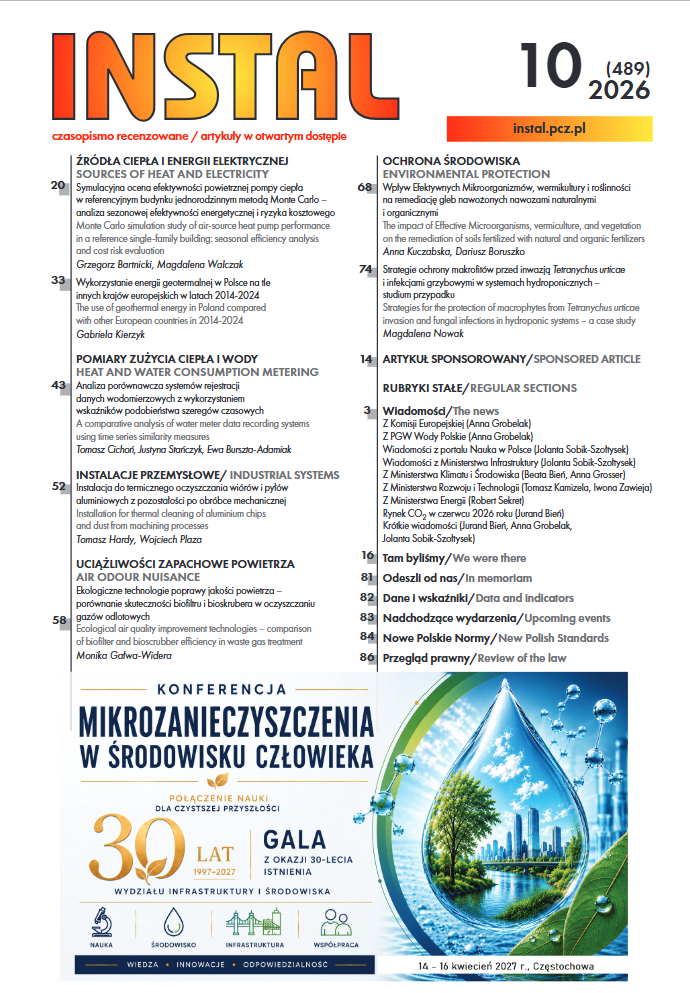
Ecological air quality improvement technologies – comparison of biofilter and bioscrubber efficiency in waste gas treatment
DOI:
https://doi.org/10.17512/INSTAL.2026.10.05Keywords:
biofilter, bioscrubber, composting, VOC, activated sludge inoculationAbstract
Emissions of odorous compounds and volatile pollutants from composting organic waste remain one of the major environmental challenges associated with municipal waste management. Biological gas treatment technologies, particularly biofilters and bioscrubbers, are increasingly applied due to their high removal efficiency and relatively low operating costs. This study aimed to compare the performance of a biofilter and a bioscrubber under comparable experimental conditions in treating off-gases generated during the composting of separately collected organic waste. The biofilter was filled with a mixture of peat, mature compost and wood chips (40:40:20, v/v), while both systems were inoculated with activated sludge to enhance microbial activity. Experimental investigations were conducted during the summer season under mesophilic conditions. Fifteen measurements were performed for each technology. Hydrogen sulfide (H₂S), ammonia (NH₃), and volatile organic compounds (VOCs) were analysed alongside inlet loading (IL), elimination capacity (EC), and removal efficiency (RE). Statistical analysis included descriptive statistics and Welch's t-test (α = 0.05). The bioscrubber demonstrated a significantly higher average removal efficiency than the biofilter, achieving approximately 96% compared with approximately 93%, and also showed a higher elimination capacity. Both technologies operated stably and showed low variability in removal efficiency throughout the experimental period. The results indicate that the biofilter is an effective solution for installations with relatively stable operating conditions, whereas the bioscrubber showed higher treatment efficiency under the variable pollutant loads and gas humidities examined in this study.The findings apply exclusively to summer operating conditions and should not be directly extrapolated to year-round operation without further investigations under low-temperature conditions.
Downloads
References
[1] Vikrant K., Kim K.-H., Szulejko J.E., Pandey S.K., Singh R.S., Giri B.S., Brown R.J.C., Lee S.H. Bio--filters for the Treatment of VOCs and Odors – A Review. Asian Journal of Atmospheric Environment. 2017;11(3):139–152. https://doi.org/10.5572/ajae.2017.11.3.139
[2] Lelicińska-Serafin K., Rolewicz-Kalińska A., Manczarski P. VOC Removal Performance of a Joint Process Coupling Biofiltration and Adsorption. International Journal of Environmental Research and Public Health. 2019;16(17):3009. https://doi.org/10.3390/ijerph16173009
[3] Gospodarek M., Rybarczyk P., Szulczyński B., Gębicki J. Comparative Evaluation of Selected Biological Methods for the Removal of Hydrophilic and Hydrophobic Odorous VOCs from Air. Processes. 2019;7(4):187. https://doi.org/10.3390/pr7040187
[4] Rolewicz-Kalińska A., Lelicińska-Serafin K., Manczarski P. Volatile Organic Compounds, Ammonia and Hydrogen Sulphide Removal Usinga Two-Stage Membrane Biofiltration Process. Chemical Engineering Research and Design. 2021;165:69–80. https://doi.org/10.1016/j.cherd.2020.10.017
[5] Barbusiński K., Parzentna-Gabor A., Kasperczyk D., Urbaniec K., Kozik V. Removal of Odors (Mainly H₂S and NH₃) Using Biological Treatment Methods. Clean Technologies. 2021;3(1):138–155. https://doi.org/10.3390/cleantechnol3010009
[6] Sheoran K., Kaur H., Siwal S.S., Saini A.K., Vo D.-V.N., Thakur V.K. Air Pollutants Removal Using Biofiltration Technique: A Challenge at the Frontiers of Sustainable Environment. ACS Engineering Au. 2022;2(5):378–396. https://doi.org/10.1021/acsengineeringau.2c00020
[7] Rybarczyk P., Szulczyński B., Gębicki J., Hupka J. Removal of Volatile Organic Compounds (VOCs) from Air: Focus on Biotrickling Filtration and Process Modeling. Processes. 2022;10(12):2531. https://doi.org/10.3390/pr10122531
[8] Çelikten H., Kuzu S.L., Saral A., Aksel M. Performance Evaluation of a Full-Scale Open Bed Biofilter through On-Site Measurements and CFD Analyses. Process Safety and Environmental Protection. 2021; 152:692–700. https://doi.org/10.1016/j.psep.2021.06.047.
[9] Gałwa-Widera M. Comparison of the Efficiency of Biofiltration on a Compost Filter and a Scrubber with Hydrogen Peroxide in Removing Odors from a Composting Plant. Journal of Ecological Engineering. 2025;26(12):400–408. https://doi.org/10.12911/22998993/208939.
[10] Delhoménie M.C., Heitz M. Biofiltration of Air: A Review. Critical Reviews in Biotechnology. 2005;25(1–2):53–72. https://doi.org/10.1080/07388550590935814.
[11] Sówka I. Metody identyfikacji odorotwórczych gazów emitowanych z obiektów przemysłowych. Prace Naukowe Instytutu Inżynierii Ochrony Środowiska Politechniki Wrocławskiej. Monografie. Nr 55. Wrocław: Oficyna Wydawnicza Politechniki Wrocławskiej; 2011.
[12] Grzelka A., Sówka I., Miller U. Metody oceny emisji odorów z obiektów gospodarki hodowlanej. Inżynieria Ekologiczna. 2018;19(2):56–64. https://doi.org/10.12912/23920629/86054.
[13] Devinny J.S., Deshusses M.A., Webster T.S. Biofiltration for Air Pollution Control. CRC Press, Boca Raton, 1999. https://doi.org/10.1201/9781315138275.
[14] Mudliar S., Giri B., Padoley K., Satpute D., Dixit R., Bhatt P., Pandey R., Juwarkar A., Vaidya A. Bioreactors for Treatment of VOCs and Odours – A Review. Journal of Environmental Management. 2010;91(5):1039–1054. https://doi.org/10.1016/j.jenvman.2010.01.006.
[15] Nzila A., Razzak A.R., Zhu J. Bioaugmentation: An Emerging Strategy of Industrial Wastewater Treatment for Reuse and Discharge. International Journal of Environmental Research and Public Health. 016;13(9):846. https://doi.org/10.3390/ijerph13090846.
[16] Muter, O. (2023). Current trends in bioaugmentation tools for bioremediation: A critical review of advances and knowledge gaps. Microorganisms, 11(3), 710. https://doi.org/10.3390/microorganisms11030710
Downloads
Published
License
Copyright (c) 2026 dr Monika Gałwa - Widera (Autor)

This work is licensed under a Creative Commons Attribution 4.0 International License.
Authors retain copyright and grant the journal the right of first publication, with the work simultaneously licensed under a Creative Commons Attribution 4.0 International License, which permits others to share the work with appropriate acknowledgment of the authorship and initial publication in this journal.