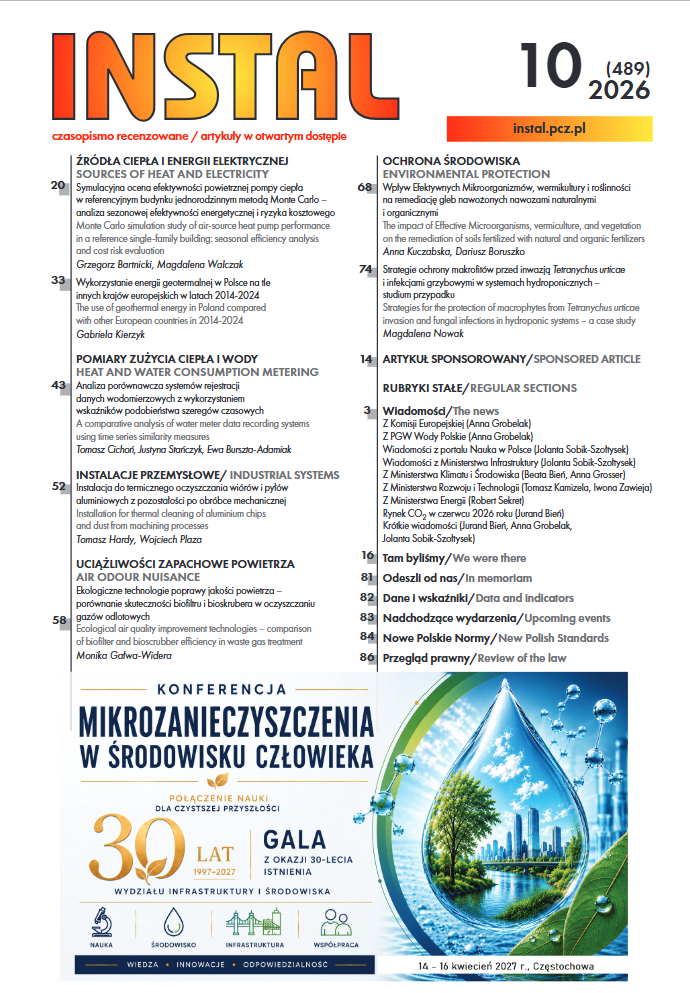
The use of geothermal energy in Poland compared with other European countries in 2014-2024
DOI:
https://doi.org/10.17512/INSTAL.2026.10.02Keywords:
geothermal energy, renewable energy sources,, primary energy production, direct energy use, energy balance, share of renewable energy sources, heating and coolingAbstract
The European Union is developing geothermal energy as an important component of the energy transition and efforts to increase independence from fossil fuels. The analysis was conducted based on data for the period 2014-2023 for Poland and the EU-27, and for the period 2014-2024 for the geothermal energy balance in Poland. Data from the European Geothermal Energy Council (EGEC), the International Geothermal Association (IGA), Eurostat, and Statistics Poland (GUS) were used. The article analyses the development of geothermal energy use in Poland against the background of European Union countries over the period 2014-2024, with particular emphasis on the dynamics of sector development, the structure of applications, and the position of geothermal energy in the national and European renewable energy mix. The results indicate that between 2014 and 2024, geothermal energy production in the EU-27 increased from 259.5 thousand TJ to 279.0 thousand TJ, representing an increase of approximately 7.5%, with an average annual growth rate of 0.72%. The development of geothermal energy in Europe, however, is highly differentiated spatially. Poland is among the countries with a developing geothermal market. Geothermal energy production increased from 847 TJ in 2014 to 1,556 TJ in 2024, representing an increase of 83.7%, with an average annual growth rate of 6.27%, which was higher than the EU-27 average. Despite this growth, Poland's share in European geothermal energy production remains small, amounting to approximately 0.56% in 2024. An analysis of the national energy balance revealed a systematic increase in the use of geothermal energy in Poland. Between 2014 and 2024, geothermal energy production increased by 83.7%, while households remained the main end-users, accounting for approximately 75% of final consumption. At the same time, the share of geothermal energy in total renewable energy production in Poland remains very small, amounting to approximately 0.2% in 2023. This indicates that, despite the growth in geothermal energy use, its potential is still exploited to a limited extent relative to the available resources. Poland follows the European model of geothermal energy utilisation, primarily in district heating.
Downloads
References
[1] Aaheim, H. A., & Bundschuh, J. (2002). The value of geothermal energy for developing countries. In D. Chandrasekharam & J. Bundschuh (Eds.), Geothermal energy resources for developing countries. A. A. Balkema Publishers.
[2] Ahsan, M., Luna, E., & Kaageson-Loe, N. (2023). Investigating compromises between performance and carbon footprint—Drilling fluid applications for enhanced geothermal systems: A case study. In Proceedings of the World Geothermal Congress 2023. International Geothermal Association. https://www.worldgeothermal.org/pdf/IGAstandard/WGC/2023/921.pdf
[3] Bertani, R. (2012). Geothermal power generation in the world 2005–2010 update report. Geothermics, 41, 1–29. https://doi.org/10.1016/j.geothermics.2011.10.001
[4] DiPippo, R. (2012). Geothermal power plants: Principles, applications, case studies and environmental impact (3rd ed.). Butterworth-Heinemann.
[5] European Geothermal Energy Council. (2025a). EGEC geothermal market report 2024 (14th ed.). https://www.egec.org/wp-content/uploads/2025/07/EGEC-MR2024-Key-Findings.pdf
[6] European Geothermal Energy Council. (2025b). The European geothermal strategy and action plan: Making Europe competitive, secure and affordable. https://www.egec.org/wp-content/uploads/2025/12/EGEC-EuropeanGeothermal-Strategy-and-Action-Plan-2025.pdf
[7] European Geothermal Energy Council. (2026a, April 21). EGEC annual report 2025. https://www.egec.org/wp-content/uploads/2026/04/EGEC-Annual-Report-2025.pdf
[8] European Geothermal Energy Council. (2026b, April 22). AccelerateEU plan puts geothermal at the heart of Europe’s energy transition. https://www.egec.org/egec-welcomes-accelerateeu--plan/
[9] European Geothermal Energy Council. (n.d.). Dekada geotermalna. Retrieved May 25, 2026, from https://www.egec.org/geothermal-decade-2/
[10] European Geothermal Energy Council. (n.d.). Geothermal market report 2024. Retrieved August 7, 2026, from https://www.egec.org/media-publications/egec-annual-report-2024/
[11] Eurostat. (n.d.). Overall share of energy from renewable sources, 2004–2022 (% of gross final energy consumption). Retrieved March 2, 2024, from https://ec.europa.eu/eurostat/statistics--explained/index.php?title=File:Table_1-Overall_share_of_energy_from_renewable_sources,_2004-2022_(%25_of_gross_final_energy_consumption).png
[12] Eurostat. (n.d.). Supply, transformation and consumption of renewables and wastes [nrg_cb_rw__custom_22186680], Production of electricity and derived heat by type of fuel [nrg_bal_peh__custom_22185419], Heat pumps - ambient heat captured by technology and climate [nrg_ind_ahbtc__custom_22186599] dostęp 4.08.2026, https://ec.europa.eu/eurostat
[13] Główny Urząd Statystyczny. (2019). Energia ze źródeł odnawialnych w 2018 roku. https://stat.gov.pl/
[14] Główny Urząd Statystyczny. (2020). Energia ze źródeł odnawialnych w 2019 roku. https://stat.gov.pl/
[15] Główny Urząd Statystyczny. (2023). Energia ze źródeł odnawialnych w 2022 roku. https://stat.gov.pl/
[16] Główny Urząd Statystyczny. (2024). Energia ze źródeł odnawialnych w 2023 roku. https://stat.gov.pl/
[17] Główny Urząd Statystyczny. (2025). Energia ze źródeł odnawialnych w 2024 roku. https://stat.gov.pl/obszary-tematyczne/srodowisko-energia/energia/energia-ze-zrodel-odnawialnych--w-2024-r-,3,19.html
[18] Górecki, W. (Ed.). (2006a). Atlas zasobów energii geotermalnej na Niżu Polskim: Formacje paleozoiczne. Akademia Górniczo-Hutnicza.
[19] Górecki, W. (2009). Możliwości wykorzystania wód i energii geotermalnej w Polsce. In Zarys stanu i perspektyw energetyki polskiej. Wydawnictwo AGH.
[20] Halaj, E., & Kępińska, B. (2019). Conjunctive uses of the geothermal water resources from Lower Cretaceous formations in the Mogilno–Łódź Trough, Poland. Sustainable Water Resources Management, 5, 1479–1494. https://doi.org/10.1007/s40899-018-0284-y
[21] Hajto, M. (2023). Zasoby geotermalne w Polsce. In Budowanie zdolności kluczowych zainteresowanych stron w dziedzinie energii geotermalnej. Instytut Gospodarki Surowcami Mineralnymi i Energią PAN.
[22] Hajto, M., & Kępińska, B. (2025). Stan wykorzystania energii geotermalnej na świecie i w Europie w 2024–2025. In A. Kasztelewicz (Ed.), IX Ogólnopolski Kongres Geotermalny: Książka rozszerzonych abstraktów. Polskie Towarzystwo Geotermalne. https://kongresgeotermalny.pl/wazne/ksiazka-abstraktow-ix-ogolnopolski-kongresgeotermalny/
[23] Hamm, S. G., et al. (2021). Geothermal energy R&D: An overview of the U.S. Department of Energy’s Geothermal Technologies Office. Journal of Energy Resources Technology, 143(10), 100801. https://doi.org/10.1115/1.4049581
[24] Hurter, S., & Haenel, R. (Eds.). (2002). Atlas zasobów geotermalnych w Europie. Urząd Publikacji Unii Europejskiej. https://op.europa.eu/en/publication-detail/-/publication/9003d463-03ed-4b0e-87e861325a2d4456
[25] International Geothermal Association. (2024). Geothermal energy database. Retrieved May 25, 2026, from https://worldgeothermal.org/geothermal-data/geothermal-energy-database
[26] International Renewable Energy Agency, & International Geothermal Association (2023). Global geothermal market and technology assessment. International Renewable Energy Agency. https://www.irena.org/Publications/2023/Feb/Global-geothermal-market-and-technologyassessment
[27] Kępińska, B. (2021). Wykorzystanie energii geotermalnej w Polsce w latach 2019–2021. Przegląd Geologiczny, 69(9), 559–565. https://geojournals.pgi.gov.pl/pg/article/view/33241
[28] Kępińska, B. (2025). Potencjał i wyzwania dla rozwoju geotermii w Polsce [Prezentacja]. Forum 3: Nowe perspektywy rozwoju geotermii w Polsce: Racjonalna gospodarka zasobami wód i energią geotermalną, Warszawa, Polska.
[29] Kępińska, B., & Hajto, M. (2023a). Przegląd wykorzystania energii geotermalnej w Polsce w latach 2022–2023. In A. Kasztelewicz (Ed.), VIII Ogólnopolski Kongres Geotermalny: Książka rozszerzonych abstraktów. Polskie Towarzystwo Geotermalne. https://kongresgeotermalny.pl/wp-content/uploads/2023/11/8-OKG-Ksiazka-Abstraktow.pdf
[30] Kępińska, B., & Hajto, M. (2023b). Stan wykorzystania energii geotermalnej na świecie i w Europie w 2022–2023. In A. Kasztelewicz (Ed.), VIII Ogólnopolski Kongres Geotermalny: Książka rozszerzonych abstraktów. Polskie Towarzystwo Geotermalne. https://kongresgeotermalny.pl/wp-content/uploads/2023/11/8-OKG-Ksiazka-Abstraktow.pdf
[31] Kępińska B., Hajto M. Przegląd wykorzystania energii geotermalnej w Polsce w latach 20222023 — [An overview of the geothermal energy use in Poland in 2022–2023] W: VIII Ogólnopolski kongres geotermalny [Dokument elektroniczny] : 29 XI-01 XII 2023, Kraków: książka rozszerzonych abstraktów / red. Aleksandra Kasztelewicz, Kraków: Polskie Stowarzyszenie Geotermiczne, 2023b, https://kongresgeotermalny.pl/wp-content/uploads/2023/11/8-OKG-Ksiazka-Abstraktow.pdf
[32] Kępińska, B., & Hajto, M. (2025). Przegląd wykorzystania energii geotermalnej w Polsce w latach 2024–2025. In IX Ogólnopolski Kongres Geotermalny: Książka rozszerzonych abstraktów. Polskie Towarzystwo Geotermalne. https://kongresgeotermalny.pl/wazne/ksiazka-abstraktow-ixogolnopolski-kongres-geotermalny/
[33] Kikstra, J. S., Nicholls, Z. R. J., Smith, C. J., Lewis, J., Lamboll, R. D., Byers, E., Sandstad, M., Meinshausen, M., Gidden, M. J., Rogelj, J., Kriegler, E., Peters, G. P., Fuglestvedt, J. S., Skeie, R. B., Samset, B. H., Wienpahl, L., van Vuuren, D. P., van der Wijst, K.-I., Al Khourdajie, A., Forster, P. M., Reisinger, A., Schaeffer, R., & Riahi, K. (2022). The IPCC Sixth Assessment Report WGIII climate assessment of mitigation pathways: From emissions to global temperatures. Geoscientific Model Development, 15(24), 9075–9109. https://doi.org/10.5194/gmd-15-9075-2022
[34] Krajowy Ośrodek Bilansowania i Zarządzania Emisjami. (2023, 25 lipca). Informacja ogólna.
[35] Kumari, W. G. P., & Ranjith, P. G. (2019). Sustainable development of enhanced geothermal systems based on geotechnical research—A review. Earth--Science Reviews, 199, 102955. https://doi.org/10.1016/j.earscirev.2019.102955
[36] Lund, J. W., & Boyd, T. L. (2016). Direct utilization of geothermal energy 2015 worldwide review. Geothermics, 60, 66–93. https://doi.org/10.1016/j.geothermics.2015.11.004
[37] Lund, J. W., Freeston, D. H., & Boyd, T. L. (2005). Direct application of geothermal energy: 2005 worldwide review. Geothermics, 34(6), 691727. https://doi.org/10.1016/j.geothermics.2005.09.003
[38] Lund, J. W., Freeston, D. H., & Boyd, T. L. (2011). Direct utilization of geothermal energy 2010 worldwide review. Geothermics, 40(3), 159–180. https://doi.org/10.1016/j.geothermics.2011.07.004
[39] Lund, J. W., & Toth, A. N. (2021). Direct utilization of geothermal energy 2020 worldwide review. Geothermics, 90, 101915. https://doi.org/10.1016/j.geothermics.2020.101915
[40] Mitchell, C. (2010). The political economy of sustainable energy. Palgrave Macmillan.
[41] Ministerstwo Klimatu i Środowiska. (2021). Wieloletni program rozwoju wykorzystania zasobów geotermalnych w Polsce.
[42] Ministerstwo Klimatu i Środowiska. (2019). Krajowy plan na rzecz energii i klimatu na lata 20212030. Retrieved June 12, 2026, from https://www.gov.pl/web/klimat/krajowy-plan-na--rzecz-energii-i-klimatu
[43] Ministerstwo Klimatu i Środowiska. (n.d.-b). Programy Narodowego Funduszu Ochrony Środowiska i Gospodarki Wodnej. Retrieved August 10, 2026, from https://www.gov.pl/web/klimat/programy-narodowego-funduszu-ochronysrodowiska-i-gospodarki-wodnej
[44] Ministerstwo Klimatu i Środowiska. (n.d.-c). W Turku powstanie ciepłownia geotermalna z dofinansowaniem NFOŚiGW. Retrieved August 10, 2026, from https://www.gov.pl/web/klimat/w-turku-powstanie-cieplownia-geotermalna-zdofinansowaniem-nfosigw
[45] Narodowy Fundusz Ochrony Środowiska i Gospodarki Wodnej. (n.d.-a). Inwestycje w odwierty geotermalne i gospodarkę wodno-ściekową. Retrieved August 10, 2026, from https://www.gov.pl/web/nfosigw/inwestycje-w-odwiertygeotermalne-i-gospodarke-wodno-sciekowa
[46] Narodowy Fundusz Ochrony Środowiska i Gospodarki Wodnej. (n.d.-b). Krynica-Zdrój i Rabka--Zdrój zbadają możliwość czerpania ciepła z wnętrza Ziemi – umożliwi to pilotaż w ramach nowej części programu Polska Geotermia Plus. Retrieved August 10, 2026, from https://www.gov.pl/web/nfosigw/krynica-zdroj-i-rabka-zdroj-zbadaja-mozliwosc-czerpania-ciepla-zwnetrza-ziemi-umozliwi-to-pilotaz-w-ramachnowej-czesci-programu-polska-geotermia-plus
[47] Narodowy Fundusz Ochrony Środowiska i Gospodarki Wodnej. (n.d.-c). Narodowy Fundusz Ochrony Środowiska i Gospodarki Wodnej przekaże ponad 52 mln zł Geotermii Podhalańskiej na rozbudowę systemu geotermalnego oraz budowę przyłączy i sieci ciepłowniczych. Retrieved August 10, 2026, from https://www.gov.pl/web/nfosigw/nfosigw-przekaze-ponad-52-mlnzl-geotermii-podhalanskiej-na-rozbudowe-systemu-geotermalnego-oraz-budowe-przylaczy-i-siecicieplowniczych
[48] Narodowy Fundusz Ochrony Środowiska i Gospodarki Wodnej. (n.d.-d). Poszukiwanie wód termalnych z dofinansowaniem NFOŚiGW. Retrieved August 10, 2026, from https://www.gov.pl/web/nfosigw/poszukiwanie-wod-termalnych-zdofinansowaniem-nfosigw
[49] Najwyższa Izba Kontroli. (2022). Wykorzystanie energii wód termalnych dla celów wytwarzania ciepła: Informacja o wynikach kontroli. https://www.nik.gov.pl/kontrole/P/21/067/
[50] Opportunitaly. (n.d.). Geothermal energy: Italy excellence. Retrieved August 3, 2026, from https://opportunitaly.gov.it/pl/news-and--media/geothermal-energy-italy-excellence
[51] Państwowy Instytut Geologiczny–Państwowy Instytut Badawczy. (n.d.). Geotermia w Szaflarach – zaskakujące parametry i możliwości wykorzystania. Retrieved August 8, 2026, from https://www.pgi.gov.pl/geotermia/wm-aktualnosci/16764-geotermia-w-szaflarach-zaskakujaceparametry-i-mozliwosci-wykorzystania.html
[52] Paulillo, A., Striolo, A., & Lettieri, P. (2019). The environmental impacts and the carbon intensity of geothermal energy: A case study on the Hellisheiði plant. Environment International, 133(Part B), 105226. https://doi.org/10.1016/j.envint.2019.105226
[53] Rybach, L. (2014). Geothermal power growth 1995–2013—A comparison with other renewables. Energies, 7(8), 4802–4812. https://doi.org/10.3390/en7084802
[54] Rybach, L., & Mongillo, M. (2006). Geothermal sustainability—A review with identified research needs. GRC Transactions, 30, 1083–1090.
[55] Schmidlé-Bloch, V., Pomart, A., Boissavy, C., Maurel, C., Philippe, M., Cardona-Maestro, A., & Genter, A. (2022). Geothermal energy use, country update for France. European Geothermal Congress 2022. https://www.afpg.asso.fr/wp-content/uploads/2023/02/EGC_2022_FRANCE--country-update.pdf
[56] SienaFree. (n.d.). Progetto geotermico Lucignano: Il TAR dà ragione a Radicondoli. Retrieved August 3, 2026, from https://sienafree.it/166400progetto-geotermico-lucignano-il-tar-da-ragionea-radicondoli
[57] Stober, I., & Bucher, K. (2013). History of geothermal energy use. In I. Stober & K. Bucher, Geothermal energy: From theoretical models to exploration and development (pp. 15–24). Springer. https://doi.org/10.1007/978-3-642-13352-7
[58] Strasszer, D., & Xydis, G. (2024). Integrating geothermal energy in Hungary: A case study on sustainable urban heating and emissions mitigation through the district heating infrastructure. Tunnelling and Underground Space Technology, 149, 105804. https://doi.org/10.1016/j.tust.2024.105804
[59] Szanyi, J., Rybach, L., & Abdulhaq, H. A. (2023). Geothermal energy and its potential for critical metal extraction—A review. Energies, 16(20), 7168. https://doi.org/10.3390/en16207168
[60] Taylor Wessing. (2026). Geothermie in Deutschland. Retrieved August 3, 2026, from https://www.taylorwessing.com/en/insights-and--events/insights/2026/04/geothermie-in--deutschland
[61] Union Française de l'Électricité. (n.d.). Observer: Baromètre 2025 de l’électricité renouvelable en France. Retrieved August 3, 2026, from https://www.geothermies.fr/actualites/news/observerbarometre-2025-de-lelectricite-renouvelable-enfrance
[62] Wang, T., Han, H., & Wang, Y. (2024). A two--stage distributionally robust optimization model for geothermal-hydrogen integrated energy system operation considering multiple uncertainties. Environment, Development and Sustainability, 26, 16223–16247. https://doi.org/10.1007/s10668-023-03294-x
Downloads
Published
License
Copyright (c) 2026 Gabriela Kierzyk (Autor)

This work is licensed under a Creative Commons Attribution 4.0 International License.
Authors retain copyright and grant the journal the right of first publication, with the work simultaneously licensed under a Creative Commons Attribution 4.0 International License, which permits others to share the work with appropriate acknowledgment of the authorship and initial publication in this journal.