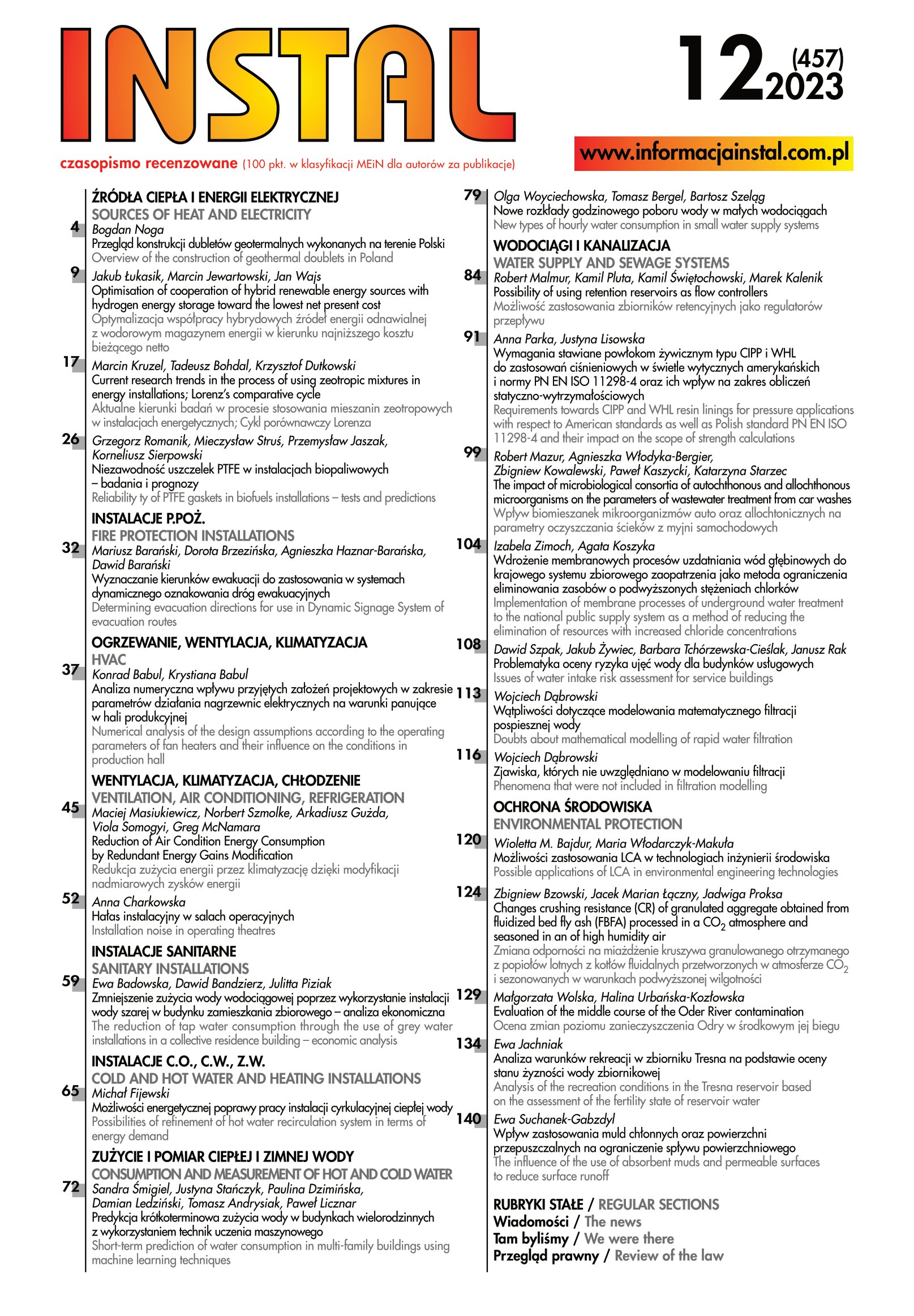
Short-term prediction of water consumption in multi-family buildings using machine learning techniques
DOI:
https://doi.org/10.36119/15.2023.12.11Keywords:
water supply networks, machine learning, water meters, water consumptionAbstract
The operational practice of water distribution systems lacks the implementation of advanced tools for processing and analyzing monitored data. This is the case at many levels of water supply management, where measurements are recorded, most often creating uninterpretable data sets. With the arrival of data recording capabilities that can be described as high-frequency, there is a need for a simultaneous implementation of suitable data science techniques as the basis for smart water supply networks. To achieve the goals of implementing intelligence at the water meter level, it is necessary to allow measurement of water consumption with a precise measurement interval and advanced data analysis, which should result in effective inference and management of water distribution systems. This paper presents the results of the use of machine learning models to predict short-term water consumption for multifamily buildings. Linear models, simple neural network, nearest neighbour algorithm and decision trees were used to predict water consumption. The study evaluated features extracted from the water consumption waveforms and combinations of data sets given to the input of the regression model. It was also verified how the degree of data
aggregation and the structure of the building influence the prediction error.
Downloads
References
E. Sarmas, E. Spiliotis, V. Marinakis, G. Tzanes, J.K. Kaldellis, H. Doukas, „ML-based energy management of water pumping systems for the application of peak shaving in small-scale islands”, Sustainable Cities and Society, 82, 2022. DOI: 10.1016/j.scs.2022.103873.
Andrić, A. Vrsalović, T. Perković, M.A. Čuvić, P. Šolić, „IoT approach towards smart water usage”, Journal of Cleaner Production, 367, 2022. DOI: 10.1016/j.jclepro.2022.133065.
T. Cichoń, J. Królikowska, „Remote Reading of Water Meters as an Element of a Smart City Concept”, Rocznik Ochrona Środowiska, 23, 2021. DOI: 10.54740/ros.2021.060.
Downloads
Published
Issue
Section
Categories
License

This work is licensed under a Creative Commons Attribution 4.0 International License.
Authors retain copyright and grant the journal the right of first publication, with the work simultaneously licensed under a Creative Commons Attribution 4.0 International License, which permits others to share the work with appropriate acknowledgment of the authorship and initial publication in this journal.