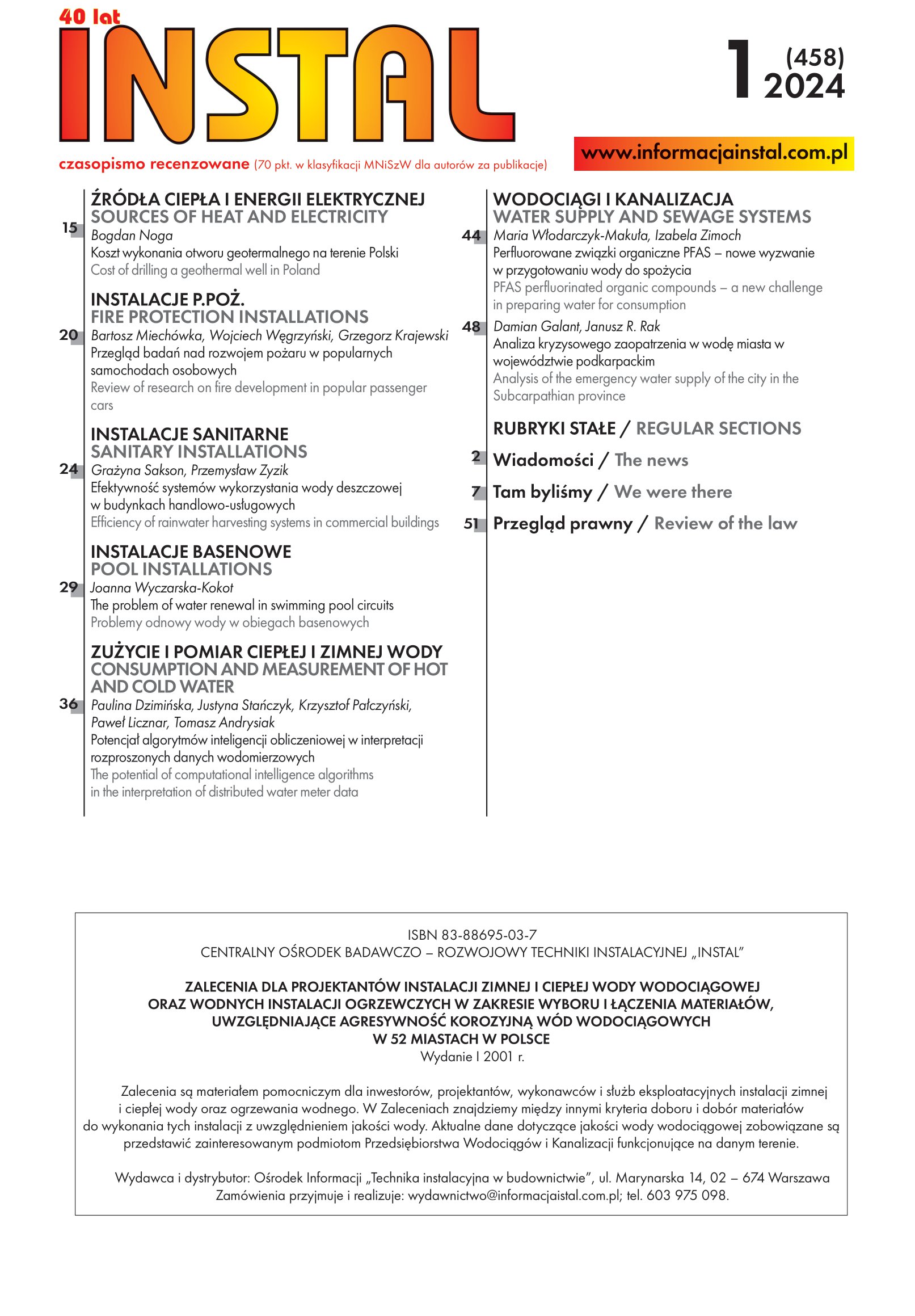
The potential of computational intelligence algorithms in the interpretation of distributed water meter data
DOI:
https://doi.org/10.36119/15.2024.1.5Keywords:
water supply networks, machine learning, water meters, water consumptionAbstract
The development of awareness and legislative aspects related to the energy efficiency of water distribution systems, combined with the ageing of water supply infrastructure and water stress, led to the search for solutions to support more effective control and management of technical infrastructure. Increasing the standard of smart or intelligent water supply systems at all levels of key areas is still a problem under domestic and foreign conditions. This also applies to the microscale of water supply networks, namely water consumers of water and the use of smart water meters with integrated machine learning algorithms. This article presents the results of research on the implementation of a short- -term water consumption prediction model with anomaly detection for multifamily residential buildings. The prediction of water consumption, based on high-frequency measurements and deep neural networks, achieved a prediction error of less than 3.0%. Anomaly detection, based on the underlying prediction model, had up to 97.3% accuracy.
Downloads
References
Rozporządzenie Ministra Infrastruktury z dnia 12 kwietnia 2002 r. w sprawie warunków technicznych, jakim powinny odpowiadać budynki i ich usytuowanie (Dz.U. 2002 nr 75 poz. 690).
Ustawa z dnia 20 kwietnia 2021 r. o zmianie ustawy o efektywności energetycznej oraz niektórych innych ustaw (Dz.U. 2021 poz. 868).
G. He, Y.Zhao, J. Wang, H. Li, Y. Zhu i S. Jiang, “The water–energy nexus: energy use for water supply in China”. International Journal of Water Resources Development, pp. 587-604, 35(4), 2019. https://doi.org/10.1080/07900627.2018.1469401
Downloads
Published
Issue
Section
Categories
License

This work is licensed under a Creative Commons Attribution 4.0 International License.
Authors retain copyright and grant the journal the right of first publication, with the work simultaneously licensed under a Creative Commons Attribution 4.0 International License, which permits others to share the work with appropriate acknowledgment of the authorship and initial publication in this journal.