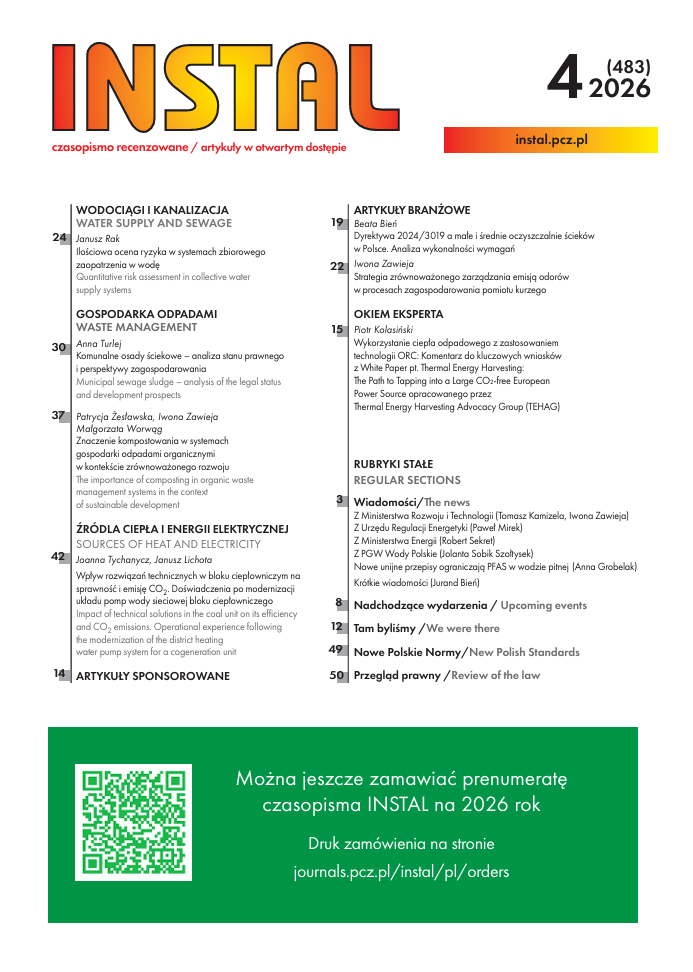
The importance of composting in organic waste management systems in the context of sustainable development
DOI:
https://doi.org/10.17512/INSTAL.2026.04.03Keywords:
organic waste, composting, sustainable development, circular economy, ecology, waste managementAbstract
Composting is a crucial element of organic waste management systems, aligning with the fundamental principles of sustainable development and the circular economy. The growing amount of biowaste generated by households, agriculture, industry, and the agri-food sector poses a significant environmental and economic challenge, requiring the implementation of effective and environmentally friendly management methods. In this context, composting plays a key role as a biological process enabling the transformation of organic waste into a valuable product: compost, used in agriculture and soil remediation, among other applications. Composting contributes to reducing the amount of waste sent to landfills. Economically, composting offers an alternative to costly waste disposal methods, enabling both reduced waste processing costs and the acquisition of a valuable source of nutrients in the form of stabilized compost. Further more, the development of composting systems promotes the implementation of innovative technological solutions, the creation of new jobs, and the strengthening of local waste management systems. Integrating the concept of composting with environmental policy and sustainable development strategies contributes to increasing the efficiency of biowaste management and achieving environmental, social, and economic goals. The aim of this article is to present the importance of composting as an element of the organic waste management system in the context of sustainable development, with particular emphasis on its role in reducing the negative impact of bio-waste on the environment, supporting the circular economy, and improving the ecological and economic efficiency of waste management systems.
Downloads
References
[1] Rosik-Dulewska, C. (2015). Podstawy gospodarki odpadami. Wydawnictwo Naukowe PWN.
[2] Campuzano, R., & González-Martínez, S. (2016). Characteristics of the organic fraction of municipal solid waste and methane production: A review. Waste Management, 54, 3–12. https://doi.org/10.1016/j.wasman.2016.05.016
[3] Głowacka, A., Bering, S., Bogusławski, B., Mazur, J., & Tarnowski, K. (2024). Management of food waste containing animal protein in the process of liming and aerobic composting. Instal, (12), 43–47. https://doi.org/10.36119/15.2024.12.8
[4] Cobo, N., López, A., & Lobo, A. (2008). Biodegradation stability of organic solid waste characterized by physico-chemical parameters. WIT Transactions on Ecology and the Environment, 109, 153–162. https://doi.org/10.2495/WM080171
[5] Kadir, A. A., Azhari, N. W., & Jamaludin, S. N. (2016). An overview of organic waste in composting. In MATEC Web of Conferences (Vol. 47, Article 05025). EDP Sciences. https://doi.org/10.1051/matecconf/20164705025
[6] Parra-Pacheco, B., Cruz-Moreno, B. A., Aguirre-Becerra, H., García-Trejo, J. F., & Feregrino--Pérez, A. A. (2024). Bioactive compounds from organic waste. Molecules, 29(10), 2243. https://doi.org/10.3390/molecules29102243
[7] Nordahl, S. L., Preble, C. V., Kirchstetter, T. W., & Scown, C. D. (2023). Greenhouse gas and air pollutant emissions from composting. Environmental Science & Technology, 57(6), 22352247. https://doi.org/10.1021/acs.est.2c05846
[8] Bandini, F., Taskin, E., Bellotti, G., Vaccari, F., Misci, C., Guerrieri, M. C., Cocconcelli, P. S., & Puglisi, E. (2022). The treatment of the organic fraction of municipal solid waste (OFMSW) as a possible source of micro- and nano-plastics and bioplastics in agroecosystems: A review. Chemical and Biological Technologies in Agriculture, 9, Article 4. https://doi.org/10.1186/s40538-021-00269-w
[9] Rahman, S. U., Yousaf, S., Ilyas, M., Riaz, M., Su, Y., Ayub, G., Machado da Silva Acioly, T., Al Asmari, A. F., Islam, S., & Ibáñez-Arancibia, E. (2025). Comparative assessment of composting methods for the organic fraction of municipal solid waste: Physicochemical insights. International Journal of Environmental Health Research, Advance online publication, 1–16. https://doi.org/10.1080/09603123.2025.2557424
[10] Balaganesh, P., Vasudevan, M., & Natarajan, N. (2022). Evaluating sewage sludge contribution during co-composting using cause-evidence--impact analysis based on morphological characterization. Environmental Science and Pollution Research, 29(34), 51161–51182. https://doi.org/10.1007/s11356-022-19246-3
[11] Stefanescu, M., Nechifor, G., Bumbac, C., Ionescu, I., & Tiron, O. (2018). Improvement of active biological sludge quality for anaerobic digestion phase in the wastewater treatment plant by ultrasonic pretreatment. Revista de Chimie, 69(1), 31–33. https://doi.org/10.37358/RC.18.1.6039
[12] Głowacka, A., Bering, S., Mazur, J., Tarnowski, K., Bogusławski, B., & Bułhak, P. (2022). Catering waste as organic matter potential for compost production. Instal, (7–8), 66–70. https://doi.org/10.36119/15.2022.7-8.9
[13] Serwis Samorządowy PAP. (2025, June 30). GUS: średnio 376 kg odpadów wytworzył przeciętny Polak w 2024 r. Retrieved January 11, 2026, from https://samorzad.pap.pl/kategoria/srodowisko/gus-srednio-376-kg-odpadowwytworzyl-przecietny-polak-w-2024-r
[14] Instytut Ochrony Środowiska – Państwowy Instytut Badawczy. (2025, February 14). Bioodpady komunalne posegregowane i poddawane recyklingowi u źródła w Polsce 2024 [Raport]. https://ios.edu.pl/wp-content/uploads/2025/03/bioodpady-komunalneposegregowane-i-poddawane-recyklingowi-uzrodla-w-polsce-2024-r.pdf
[15] Borkowska, M., & Kruszyński, M. (2019). Ekologistyka odpadów opakowaniowych w rolnictwie. Ekonomika i Organizacja Logistyki, 4(1), 5–15. https://doi.org/10.22630/EIOL.2019.4.1.1
[16] Gaur, V. K., Sharma, P., Sirohi, R., Awasthi, M. K., Dussap, C.-G., & Pandey, A. (2020). Assessing the impact of industrial waste on environment and mitigation strategies: A comprehensive review. Journal of Hazardous Materials, 398, 123019. https://doi.org/10.1016/j.jhazmat.2020.123019
[17] Białecka, B. (2008). Gospodarka odpadami z przemysłu rolno-spożywczego w województwie śląskim. Problemy Ekologii, 12, 28–32.
[18] Pandey, A. K., Thakur, S., Mehra, R., Kaler, R. S. S., Paul, M., & Kumar, A. (2025). Transforming agri-food waste: Innovative pathways toward a zero-waste circular economy. Food Chemistry: X, 28, 102604. https://doi.org/10.1016/j.fochx.2025.102604
[19] Główny Urząd Statystyczny. (n.d.). GUS – Bank Danych Lokalnych: Metadane podgrupy 223 (Odpady komunalne). Retrieved January 11, 2026, from https://bdl.stat.gov.pl/bdl/metadane/podgrupy/223
[20] Eurostat. (n.d.). Municipal waste statistics. Statistics Explained. Retrieved January 11, 2026, from https://ec.europa.eu/eurostat/statistics-explained/index.php?title=Municipal_waste_statistics
[21] Cesaro, A., Belgiorno, V., & Guida, M. (2015). Compost from organic solid waste: Quality assessment and European regulations for its sustainable use. Resources, Conservation and Recycling, 94, 72–79. https://doi.org/10.1016/j.resconrec.2014.11.003
[22] Raza, S., & Ahmad, J. (2016). Composting process: A review. International Journal of Biological Research, 4(2), 102–104. https://doi.org/10.14419/ijbr.v4i2.6354
[23] Płuciennik-Koropczuk, E., & Myszograj, S. (2020). Kompostowanie komunalnych osadów ściekowych. In J. Bień, M. Gromiec, & L. Pawłowski (Eds.), Ocena gospodarki ściekowo-osadowej w Polsce (pp. 165–178) (Monografie Komitetu Inżynierii Środowiska PAN, Vol. 166). Wydawnictwo Polskiej Akademii Nauk.
[24] Manyapu, V., Lepcha, A., Sharma, S. K., & Kumar, R. (2022). Chapter One – Role of psychrotrophic bacteria and cold-active enzymes in composting methods adopted in cold regions. In G. M. Gadd & S. Sariaslani (Eds.), Advances in Applied Microbiology (Vol. 121, pp. 1–26). Academic Press. https://doi.org/10.1016/bs.aambs.2022.08.001
[25] Manea, E. E., Bumbac, C., Dinu, L. R., Bumbac, M., & Nicolescu, C. M. (2024). Composting as a sustainable solution for organic solid waste management: Current practices and potential improvements. Sustainability, 16(15), 6329. https://doi.org/10.3390/su16156329
[26] Wróblewski, P. (2018). Badanie sprawności kompostowania wybranych odpadów organicznych [Unpublished thesis].
[27] Chan, M. T., Selvam, A., & Wong, J. W. C. (2016). Reducing nitrogen loss and salinity during struvite food waste composting by zeolite amendment. Bioresource Technology, 200, 838–844. https://doi.org/10.1016/j.biortech.2015.10.093
[28] Smith, S. J., Satchwell, A. J., Kirchstetter, T. W., & Scown, C. D. (2021). The implications of facility design and enabling policies on the economics of dry anaerobic digestion. Waste Management, 128, 122–131. https://doi.org/10.1016/j.wasman.2021.04.048
[29] Żary-Sikorska, E. (2024). Odpady z przetwórstwa owoców i warzyw – charakterystyka problemu. Infrastruktura i Ekologia Terenów Wiejskich, 19(1.1), 93–106. https://doi.org/10.14597/infraeco.2024.007
[30] Li, J., Liang, L. N., Li, X., & Yang, H. F. (2014). Effects of compost amendment on soil chemical and biological properties in greenhouse soil. Acta Horticulturae, 1018, 195–202. https://doi.org/10.17660/ActaHortic.2014.1018.19
[31] Bondì, C., Castellini, M., & Iovino, M. (2022). Compost amendment impact on soil physical quality estimated from hysteretic water retention curve. Water, 14(7), 1002. https://doi.org/10.3390/w14071002
Downloads
Published
License
Copyright (c) 2026 Patrycja Żesławska, Iwona Zawieja, Małgorzata Worwąg (Autor)

This work is licensed under a Creative Commons Attribution 4.0 International License.
Authors retain copyright and grant the journal the right of first publication, with the work simultaneously licensed under a Creative Commons Attribution 4.0 International License, which permits others to share the work with appropriate acknowledgment of the authorship and initial publication in this journal.