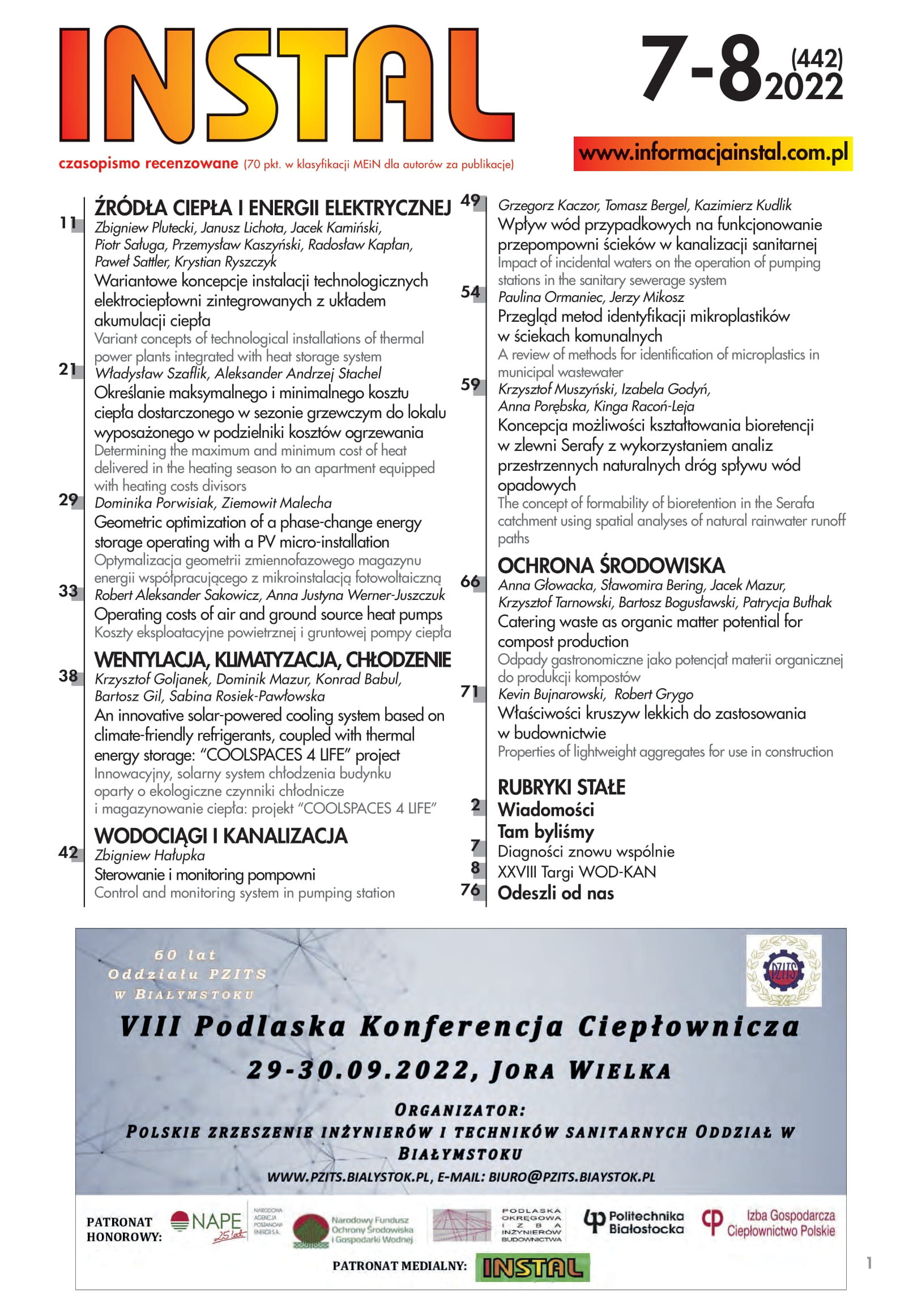
Catering waste as organic matter potential for compost production
DOI:
https://doi.org/10.36119/15.2022.7-8.9Keywords:
waste, category III waste, catering waste per residenAbstract
The aim of the week long field/pilot study was to conduct research on the identification and physicochemical evaluation of waste fractions from selected food service units. During the field study, food waste was segregated for each meal (breakfast, lunch, dinner, or lunch-and-dinner) at each research facility. Each segregated waste fraction was weighed and then samples were collected for physicochemical testing. Preliminary pilot/field studies indicate that the amount of catering waste generated by one guest staying in the investigated health resorts or hotels for the Kamien Pomorski commune and surroundings can range from 76.4 kg/(M-a) according to the results obtained for the “Jantar” resort to 256.2 kg/(M-a) according to the results obtained for the Mieszko Nowe health resort. The physicochemical analyses of food wastes indicate that the dry matter content of catering wastes ranges from 17.94 to 28.51% (mean 24.43%) and the organic matter content from 70.41 to 94.93% (mean 87.54%). The content of heavy metals in the analyzed samples did not exceed the content permitted by legal acts. This waste can be used as material in the composting process. However, it should be remembered that food waste should first undergo a hygienization process. This is in line with the European plan for a resource-efficient Europe. This plan aims to introduce waste management as a resource by 2020.
Downloads
References
Beretta, C., Stoessel, F., Baier, U., Hellweg, S., 2013. Ilościowe określenie strat żywności i możliwości zmniejszenia w Szwajcarii. Waste Manag. 33, 764–773. https://doi.org/10.1016/j.wasman.2012.11.007
Bräutigam K.-R., Jörissen J.,Priefer C., The extent of food waste generation across EU-27: Different calculation methods and the reliability of their results, Waste Management & Research2014, Vol. 32(8) 683 –694, DOI:10.1177/0734242X14545374
Corrado S., Sala S., Food waste accounting along global and European food supply chains: state of the art and outlook, Waste Manag., 79 (2018), pp. 120-131
Downloads
Published
License

This work is licensed under a Creative Commons Attribution 4.0 International License.
Authors retain copyright and grant the journal the right of first publication, with the work simultaneously licensed under a Creative Commons Attribution 4.0 International License, which permits others to share the work with appropriate acknowledgment of the authorship and initial publication in this journal.