
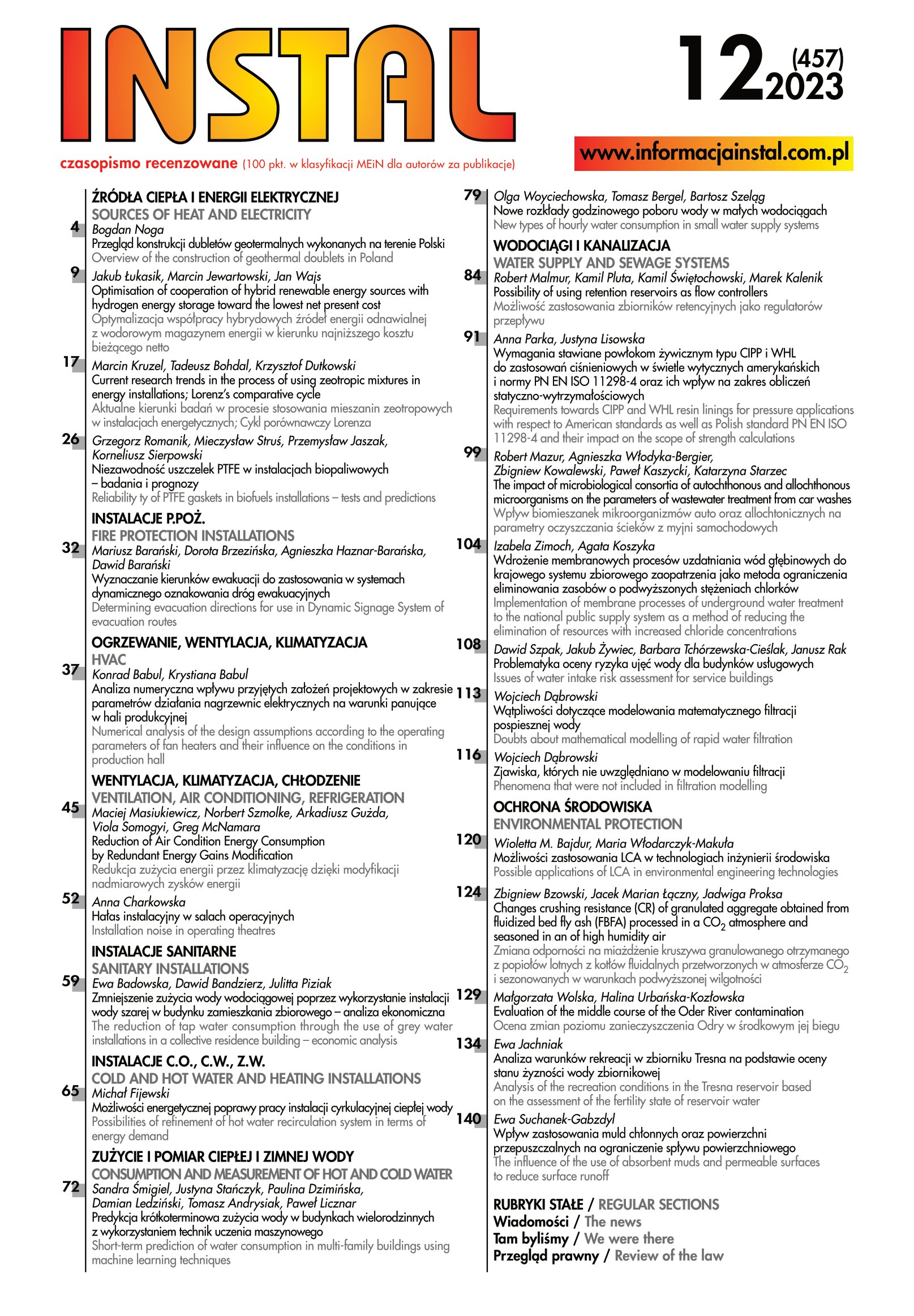
Current research trends in the process of using zeotropic mixtures in energy installations; Lorenz’s comparative cycle
DOI:
https://doi.org/10.36119/15.2023.12.3Keywords:
Temperature glide, Lorenz cycle, zeotropic mixtures, condensation, heat pumps, mixture compositionAbstract
This paper is devoted to modern research directions and the development of the use of zeotropic mixtures in compact heat exchangers presents selected problems regarding the use of zeotropic mixtures in the implementation of refrigeration cycles in heat pumps. The phenomenon of temperature glide occurring in phase transitions has a significant impact on the selection of an appropriate reference circuit. For homogeneous refrigerants and for azeotropic mixtures, the reference cycle is the Carnot cycle with constant source temperature levels. In the case of zeotropic mixtures, due to temperature glide, there is a system with variable values of the temperature of the heat sources, for which the Lorenz cycle is an appropriate pattern. The method of calculating the coefficient of performance of a heat pump operating according to such a cycle and the criteria for assessing the approximation of the real cycle to the model cycle is given.
Downloads
References
Kruzel M., Bohdal T., Dutkowski K., Kuczy W., Current Research Trends in the Process of Condensation of Cooling Zeotropic Mixtures in Compact Condensers, (2022).
Schaefer L.A., Shelton S. V., Heat Exchanger Mean Temperature Differences for Refrigerant Mixtures, in: Advanced Energy Systems, American Society of Mechanical Engineers, 1998: pp. 383–389. https://doi.org/10.1115/IMECE1998-0865.
Liu J., Zhou F., Lyu N., Fan H., Zhang X., Analysis of low GWP ternary zeotropic mixtures applied in high-temperature heat pump for waste heat recovery, Energy Convers Manag.292 (2023) 117381. https://doi.org/10.1016/ j.enconman.2023.117381.
Ganesan P., Eikevik T.M., New zeotropic CO2-based refrigerant mixtures for cascade high-temperature heat pump to reach heat sink temperature up to 180 °C, Energy Conversion and Management: X. 20 (2023). https://doi.org/10.1016/j.ecmx.2023.100407.
Downloads
Published
Issue
Section
Categories
License

This work is licensed under a Creative Commons Attribution 4.0 International License.
Authors retain copyright and grant the journal the right of first publication, with the work simultaneously licensed under a Creative Commons Attribution 4.0 International License, which permits others to share the work with appropriate acknowledgment of the authorship and initial publication in this journal.