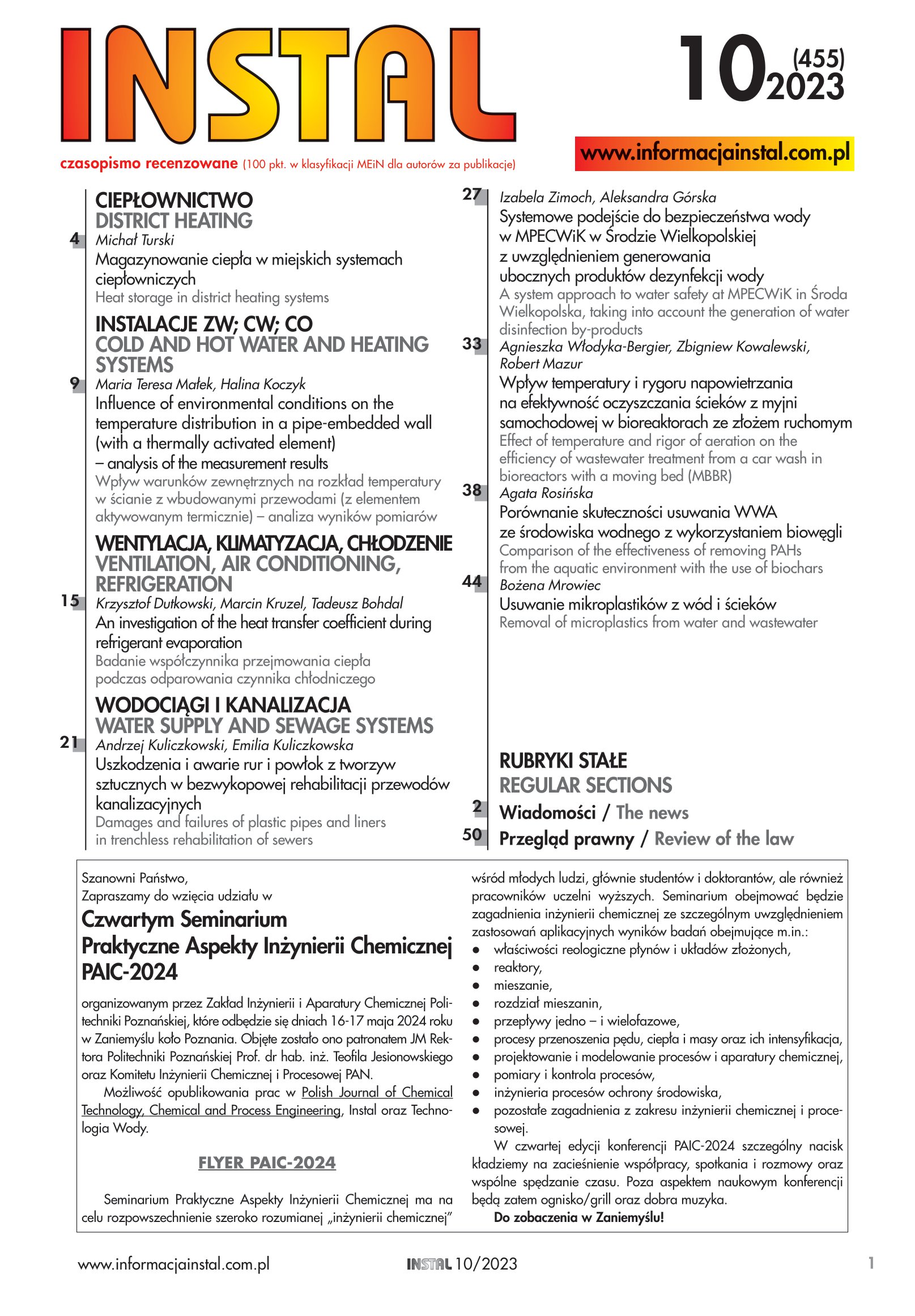
Badanie współczynnika przejmowania ciepła podczas odparowania czynnika chłodniczego
DOI:
https://doi.org/10.36119/15.2023.10.3Słowa kluczowe:
dane eksperymentalne, czynnik chłodniczy, współczynnik przenikania ciepła, minikanały, odparowanie rozprężneAbstrakt
W pracy przedstawiono wyniki badań eksperymentalnych lokalnego współczynnika przejmowania ciepła podczas odparowywania czynnika chłodniczego w minikanale poziomym. Wymiana ciepła odbywała się pomiędzy ogrzewaną ścianką kanału a przepływającym wewnątrz czynnikiem roboczym (R134a i R404A). Zastosowano minikanały rurowe ze stali nierdzewnej AISI 316 o średnicy wewnętrznej w zakresie di = 0,64 – 2,30 mm. Tak zwane minikanały są szeroko stosowane do budowy miniaturowych wymienników ciepła. Badania przeprowadzone w zakresie gęstości strumienia masy G = 350 – 1400 kg/(m2s) i gęstości strumienia ciepła dochodzącej do q = 90 kW/m2 pozwoliły zaobserwować występowanie zjawiska flashingu, nie obserwowanego w konwencjonalnych kanałach. Wykazano, że w strefie objętej zjawiskiem flashingu pogarszają się warunki wymiany ciepła, a wartość lokalnego współczynnika przejmowania ciepła w tej strefie może spaść nawet o 50%.
Pobrania
Bibliografia
I. Aoki, Analysis of characteristics of water flash evaporation under low-pressure conditions, Heat Transfer – Asian Research. 29 (2000) 22–33. https://doi.org/10.1002/(sici)1523-1496(200001)29:1<22::aid-htj3>3.0.co;2-v.
D. Saury, S. Harmand, M. Siroux, Experimental study of flash evaporation of a water film, n.d. www.elsevier.com/locate/ijhmt.
D. Saury, S. Harmand, M. Siroux, Flash evaporation from a water pool: Influence of the liquid height and of the depressurization rate, International Journal of Thermal Sciences. 44 (2005) 953–965. https://doi.
org/10.1016/j.ijthermalsci.2005.03.005
Pobrania
Opublikowane
Numer
Dział
Kategorie
Licencja

Utwór dostępny jest na licencji Creative Commons Uznanie autorstwa 4.0 Międzynarodowe.
Authors retain copyright and grant the journal the right of first publication, with the work simultaneously licensed under a Creative Commons Attribution 4.0 International License, which permits others to share the work with appropriate acknowledgment of the authorship and initial publication in this journal.