
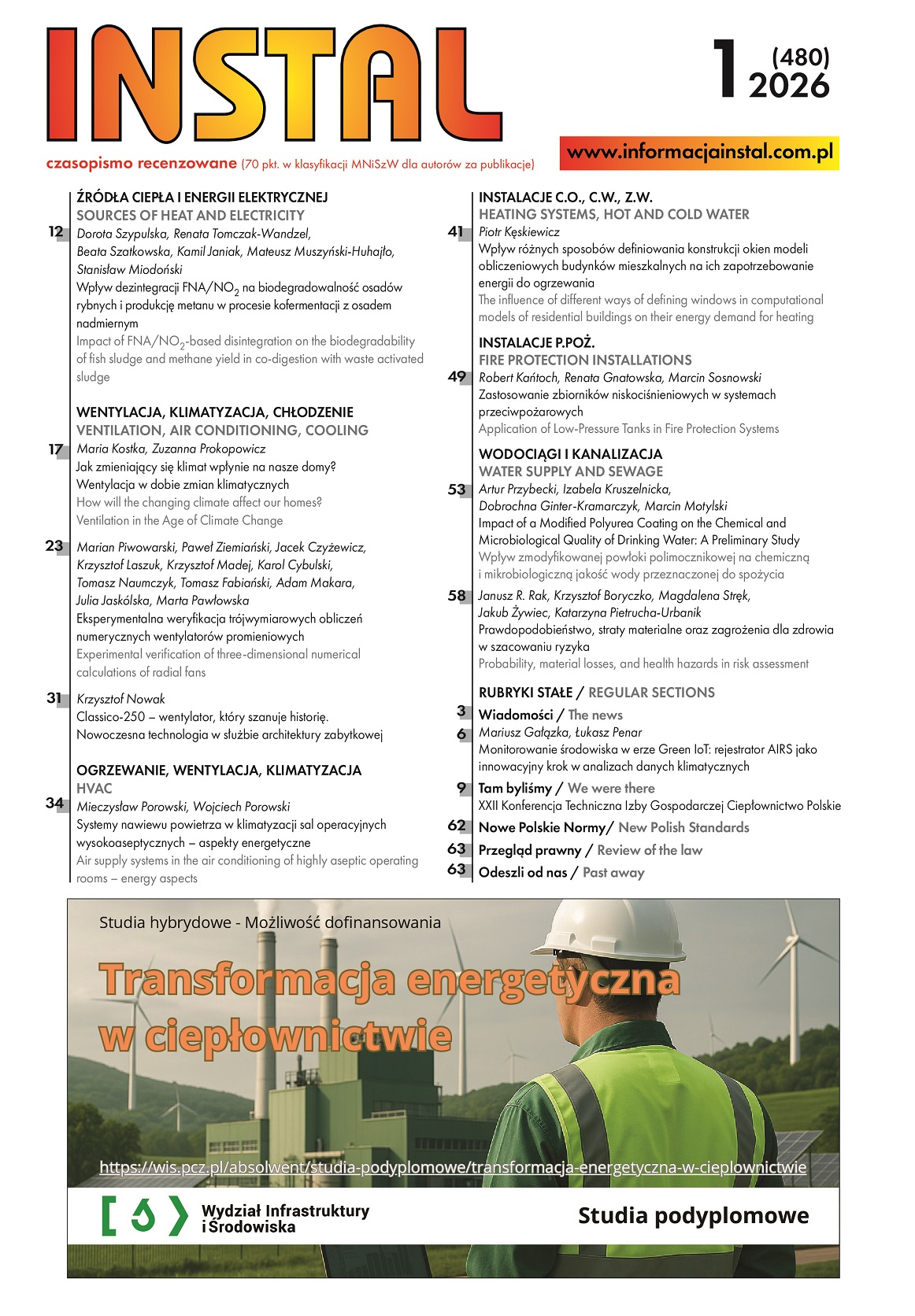
Experimental verification of three-dimensional numerical calculations of radial fans
DOI:
https://doi.org/10.36119/15.2026.1.3Keywords:
fans, numerical analysis, efficiency analysis, managing innovative project,, research laboratoryAbstract
The article presents the results of experimental verification of three-dimensional CFD (Computational Fluid Dynamics) calculations for radial fans, carried out as part of the COLUBRIS research project at Nyborg-Mawent. The calculations were performed in ANSYS CFX 3D for viscous and compressible flow using the k-ω SST turbulence model. The analyses were performed for a complete geometric model (suction nozzle, impeller, casing, outlet) at a rotational speed of 2950 rpm and a flow range of 0.4–1.2 m3/s, corresponding to total pressure
values of 1.5–3.8 kPa. The CFD results were compared with laboratory measurements performed on an actual test bench. A very good quantitative and qualitative agreement was obtained – the maximum differences were up to 3.5% for efficiency, 3.1% for total pressure, and 2.2% for power. The largest discrepancies occurred at extreme flow rates (below 0.5 m3/s and above 1.1 m3/s), which was attributed to separation and recirculation
phenomena in the diffuser duct. The results obtained confirm the reliability of the methodology and the usefulness of 3D models for the design and further optimization of radial fans, including the identification of areas generating flow and acoustic losses.
Downloads
References
[1] Schild, P.G.; Mysen, M. Recommendations on Specific Fan Power and Fan System Efficiency; AIVC document AIC-TN65; INIVE EEIG: Oslo, Norway, 2009; ISBN 2-930471-30-1.
[2] Fortuna, S. Fans. Theoretical Basis, Structural and Operational Issues and Application; Techwent Publishing House: Kraków, Poland, 1999; ISBN: 83-912363-0-7. (In Polish)
[3] Waide, P.; Brunner, C. Energy-Efficiency Policy Opportunities for Electric Motor-Driven Systems; International Energy Agency: Paris, France, 2011
Downloads
Published
Issue
Section
Categories
License

This work is licensed under a Creative Commons Attribution 4.0 International License.
Authors retain copyright and grant the journal the right of first publication, with the work simultaneously licensed under a Creative Commons Attribution 4.0 International License, which permits others to share the work with appropriate acknowledgment of the authorship and initial publication in this journal.