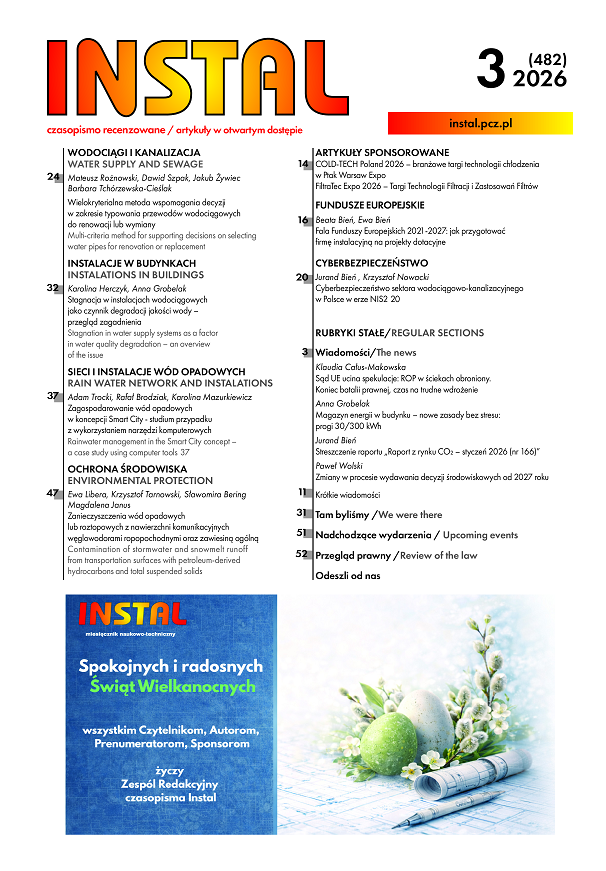
Rainwater management in the Smart City concept – a case study using computer tools
DOI:
https://doi.org/10.17512/INSTAL.2026.03.03Keywords:
hydrodynamic modelling, Smart City, decision support systems, stormwater managementAbstract
Climate change and the associated increase in precipitation intensity, causing, among other things, flood risks in cities, point to the need to develop new methods for managing stormwater systems. The aim of the study was to develop a methodology for using computer tools to assess and improve the performance of stormwater drainage systems within the context of the Smart City concept. In a case study of a selected urban area, an analysis of the existing drainage system was carried out using GIS and hydrodynamic models, enabling the identification of critical locations and the assessment of system performance under various rainfall scenarios. On this basis, retention measures were proposed, including retention reservoirs, pre-treatment devices and a monitoring and control system. The developed methodology enables the planning of investments and infrastructure modernisation in a way that supports sustainable urban development, reduces the risk of local flooding and increases the system's resilience to extreme weather conditions. The results indicate that integrating computer tools with intelligent sewerage network management is an effective solution within the Smart City strategy.
Downloads
References
Borga, M., Comiti, F., Ruin, I., & Marra, F. (2019). Forensic analysis of flash flood response. WIREs Water, 6(2), e1338. https://doi.org/10.1002/wat2.1338
Doswell, C. A., Brooks, H. E., & Maddox, R. A. (1996). Flash flood forecasting: An ingredients-based methodology. Weather and Forecasting, 11(4), 560–581. https://doi.org/10.1175/1520-0434(1996)011%3C0560:FFFAIB%3E2.0.CO;2
Kaźmierczak, B., Kotowski, A., & Piekarska, K. (Eds.). (2015). Interdyscyplinarne zagadnienia w inżynierii i ochronie środowiska: Praca zbiorowa (Vol. 6). Oficyna Wydawnicza Politechniki Wrocławskiej.
Brodziak, R. (2018). Smart Water – zintegrowane ICT w sterowaniu systemami wodociągowymi. Instal, (9).
Orłowski, A., & Rosińska, P. (2018). Koncepcja smart cities – obszar smart environment. Studia Komitetu Przestrzennego Zagospodarowania Kraju PAN, (184), 102–117.
Giffinger, R., Fertner, C., Kramar, H., Kalasek, R., Milanović, N., & Meijers, E. (2007). Smart cities: Ranking of European medium-sized cities [Report].
Almulhim, A. I., & Yigitcanlar, T. (2025). Understanding smart governance of sustainable cities: A review and multidimensional framework. Smart Cities, 8(4), 113. https://doi.org/10.3390/smartcities8040113
Przestrzelska, K., Wartalska, K., Rosińska, W., Jurasz, J., & Kaźmierczak, B. (2024). Climate resilient cities: A review of blue-green solutions worldwide. Water Resources Management, 38(15), 5885–5910. https://doi.org/10.1007/s11269-024-03950-5
Boguniewicz-Zabłocka, J., & Łukasiewicz, E. (2025). Blue–green infrastructure effectiveness for urban stormwater management: A multi-scale residential case study. Land, 14(7), 1340. https://doi.org/10.3390/land14071340
Müller-Eie, D., & Kosmidis, I. (2023). Sustainable mobility in smart cities: A document study of mobility initiatives of mid-sized Nordic smart cities. European Transport Research Review, 15(1), 36. https://doi.org/10.1186/s12544-023-00610-4
Szpak, A., Modrzyńska, J., & Piechowiak, J. (2022). Resilience of Polish cities and their rainwater management policies. Urban Climate, 44, 101228. https://doi.org/10.1016/j.uclim.2022.101228
Sakson-Sysiak, G., & Zyzik, P. (2024). Efektywność systemów wykorzystania wody deszczowej w budynkach handlowo-usługowych. Instal, (1). https://doi.org/10.36119/15.2024.1.3
Dzimińska, P., Stańczyk, J., Drzewiecki, S., & Licznar, P. (2022). Wykorzystanie systemu rejestracji danych z dużą częstotliwością do analizy nierównomierności zużycia wody. Instal, (1), 24. https://doi.org/10.36119/15.2022.1.3
Retencja.pl. (n.d.). Gliwice inwestują w nowoczesne zarządzanie deszczówką. Retrieved March 8, 2025, from https://retencja.pl/wiadomosci/gliwice-inwestuja-w-nowoczesne-zarzadzanie-deszczowka/
Prezydent Miasta Poznania. (2024, March 20). Standardy retencji dla Miasta Poznania – załącznik do zarządzenia nr 321/2024/P.
Aquanet Retencja. (2024). Projektowanie, wykonawstwo zagospodarowania wód opadowych i roztopowych za pomocą błękitno-zielonej infrastruktury oraz sieci i przyłączy kanalizacji deszczowej – wymagania ogólne.
Aquanet Retencja. (n.d.). Układ deszczomierzy. Retrieved March 8, 2025, from https://www.aquanet-retencja.pl/deszczomierze/
Barthélemy, J., et al. (2020). Problem-driven and technology-enabled solutions for safer communities (pp. 1–28).
Mazur, K. (2022). Zarządzanie wodami deszczowymi w Kopenhadze. BUILDER, 302(9), 28–31. https://doi.org/10.5604/01.3001.0015.9535
Bohatkiewicz, J., Zalewski, J., Licznar, P., & Gaca, S. (2023). Wytyczne projektowania urządzeń do odwodnienia dróg zamiejskich i ulic. Część 1: Wymagania podstawowe. Ministerstwo Infrastruktury.
Wijura, A., Lichtarski, G., & Piechówka, A. (n.d.). Gorzów Wielkopolski. Państwowy Instytut Geologiczny.
Geoportal Krajowy. (n.d.). Geoportal Krajowy. Retrieved March 29, 2025, from https://mapy.geoportal.gov.pl/wss/ext/KrajowaIntegracjaStudiumKierunkowZagospodarowaniaPrzestrzennego
KIUT. (n.d.). Krajowa Integracja Uzbrojenia Terenu (KIUT). Retrieved March 29, 2025, from https://integracja.gugik.gov.pl/cgi-bin/KrajowaIntegracjaUzbrojeniaTerenu
Kotowski, A., Dancewicz, A., & Kaźmierczak, B. (2010). Modelowanie opadów do wymiarowania kanalizacji (Studia z Zakresu Inżynierii, Nr 68). Polska Akademia Nauk, Instytut Podstawowych Problemów Techniki.
European Committee for Standardization. (2017). Drain and sewer systems outside buildings—Sewer system management (EN 752:2017).
IMGW-PIB. (n.d.). Model IMGW PMAXTP. Retrieved March 29, 2025, from https://klimat.imgw.pl/opady-maksymalne/
Soroka, J., & Matczak, P. (2024). Burza superkomórkowa z deszczem nawalnym 8 września 2022 roku w rejonie Gorzowa Wielkopolskiego. Przegląd Geofizyczny, 69(1–2), 25–46. https://doi.org/10.32045/PG-2024-045
Kaźmierczak, B., & Kotowski, A. (2012). Weryfikacja przepustowości kanalizacji deszczowej w modelowaniu hydrodynamicznym. Oficyna Wydawnicza Politechniki Wrocławskiej.
Minister Gospodarki Morskiej i Żeglugi Śródlądowej. (2019, July 12). Rozporządzenie w sprawie substancji szczególnie szkodliwych dla środowiska wodnego oraz warunków, jakie należy spełnić przy wprowadzaniu do wód lub do ziemi ścieków, a także odprowadzaniu wód opadowych lub roztopowych do wód lub do urządzeń wodnych.
Thorndahl, S., et al. (2017). Weather radar rainfall data in urban hydrology. Hydrology and Earth System Sciences, 21(3), 1359–1380. https://doi.org/10.5194/hess-21-1359-2017
Polski Komitet Normalizacyjny. (1992). PN-92/B01706 Instalacje wodociągowe—Wymagania w projektowaniu.
Downloads
Published
License
Copyright (c) 2026 Adam Trocki, Rafał Brodziak, Karolina Mazurkiewicz (Autor)

This work is licensed under a Creative Commons Attribution 4.0 International License.
Authors retain copyright and grant the journal the right of first publication, with the work simultaneously licensed under a Creative Commons Attribution 4.0 International License, which permits others to share the work with appropriate acknowledgment of the authorship and initial publication in this journal.